
Apartment Utilities Cost Calculator
Pick your state, the apartment's size and its heat to see what renters typically pay for electricity and gas, then add water, trash and internet for a monthly total.
By Tess Mullins · Updated
Your apartment
Utilities a month
About $89
About $89 a month, or $1,068 a year, for the bills you pay.
| Bill | Typical | Middle half |
|---|---|---|
| Electricity | $89 | $56 to $136 |
| Total | $89 |
Renters in 1-bedroom apartments across the US use about 490 kWh of electricity a month. At the US average price of 18.19¢ per kWh (January to August 2026), that's about $89 a month; half of them pay $56 to $136.
Bills run higher in summer with air conditioning and in winter with electric heat. Sharing with roommates? Split the rent and these bills
Based on what renters in apartments told the Census Bureau they paid in 2024, priced at EIA's current state averages. Your building, appliances and habits can put your bills above or below. How we calculate
General information, not legal or financial advice.

The short answer
Renters in 1-bedroom apartments across the US typically pay about $89 a month for electricity when it’s in their name, about $77 in a studio and about $122 with two bedrooms. With gas heat, the electric bill drops to about $67 for a 1-bedroom and a gas bill of about $41 comes on top. Water, sewer, trash and internet are extra when they aren’t in the rent.
Your state makes a big difference: for a 1-bedroom, the typical electric bill runs from about $52 in North Dakota to about $123 in Hawaii. The calculator above uses your state’s renters and today’s prices there.
How to use the calculator
- Pick your state and the number of bedrooms.
- Pick the heat. Baseboard heaters, wall heaters and heat pumps are electric. A radiator or a furnace often runs on gas or on the building’s boiler. If you can’t tell, leave it at Not sure.
- Tick the bills in your name. The listing or the lease says which utilities are included in the rent.
- Add water, sewer, trash and internet if you pay for them, from the landlord’s figure and your internet plan.
The result shows the typical bill for each utility, the range the middle half of renters pay, and the total a month and a year. Use Copy link to compare apartments, or to send the total to the rent split calculator when you share the bills.
Typical bills by apartment size
What renters across the US typically pay a month, at the national average prices (18.19¢ per kWh for January to August 2026, and $15.34 per thousand cubic feet of gas in 2025):
| Apartment | Electric heat ($) | Gas heat: electric ($) | Gas heat: gas ($) |
|---|---|---|---|
| Studio | 90 | 59 | 37 |
| 1 bedroom | 103 | 67 | 41 |
| 2 bedrooms | 142 | 92 | 56 |
| 3+ bedrooms | 183 | 120 | 73 |
With gas heat, add the two gas heat columns for the total. Heat that comes from the building’s boiler, oil or propane usually means a lower electric bill and no gas bill for heat.
Typical electric bills by state
The typical monthly electric bill for renters who pay their own, heat not specified, at each state’s current average price:
| State | Studio ($) | 1 bed ($) | 2 beds ($) | 3+ beds ($) |
|---|---|---|---|---|
| United States | 77 | 89 | 122 | 149 |
| Alabama | 103 | 119 | 163 | 199 |
| Alaska | 63 | 73 | 99 | 121 |
| Arizona | 89 | 103 | 140 | 171 |
| Arkansas | 87 | 101 | 137 | 168 |
| California | 73 | 85 | 116 | 141 |
| Colorado | 64 | 74 | 101 | 124 |
| Connecticut | 83 | 96 | 131 | 160 |
| Delaware | 89 | 103 | 140 | 171 |
| District of Columbia | 97 | 113 | 153 | 187 |
| Florida | 90 | 104 | 142 | 173 |
| Georgia | 95 | 110 | 150 | 183 |
| Hawaii | 107 | 123 | 168 | 205 |
| Idaho | 59 | 68 | 93 | 113 |
| Illinois | 63 | 73 | 99 | 121 |
| Indiana | 88 | 101 | 138 | 169 |
| Iowa | 56 | 65 | 89 | 108 |
| Kansas | 75 | 86 | 118 | 144 |
| Kentucky | 77 | 89 | 122 | 149 |
| Louisiana | 98 | 113 | 154 | 188 |
| Maine | 78 | 91 | 124 | 151 |
| Maryland | 93 | 108 | 147 | 180 |
| Massachusetts | 80 | 92 | 126 | 153 |
| Michigan | 68 | 79 | 108 | 132 |
| Minnesota | 54 | 62 | 85 | 104 |
| Mississippi | 100 | 116 | 158 | 192 |
| Missouri | 76 | 89 | 121 | 147 |
| Montana | 56 | 65 | 89 | 109 |
| Nebraska | 71 | 82 | 112 | 137 |
| Nevada | 70 | 81 | 110 | 135 |
| New Hampshire | 78 | 90 | 123 | 150 |
| New Jersey | 86 | 100 | 136 | 166 |
| New Mexico | 54 | 63 | 85 | 104 |
| New York | 93 | 108 | 147 | 180 |
| North Carolina | 82 | 95 | 129 | 158 |
| North Dakota | 45 | 52 | 71 | 87 |
| Ohio | 74 | 86 | 117 | 143 |
| Oklahoma | 88 | 102 | 139 | 170 |
| Oregon | 74 | 85 | 116 | 142 |
| Pennsylvania | 83 | 96 | 130 | 159 |
| Rhode Island | 70 | 81 | 111 | 136 |
| South Carolina | 85 | 99 | 134 | 164 |
| South Dakota | 64 | 75 | 102 | 124 |
| Tennessee | 84 | 98 | 133 | 163 |
| Texas | 95 | 110 | 151 | 184 |
| Utah | 47 | 54 | 73 | 90 |
| Vermont | 62 | 72 | 98 | 120 |
| Virginia | 82 | 95 | 130 | 158 |
| Washington | 77 | 89 | 121 | 148 |
| West Virginia | 79 | 91 | 124 | 152 |
| Wisconsin | 70 | 82 | 111 | 136 |
| Wyoming | 68 | 79 | 107 | 131 |
How we calculate
The estimates start from what renters actually paid, then price that use at your state’s current rates.
- What renters paid. The Census Bureau’s American Community Survey asks households what they paid for electricity and gas last month. We use the 2024 survey’s answers from renters in buildings with two or more apartments who pay the bill themselves: 184,628 households for electricity.
- From dollars to energy. Each bill is divided by the state’s average residential price that year, from EIA (the U.S. Energy Information Administration). That turns it into kWh of electricity or cubic feet of gas, so the same use can be priced at today’s rates.
- By size and heat. For each size (studio, 1, 2, or 3 or more bedrooms), we take the median and the middle half across the US: electricity for apartments with electric heat, without it, and all together; gas for gas heat, for gas that doesn’t heat (a stove or a water heater), and all together.
- Your state. A factor for each state compares how much its renters use with renters of the same size and heat nationwide, and scales the national figures. Where fewer than 50 renters in a state answered for a kind of heat, we use the state’s factor for all heat types; for gas, the census division’s.
- Today’s prices. Electricity at your state’s average residential price for January to August 2026, from EIA’s monthly figures, which we update as EIA publishes them. Gas at the latest full year EIA gives for your state (2025 for most states).
- Total. The typical electric and gas bills you pay, plus your amounts for water, sewer, trash and internet. Typical is the median: half of renters like you pay less, and half pay more.
The survey asks about last month, so the figures mix every season. The answers are what people remember paying, and a building’s age, its appliances and how many people live there all move the bill. Treat the result as a budget figure, not a quote.
Worked examples
Example: A 1-bedroom in Texas with electric heat
What we know
- Texas, 1 bedroom
- Heat: electric
- Bills in your name: electricity
How it works out
- Renters in 1-bedroom apartments with electric heat in Texas use about 680 kWh of electricity a month. At Texas's average price of 16.03¢ per kWh (January to August 2026), that's about $110 a month; half of them pay $69 to $163.
About $110 a month, or $1,320 a year, for the bills you pay.
Example: A 2-bedroom in Illinois with gas heat
What we know
- Illinois, 2 bedrooms
- Heat: gas
- Bills in your name: electricity and gas
How it works out
- Renters in 2-bedroom apartments without electric heat in Illinois use about 480 kWh of electricity a month. At Illinois's average price of 19.23¢ per kWh (January to August 2026), that's about $93 a month; half of them pay $58 to $148.
- Gas for heat and hot water runs about $68 a month at Illinois's average price of $11.25 per thousand cubic feet (2025); half of renters pay $39 to $113.
About $161 a month, or $1,932 a year, for the bills you pay.
Example: A studio in New York with the building's heat
What we know
- New York, studio
- Heat: oil, propane or the building's boiler
- Bills in your name: electricity
How it works out
- Renters in studio apartments without electric heat in New York use about 320 kWh of electricity a month. At New York's average price of 29.26¢ per kWh (January to August 2026), that's about $95 a month; half of them pay $59 to $166.
About $95 a month, or $1,140 a year, for the bills you pay.
Water, sewer, trash and internet
The calculator doesn’t estimate these. Water, sewer and trash are set by the city or the building: some leases include them, some charge a flat monthly fee, and some split the building’s bill among the apartments by a formula. The survey’s water figures aren’t reliable enough to estimate from, so ask the landlord what these cost and enter the amount. Internet depends on the provider and the plan you pick, not on the apartment.
Before you sign
- Ask which bills are yours. The listing and the lease should say which utilities are in the rent. If they don’t, ask in writing.
- Ask what a typical month cost. The landlord or the last tenant may know the past year’s bills, which beats any estimate.
- Budget for the high months. Summer air conditioning and winter electric heat can push a bill to the top of the range. Some utilities offer budget billing, which spreads the year’s cost evenly; ask yours.
- Add renters insurance. Some landlords require it. The renters insurance calculator shows how much coverage you need and what renters in your state pay on average.
- Count it in the rent. If a landlord checks your income against the rent, the 40x rent calculator shows what you’d need to earn, and the rent affordability calculator takes these bills off the most you can spend. Add the utilities to see what the apartment really costs you each month.
Comparing two apartments where one includes utilities? Add this total to the other one’s rent, and you’re comparing like with like.
Frequently asked questions
What's the average utility bill for a 1-bedroom apartment?
Across the US, renters in 1-bedroom apartments who pay their own electricity typically pay about $89 a month for it, at EIA's average price for January to August 2026. With gas heat, the electric bill is lower, about $67, and the gas bill adds about $41. Water, sewer, trash and internet come on top when they aren't in the rent.
What's the average utility bill for a studio apartment?
About $77 a month for electricity across the US, and about $89 for a 1-bedroom. It depends a lot on the state: for a 1-bedroom, the typical electric bill runs from about $52 in North Dakota to about $123 in Hawaii.
What's the average utility bill for a 2-bedroom apartment?
About $122 a month for electricity across the US, and about $149 with 3 or more bedrooms. Add gas if you pay for it, and water, trash and internet if they aren't in the rent. Pick your state in the calculator for a closer figure.
Which utilities do renters usually pay?
In the Census Bureau's 2024 survey, 87% of renters in apartments paid their own electric bill, 27% paid for gas and 34% paid for water. The rest had them in the rent, or didn't use gas at all. Your lease says which bills are yours.
Why could my bills be higher than the estimate?
The estimate is the middle of what renters like you pay, so half pay more. Bills run higher in summer with air conditioning, in winter with electric heat, in older buildings, with more people at home and with appliances such as an electric dryer. The calculator also shows the range the middle half of renters pay.
Does the calculator include water, sewer, trash and internet?
Not as an estimate. Water, sewer and trash are billed by the city or the building, often as a flat fee or split among the apartments, and internet depends on the plan you pick. Ask the landlord what they cost and enter them, and the calculator adds them to the total.
How do I find out what the utilities cost before I sign?
Ask the landlord which bills are yours, which are in the rent, and what a typical month cost the last tenant. Check the lease for a monthly fee for water, sewer or trash. Then use the calculator for the bills that depend on you.
Next step
Rent Split CalculatorEnter the rent and each bedroom's size to split rent fairly between roommates, with shared space split equally and extras for features you agree on.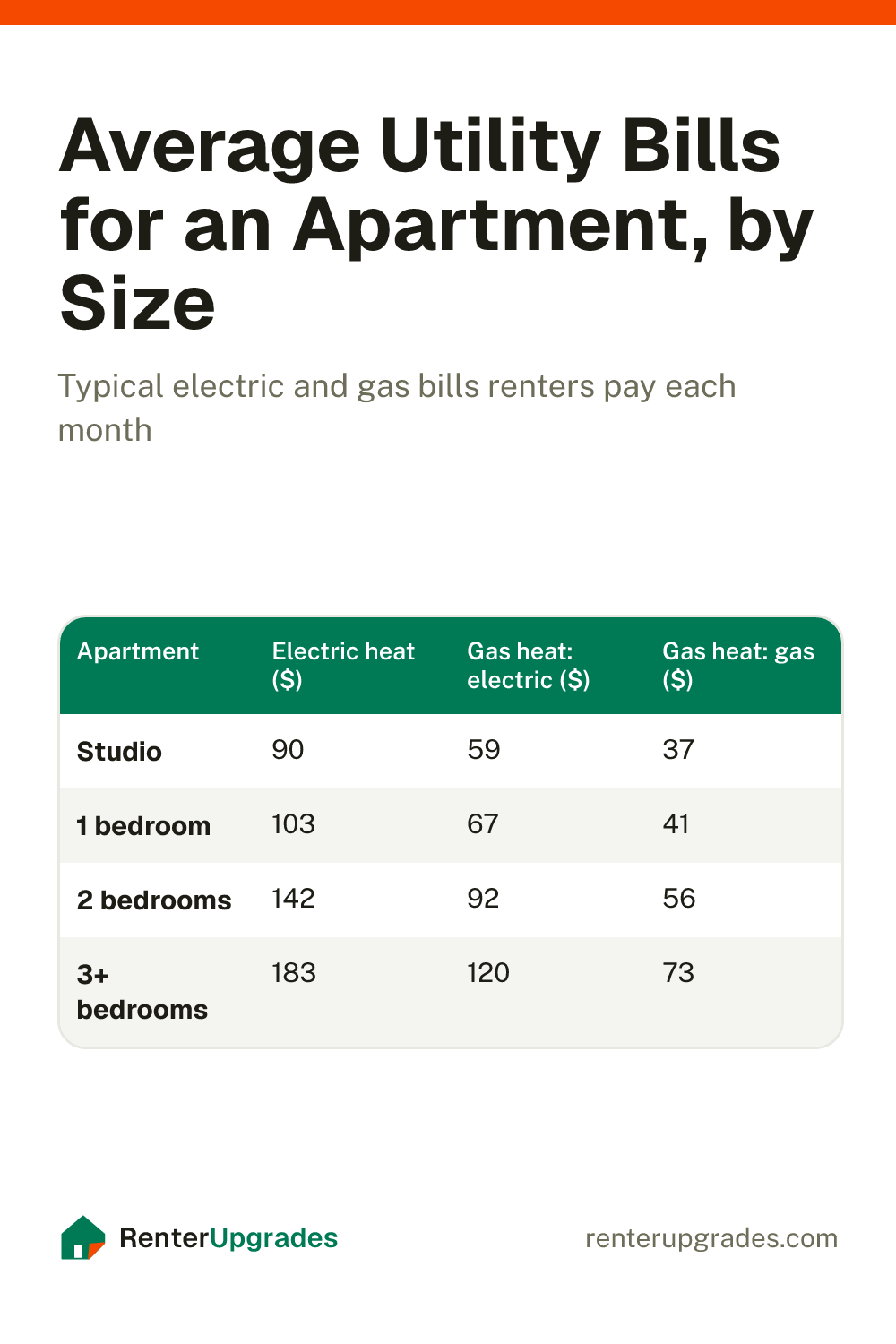
Save it for later
Pin this page so it's handy when you're ready to hang things.
Save to Pinterest (opens in a new tab)