
How Much Rent Can I Afford?
Enter your pay before taxes and the utilities you'll pay to see the most rent that keeps housing within 30% of your income, what landlords' income rules allow, and how that compares with what renters in your state pay.
By Tess Mullins · Updated
Your income
Rent you can afford
Up to $1,500 a month
Your income: $60,000 a year, or $5,000 a month before taxes. HUD counts renters who spend more than 30% of their income on rent and utilities as cost burdened. 30% of $5,000 is $1,500 a month for both.
| 30% of income (rent and utilities) | $1,500 |
|---|---|
| Landlord's 3x monthly rule | $1,667 |
| Severe burden (50%) | $2,500 |
Landlords check income their own way: a monthly income of 3 times the rent allows up to $1,667. The 40x yearly rule common in New York City allows $1,500, the same as 30% of monthly income.
The median gross rent for a 1-bedroom across the US was $1,300 a month in 2024, rent and utilities together. That would be 26% of your income. The median renter household across the US spent 30% of its income on rent and utilities.
At $2,500 a month, rent and utilities would take 50% of your income, which HUD counts as a severe cost burden.
Need the income for a specific rent? The 40x rent calculator works it backward, and the utilities calculator estimates the bills.
General information, not financial advice: the 30% line is a guide for housing costs, not a budget. Debts, savings and where you live change what's comfortable. How we calculate
General information, not legal or financial advice.

The short answer
Keep rent and utilities together within 30% of your income before taxes: HUD counts renters who spend more as cost burdened, and more than 50% as severely cost burdened. On a $60,000 salary, $5,000 a month, that’s up to $1,500 for rent and utilities. If you pay utilities yourself, take them off to get the rent.
Landlords use their own rules. Many ask for a monthly income of 3 times the rent, which allows up to $1,667 on the same salary; the 40x yearly rule common in New York City allows $1,500, the same as 30%.
How to use the calculator
- Enter your pay before taxes, as a year, a month or an hour. With roommates or a partner on the lease, enter everyone’s income together.
- Add the utilities you’ll pay, such as electricity, gas, water and trash, if they aren’t in the rent. The apartment utilities cost calculator estimates them for your state.
- Pick a state and a size to compare with what renters there pay.
The result shows the most rent within 30% of your income, what landlords’ income rules allow, the 50% line, and the median rent where you’re looking. Use Copy link to keep the numbers while you search.
Rent by salary
The most rent, utilities included, at 30% of income and at the 3x monthly rule:
| Salary ($) | 30% of income ($) | 3x monthly ($) |
|---|---|---|
| 30,000 | 750 | 833 |
| 40,000 | 1,000 | 1,111 |
| 50,000 | 1,250 | 1,389 |
| 60,000 | 1,500 | 1,667 |
| 75,000 | 1,875 | 2,083 |
| 100,000 | 2,500 | 2,778 |
The 40x yearly rule gives the same figures as the 30% column: 12 months ÷ 40 is 30%.
What renters pay by state
The median gross rent (rent plus the utilities the renter pays) for a 1-bedroom and a 2-bedroom in the Census Bureau’s 2024 American Community Survey:
| State | 1 bedroom ($) | 2 bedrooms ($) |
|---|---|---|
| United States | 1,300 | 1,500 |
| Alabama | 893 | 1,030 |
| Alaska | 1,031 | 1,490 |
| Arizona | 1,400 | 1,660 |
| Arkansas | 800 | 940 |
| California | 1,860 | 2,180 |
| Colorado | 1,616 | 1,858 |
| Connecticut | 1,260 | 1,630 |
| Delaware | 1,170 | 1,560 |
| District of Columbia | 1,983 | 2,400 |
| Florida | 1,600 | 1,820 |
| Georgia | 1,414 | 1,451 |
| Hawaii | 1,569 | 1,930 |
| Idaho | 1,040 | 1,280 |
| Illinois | 1,171 | 1,334 |
| Indiana | 930 | 1,120 |
| Iowa | 750 | 1,013 |
| Kansas | 883 | 1,071 |
| Kentucky | 840 | 1,000 |
| Louisiana | 940 | 1,020 |
| Maine | 890 | 1,387 |
| Maryland | 1,470 | 1,735 |
| Massachusetts | 1,480 | 2,000 |
| Michigan | 980 | 1,200 |
| Minnesota | 1,160 | 1,380 |
| Mississippi | 822 | 957 |
| Missouri | 860 | 1,040 |
| Montana | 920 | 1,230 |
| Nebraska | 989 | 1,110 |
| Nevada | 1,360 | 1,660 |
| New Hampshire | 1,300 | 1,700 |
| New Jersey | 1,550 | 1,900 |
| New Mexico | 900 | 1,050 |
| New York | 1,530 | 1,620 |
| North Carolina | 1,291 | 1,292 |
| North Dakota | 829 | 970 |
| Ohio | 870 | 1,100 |
| Oklahoma | 850 | 1,020 |
| Oregon | 1,365 | 1,606 |
| Pennsylvania | 1,060 | 1,310 |
| Rhode Island | 1,040 | 1,600 |
| South Carolina | 1,213 | 1,283 |
| South Dakota | 770 | 1,030 |
| Tennessee | 1,200 | 1,220 |
| Texas | 1,312 | 1,480 |
| Utah | 1,380 | 1,550 |
| Vermont | 1,100 | 1,482 |
| Virginia | 1,545 | 1,545 |
| Washington | 1,645 | 1,850 |
| West Virginia | 654 | 900 |
| Wisconsin | 990 | 1,140 |
| Wyoming | 761 | 969 |
Across the US, the median renter household spent 30% of its income on gross rent, and about half (50% to 52%) spent 30% or more. The calculator also has the medians for a studio and for 3 or more bedrooms, and the median share of income in the state you pick. Where fewer than 50 renter households of a size answered the survey, as for a studio in some smaller states, it compares with the state’s median for all sizes instead.
How we calculate
- Monthly income. A yearly income divided by 12, a monthly income as is, or an hourly rate times your hours a week times 52, divided by 12. Always before taxes, as HUD and the Census Bureau measure it.
- The 30% line. HUD defines a cost burden as monthly housing costs, utilities included, above 30% of monthly income, and a severe one above 50%. The calculator gives 30% of your monthly income as the most for rent and utilities together.
- Rent after utilities. That amount less the utilities you enter.
- Landlords’ rules. Monthly income ÷ 3 for the common monthly rule, and yearly income ÷ 40 for New York City’s, as on the 40x rent calculator.
- What renters pay. We computed the medians from the Census Bureau’s 2024 American Community Survey microdata: 336,110 renter households paying cash rent, weighted to represent all renters. Gross rent is the rent plus the utilities and fuels the renter pays. Our medians can differ by a few dollars from the Census Bureau’s published tables, which compute them a slightly different way.
Worked examples
The incomes in these examples are made up to show the math, not typical pay.
Example: A $60,000 salary, utilities included in the rent
What we know
- Income: $60,000 a year
- Compared with: the US, 1 bedroom
How it works out
- Your income: $60,000 a year, or $5,000 a month before taxes.
- HUD counts renters who spend more than 30% of their income on rent and utilities as cost burdened. 30% of $5,000 is $1,500 a month for both.
- Landlords check income their own way: a monthly income of 3 times the rent allows up to $1,667. The 40x yearly rule common in New York City allows $1,500, the same as 30% of monthly income.
- The median gross rent for a 1-bedroom across the US was $1,300 a month in 2024, rent and utilities together. That would be 26% of your income. The median renter household across the US spent 30% of its income on rent and utilities.
Up to $1,500 a month.
Example: $22 an hour in Texas, paying your own utilities
What we know
- Income: $22 an hour for 40 hours a week
- Utilities: $150 a month
- Compared with: Texas, 1 bedroom
How it works out
- Your income: $22 an hour for 40 hours a week is $45,760 a year, or $3,813 a month before taxes.
- HUD counts renters who spend more than 30% of their income on rent and utilities as cost burdened. 30% of $3,813 is $1,144 a month for both. Less your $150 of utilities, that leaves $994 for the rent.
- Landlords check income their own way: a monthly income of 3 times the rent allows up to $1,271. The 40x yearly rule common in New York City allows $1,144, the same as 30% of monthly income.
- The median gross rent for a 1-bedroom in Texas was $1,312 a month in 2024, rent and utilities together. That would be 34% of your income. The median renter household in Texas spent 31% of its income on rent and utilities.
Up to $994 a month in rent.
Example: Two roommates in California with $9,000 a month together
What we know
- Income: $9,000 a month
- Utilities: $200 a month
- Compared with: California, 2 bedrooms
How it works out
- Your income: $9,000 a month before taxes.
- HUD counts renters who spend more than 30% of their income on rent and utilities as cost burdened. 30% of $9,000 is $2,700 a month for both. Less your $200 of utilities, that leaves $2,500 for the rent.
- Landlords check income their own way: a monthly income of 3 times the rent allows up to $3,000. The 40x yearly rule common in New York City allows $2,700, the same as 30% of monthly income.
- The median gross rent for a 2-bedroom in California was $2,180 a month in 2024, rent and utilities together. That would be 24% of your income. The median renter household in California spent 33% of its income on rent and utilities.
Up to $2,500 a month in rent.
Making the numbers work
- Count everyone sharing the rent. Enter your combined income, then use the rent split calculator to divide the rent fairly.
- Watch the move-in costs. The first month, a security deposit and fees come due at once. The moving cost calculator adds them to the cost of the move.
- Look at the net rent. A deal with free weeks lowers what you pay over the lease; the net effective rent calculator shows the real monthly cost.
- Tour with a checklist. The apartment hunting checklist covers what to check, the fees to ask about and the signs of a rental scam.
- Leave room for the rest. The 30% line covers rent and utilities only. Renters insurance, internet and any debts come on top.
- Push back on a big increase. If a renewal would take you past the line, the rent increase letter asks your landlord for a smaller one.
- Short one month? Tell your landlord before the due date with the late rent letter, and say when you’ll pay.
- Thinking of buying instead? The rent vs buy calculator follows both choices year by year at today’s mortgage rate and shows when buying would pull ahead.
Run the numbers on your take-home pay too. If rent and utilities would take much more than 30% of what actually lands in your account, the budget will feel tighter than the rule suggests.
Frequently asked questions
How much rent can I afford?
A common guide is up to 30% of your gross monthly income for rent and utilities together: HUD counts households that spend more as cost burdened. On a $60,000 salary, that's $1,500 a month. If you pay utilities yourself, take them off to get the rent.
What is the 30% rule for rent?
It's the line HUD uses to measure housing affordability: monthly housing costs, utilities included, above 30% of monthly income count as a cost burden, and above 50% as a severe one. It's a guide for comparing, not a law or a budget, and it uses income before taxes.
Is the 30% rule based on gross or net income?
Gross income, before taxes. HUD's measure compares housing costs with monthly income, and the Census Bureau's survey counts earnings before taxes and other deductions. If your take-home pay is low after taxes or debts, a lower share may be more comfortable.
How does the 30% rule compare with landlords' income rules?
Many landlords ask for a monthly income of 3 times the rent, which allows a little more: $1,667 on a $60,000 salary. The 40x yearly rule common in New York City works out to exactly 30% of monthly income, $1,500 on the same salary.
How much of their income do renters actually spend on rent?
In the Census Bureau's 2024 survey, the median renter household spent 30% of its income on rent and utilities, and about half (50% to 52%) spent 30% or more. About a quarter (26%) spent 50% or more.
What's the median rent in the US?
The median gross rent, rent plus utilities, was $1,498 a month in the Census Bureau's 2024 survey: $1,300 for a 1-bedroom and $1,500 for a 2-bedroom. It ranged from $889 in West Virginia to $2,100 in California.
Next step
40x Rent CalculatorEnter the rent and your yearly income to see whether you meet the 40x rule, how much you'd need, and what a guarantor would need. Or work out the most rent your income qualifies for.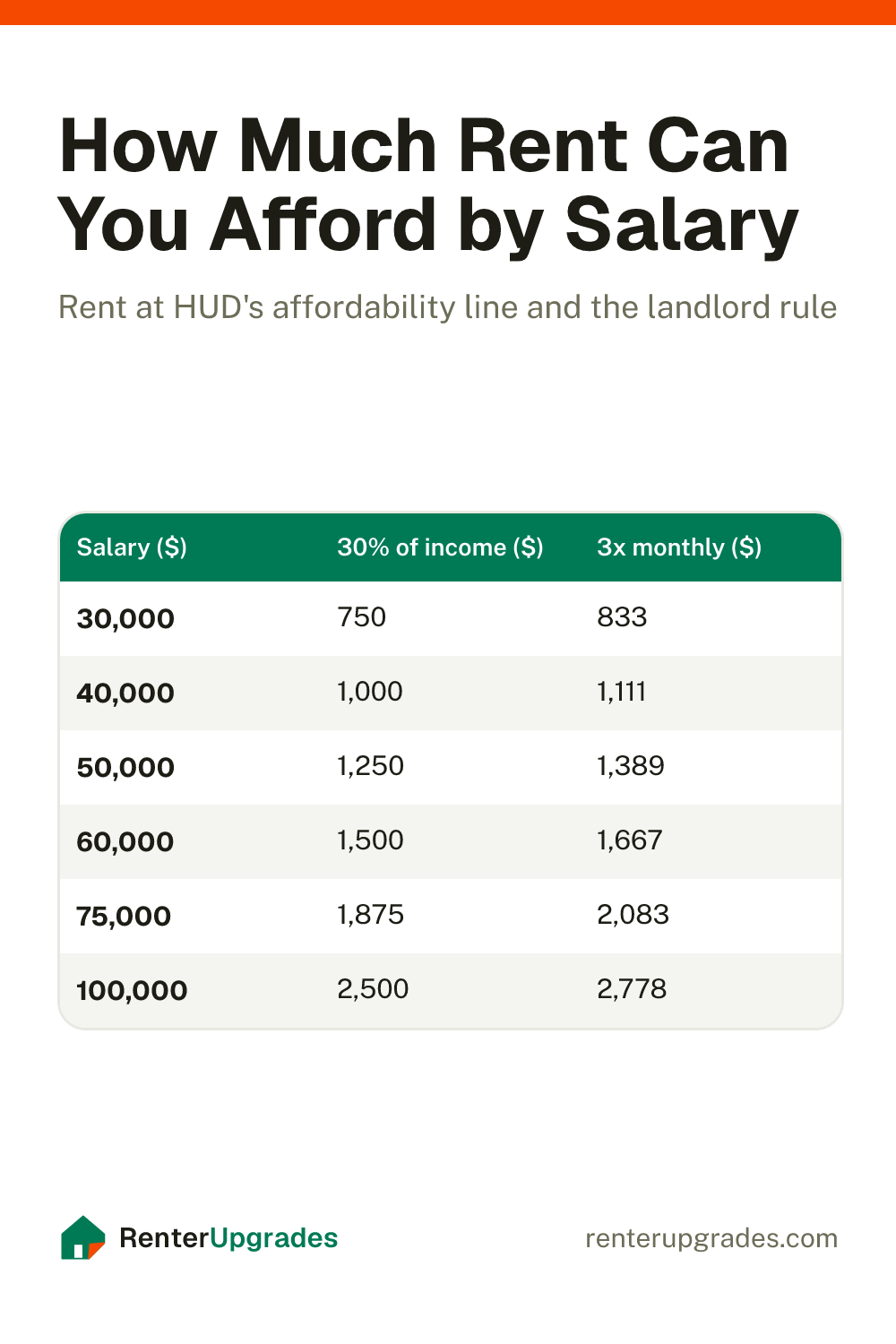
Save it for later
Pin this page so it's handy when you're ready to hang things.
Save to Pinterest (opens in a new tab)