
Renters Insurance Calculator
Enter what your things would cost to buy new, by category, to see how much personal property coverage to look for, plus loss of use, liability, the lower limits on jewelry and cash, and what renters in your state pay.
By Tess Mullins · Updated
Your coverage
Personal property coverage
Add your things
Enter what your things would cost to buy new, by category, and the calculator adds them up and checks them against the usual limits.
Renters across the US paid $173 a year on average in 2023 (NAIC).
Renters policies don't cover floods. FEMA's flood insurance for renters covers belongings up to $100,000 and starts 30 days after you buy it.
General information, not insurance advice: limits and terms vary by insurer and state, so check the policy itself. Premiums are NAIC's 2023 averages. How we calculate
General information, not legal or financial advice.

The short answer
Get enough personal property coverage to replace everything you own: add up what your things would cost to buy new and round up. Loss of use, which pays the extra cost of living elsewhere after a covered loss, is usually 20% of that. Liability generally starts at $100,000, and the Insurance Information Institute notes that some experts recommend at least $300,000.
Renters across the US paid $173 a year on average in 2023, about $14 a month, according to the NAIC, the national association of state insurance regulators. The most common amount of coverage was $20,000 to $24,999, which averaged $156.
How to use the calculator
- Pick your state to see what renters there paid on average.
- Go room by room and add up what your things would cost to buy new, then enter the totals by category. A rough figure is fine; round up when in doubt.
- Enter jewelry, firearms, cash and business property separately. Policies cover them only up to lower limits, and the calculator checks them.
- Add your savings and other assets to see how much liability coverage protects them.
The result shows the personal property limit to look for, loss of use, liability and medical payments, any category past its usual limit, and NAIC’s average premiums. Use Copy link to keep your numbers for when you get quotes.
What renters insurance costs
The average yearly premium for renters policies (the HO-4 form) across the US in 2023, by the amount of personal property coverage, and the share of renters at each amount:
| Coverage | Average a year ($) | Renters (%) |
|---|---|---|
| Under $10,000 | 115 | 5 |
| $10,000 to $19,999 | 144 | 32 |
| $20,000 to $29,999 | 159 | 31 |
| $30,000 to $39,999 | 183 | 12 |
| $40,000 to $59,999 | 205 | 13 |
| $60,000 to $99,999 | 254 | 4 |
| $100,000 and over | 415 | 3 |
By state, the averages ran from $125 in South Dakota to $263 in Mississippi, all coverage amounts together. Pick your state in the calculator to see its average. The NAIC calls average premium an imperfect measure of price, since hazards and costs differ from place to place, and your quote depends on your building, your coverage and your deductible.
Lower limits on jewelry, firearms, cash and business property
A renters policy covers some kinds of property only up to a set amount, whatever your total limit. The standard renters form (ISO’s HO 00 04) sets these, and the Texas Department of Insurance names lower ones as common:
| Property | Standard form | Common lower limit |
|---|---|---|
| Jewelry and watches (theft) | $1,500 | $500 |
| Firearms (theft) | $2,500 | None given |
| Cash | $200 | $100 |
| Business property at home | $2,500 | Same |
Insurers can use their own forms, so check yours. If you own more than the limit, ask your insurer about additional coverage, as the NAIC suggests for jewelry, art, computers and firearms.
How we calculate
- Personal property. The total of your categories, at what they’d cost to buy new, rounded up to the next $1,000. The NAIC and the Insurance Information Institute both say to insure enough to replace everything you own.
- Loss of use. 20% of the personal property limit, as California’s and North Carolina’s insurance departments describe it (some insurers offer more).
- Special limits. Jewelry and watches, firearms, cash and business property are checked against the standard form’s limits and the lower ones the Texas Department of Insurance names as common: theft of jewelry $500 to $1,500, cash $100 to $200, theft of firearms $2,500 and business property at home $2,500.
- Liability. $100,000, where policies generally start, or $300,000 once your savings and assets are above $100,000. The Insurance Information Institute says liability should be enough to protect your assets. Above $300,000, the result suggests asking about an umbrella policy.
- Medical payments to others. $1,000 to $5,000, the range the Insurance Information Institute gives.
- Premiums. NAIC’s 2023 averages for renters policies: your state’s, all coverage amounts together, and the US average for policies with about your amount of coverage. The table above groups NAIC’s 15 coverage ranges into 7.
Worked examples
The belongings in these examples are made up to show the math, not typical amounts. Use your own.
Example: A studio with everyday things
What we know
- United States
- Furniture, electronics, clothing and the rest: $9,500
How it works out
- Your things would cost about $9,500 to buy new, rounded up to $10,000. That's the personal property limit to look for, with replacement cost coverage if you can: actual cash value takes off for age and wear.
- Loss of use, for the extra cost of living elsewhere after a covered loss, is usually 20% of that: $2,000.
- Liability: at least $100,000, where policies generally start. The Insurance Information Institute notes that some experts recommend at least $300,000.
- Renters across the US paid $173 a year on average in 2023, and $140 with $10,000 to $14,999 of coverage (NAIC).
About $10,000 of personal property coverage and $2,000 for loss of use.
Example: A 1-bedroom in Texas with jewelry
What we know
- Texas
- Furniture, electronics, clothing and the rest: $18,500
- Jewelry and watches: $2,500
- Savings and other assets: $20,000
How it works out
- Your things would cost about $21,000 to buy new. That's the personal property limit to look for, with replacement cost coverage if you can: actual cash value takes off for age and wear.
- Loss of use, for the extra cost of living elsewhere after a covered loss, is usually 20% of that: $4,200.
- Jewelry and watches, $2,500: the standard renters form covers theft of jewelry and watches up to $1,500 in all, and many policies only $500. Ask your insurer about additional coverage.
- Liability: at least $100,000, where policies generally start. The Insurance Information Institute notes that some experts recommend at least $300,000.
- Renters in Texas paid $201 a year on average in 2023, all coverage amounts together. Across the US, policies with $20,000 to $24,999 of coverage averaged $156 (NAIC).
About $21,000 of personal property coverage and $4,200 for loss of use.
Example: A 2-bedroom in California with a side business and savings
What we know
- California
- Furniture, electronics, clothing and the rest: $28,000
- Cash at home: $150
- Things used for a business: $4,000
- Savings and other assets: $150,000
How it works out
- Your things would cost about $32,150 to buy new, rounded up to $33,000. That's the personal property limit to look for, with replacement cost coverage if you can: actual cash value takes off for age and wear.
- Loss of use, for the extra cost of living elsewhere after a covered loss, is usually 20% of that: $6,600.
- Cash at home, $150: many policies cover cash up to $100 (the standard form allows $200). If yours does, ask your insurer about additional coverage.
- Things used for a business, $4,000: the standard renters form covers business property at home up to $2,500 in all. Ask your insurer about additional coverage.
- Liability: $300,000, enough to cover your $150,000 in savings and assets.
- Renters in California paid $171 a year on average in 2023, all coverage amounts together. Across the US, policies with $30,000 to $34,999 of coverage averaged $185 (NAIC).
About $33,000 of personal property coverage and $6,600 for loss of use.
What renters insurance doesn’t cover
- Floods. FEMA’s National Flood Insurance Program sells flood insurance for renters that covers belongings up to $100,000. It starts 30 days after you buy it, so don’t wait for a storm.
- Earthquakes. California’s insurance department notes that renters policies don’t cover earthquake damage. In California, renters can buy earthquake insurance, mostly through the California Earthquake Authority.
- Your landlord’s building. The building is your landlord’s to insure, and your landlord’s insurance doesn’t cover your things.
Before you buy
- Make a home inventory. The NAIC’s free Home Inventory app and the Insurance Information Institute both walk you through one, and the NAIC says an accurate inventory helps settle a claim. When you photograph the unit for the move-in checklist, photograph your own things too.
- Ask for replacement cost. Actual cash value takes off for age and wear: in Wisconsin’s insurance guide, furniture that costs $500 to replace is worth $250 after 10 years.
- Choose a deductible you can afford. A higher deductible lowers the premium, but you pay it when you make a claim.
- Check your lease. Some landlords require renters insurance, so read the lease before you buy. For a first place, the first apartment checklist puts the policy with everything else to set up before move-in day.
- Moving soon? The moving cost calculator adds the new place’s deposit and fees to the cost of the move.
Update your inventory once a year, and after big purchases, so your coverage keeps up with what you own.
Frequently asked questions
How much renters insurance do I need?
Enough personal property coverage to replace everything you own. A home inventory tells you how much: add up what your things would cost to buy new, and round up. For liability, policies generally start at $100,000, and the Insurance Information Institute notes that some experts recommend at least $300,000. In 2023, 77% of renters policies covered less than $35,000 of belongings, and the most common amount was $20,000 to $24,999.
How much does renters insurance cost?
Renters across the US paid $173 a year on average in 2023, about $14 a month, according to the NAIC (the national association of state insurance regulators). The state averages ran from $125 in South Dakota to $263 in Mississippi. More coverage costs more: policies with $10,000 to $14,999 of coverage averaged $140, and $50,000 to $59,999 averaged $205.
Is renters insurance required?
Not by law, but some landlords require it in the lease, as the Texas Department of Insurance points out. Your landlord's insurance doesn't cover your things, so without your own policy, a fire or a burglary is your loss.
What's the difference between replacement cost and actual cash value?
Replacement cost pays what it costs to buy a new item like the one you lost. Actual cash value takes off for age and wear: in Wisconsin's insurance guide, furniture that costs $500 to replace, with a life of 20 years, is worth $250 after 10 years. The Insurance Information Institute says replacement cost coverage costs about 10% more.
What doesn't renters insurance cover?
Floods and earthquakes. FEMA's National Flood Insurance Program sells flood insurance for renters that covers belongings up to $100,000, and it starts 30 days after you buy it. In California, renters can buy earthquake insurance, mostly through the California Earthquake Authority. Jewelry, firearms, cash and business property are covered only up to lower limits.
What deductible should I choose?
One you can afford to pay after a loss, as the NAIC puts it. The Insurance Information Institute suggests at least $500, and says raising it to $1,000 may cut the premium by as much as 25%.
Next step
Move-In Checklist for TenantsPick your rooms, check each item and note any damage to make a move-in checklist you and your landlord can sign. Download the PDF or print it.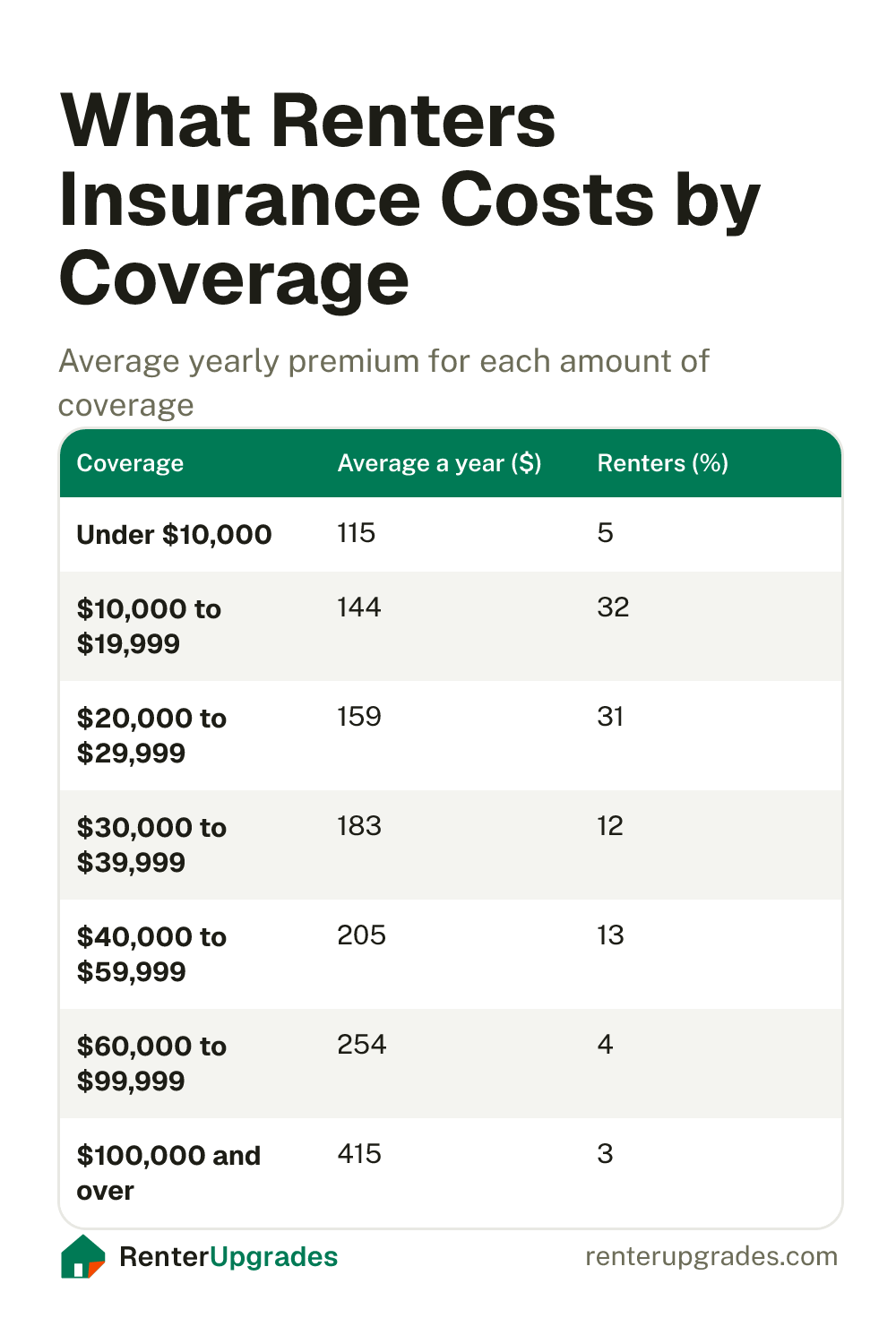
Save it for later
Pin this page so it's handy when you're ready to hang things.
Save to Pinterest (opens in a new tab)