
Letter to Landlord Asking for Your Deposit Back
Fill in your deposit, what you got back and the deductions you disagree with to write a clear, dated request for your money. Copy it or download a PDF.
By Tess Mullins · Updated
Letter preview
[Your name][Your address]
[Date]
[Landlord's name][Landlord's address]
Re: Return of security deposit for [Rental address]
Dear [Landlord's name],
I moved out of [Rental address] on [move-out date] and returned the keys. I paid a security deposit of [deposit amount].
I haven't received my deposit or an itemized list of deductions.
I left the unit clean and in the condition I received it, apart from normal wear and tear. I have photos of the unit from the day I moved out.
Please send [amount owed] to my forwarding address, [Your forwarding address], by [date]. This letter also gives you that address in writing.
I'm keeping a copy of this letter for my records. Thank you for your prompt attention.
Sincerely,
Signature
[Your name]
General information, not legal advice. Check your lease and your state's law before you rely on it.

When to use this letter
Use it after you’ve moved out when your state’s deadline has passed and you haven’t received your deposit or a list of deductions, or when you got part of it back and disagree with some of the charges. Check the deadline for your state first: in California the landlord has 21 days after you move out, in New York 14 days and in Texas 30 days.
A polite, specific letter often settles it. If it doesn’t, it’s also the record you’ll want if you go to small claims court. Still packing? The move-out checklist covers the steps that protect your deposit before you leave.
How to use the generator
- Add your details, with your forwarding address: that’s where the deposit should go.
- Describe the rental and your move-out date, and enter the deposit you paid.
- Say what you got back. If you received part of it, list each deduction you disagree with, its amount and why. If you accept some of the charges, enter the total you’re asking for, so the letter demands only what you dispute.
- Add the deadline and the law that sets it, if you know them. The state examples below can help.
- Pick a date to pay by, then download the PDF or copy the text.
Your answers stay in your browser. A draft is saved on this device until you press Clear.
Sample letter
Here’s a finished letter made with the generator. The names, addresses and amounts are made up.
Jordan Ellis45 River Road, Unit 7Anytown, ST 12346jordan@example.com
August 5, 2027Sent by Certified Mail, return receipt requested
Pat MorganMorgan Property Management200 Oak AvenueAnytown, ST 12345
Re: Return of security deposit for 100 Main Street, Apt 2B, Anytown, ST 12345
Dear Pat Morgan,
I moved out of 100 Main Street, Apt 2B, Anytown, ST 12345 on June 30, 2027 and returned the keys. I paid a security deposit of $1,800.
I received $1,200 and a list of deductions. I disagree with these deductions:
- Repainting the bedroom, $450: normal wear and tear after two years
- Carpet replacement, $150: the stain was listed on my move-in checklist
I left the unit clean and in the condition I received it, apart from normal wear and tear. I have photos of the unit from the day I moved out.
Please send $600 to my forwarding address, 45 River Road, Unit 7, Anytown, ST 12346, by August 19, 2027. This letter also gives you that address in writing.
I'm keeping a copy of this letter for my records. Thank you for your prompt attention.
Sincerely,
Signature
Jordan Ellis
What to include
- The basics: the rental’s address, your move-out date and the deposit amount.
- What happened since: nothing at all, or a partial refund with a list of deductions.
- Each deduction you dispute, with the amount and a short reason: normal wear and tear, damage that was there at move-in, or a charge you can’t find in the lease.
- Your evidence: move-in and move-out photos, your move-in checklist and receipts for cleaning or repairs.
- The deadline, if your state has one and it has passed.
- What you want and by when: the amount you’re asking for and a reasonable date to pay. Ask only for the deductions you dispute: a letter that demands charges you accept is weaker if it ends up in front of a judge.
- Your forwarding address in writing. In Texas, for example, the landlord doesn’t have to return the deposit until you give it.
Keep the tone calm and factual. Your landlord may share the letter with someone else, and a judge may read it later.
Deposit deadlines in a few states
How long a landlord has to return the deposit, or send an itemized list of deductions:
- California: 21 days after you move out. Since Jan 1, 2026, if you paid the deposit or your rent electronically, the landlord generally has to return the deposit electronically, to an account you name in writing, unless you both agreed in writing on another way. (Civil Code 1950.5(h))
- Florida: 15 days after the lease ends, or 30 days to send you written notice of a claim on the deposit. (Statutes 83.49(3))
- Georgia: 30 days after the landlord gets the unit back. (O.C.G.A. 44-7-34)
- Maryland: 45 days after the tenancy ends. (Real Property 8-203)
- Massachusetts: 30 days after the tenancy ends. (General Laws c. 186, §15B)
- New York: 14 days after you move out. (General Obligations Law 7-108(1-a)(e))
- Texas: 30 days after you move out. (Property Code 92.103)
- Virginia: 45 days after the tenancy ends. (Code of Virginia 55.1-1226)
- Washington: 30 days after the lease ends and you move out. (RCW 59.18.280)
- Wisconsin: 21 days after you move out. (Wisconsin DATCP, tenant rights (ATCP 134.06))
Some states also add a penalty when a landlord keeps a deposit in bad faith:
- California: keeping a deposit in bad faith can cost the landlord up to twice the deposit, on top of actual damages. (Civil Code 1950.5(m))
- Texas: a landlord who keeps a deposit in bad faith owes $100, three times the amount wrongly kept, and your reasonable attorney's fees. (Property Code 92.109)
- New York: a landlord who misses the deadline for the itemized statement loses the right to keep any part of the deposit. (General Obligations Law 7-108(1-a)(e))
These are examples, not a complete list. Your state’s law decides the deadline, what counts as a fair deduction and what happens if the landlord misses it. The security deposit calculator gives the deadline date for every state and your move-out, with the law to cite in the letter.
How to send it and keep a record
- Follow your lease. Some leases say where and how notices must go.
- Mail with proof shows when you sent it. Certified Mail costs $5.55 on top of postage, plus $4.65 for a paper return receipt that shows who signed for it (USPS prices from Oct 4, 2026).
- Email also leaves a dated record. Save the reply.
- Keep copies of the letter, your lease, photos, the move-out checklist and anything the landlord sends you.
If you still don’t get it back
Give your landlord until the date in your letter. If the money doesn’t come, small claims court is usually the next step: it handles smaller claims, and people often file without a lawyer. In California, for example, individuals can generally sue for up to $12,500. Your county court’s website explains how to file.
If you’re not sure about your rights, USAGov explains how to find free or low-cost legal aid.
Before you move out, take dated photos of every room and give your landlord your forwarding address in writing. Both make this letter, and any claim after it, much stronger.
Frequently asked questions
How do I ask my landlord for my security deposit back?
Put it in writing. Give your move-out date, the deposit you paid, what you got back and the deductions you disagree with, then ask for the rest by a date and give your forwarding address. Send it in a way you can prove, and keep a copy.
How long does a landlord have to return a security deposit?
It depends on the state. California allows 21 days after you move out, New York 14 days and Texas 30 days, for example. Many states also require an itemized list of deductions by the same deadline. The state examples on this page link to each law.
What can a landlord deduct from a security deposit?
Usually unpaid rent and the cost of repairing damage beyond normal wear and tear, and in some states cleaning to bring the unit back to how clean it was when you moved in. Normal wear from everyday living generally can't be charged. Your state's law and your lease set the details.
Do I need to give my landlord a forwarding address?
Yes, and in writing. In Texas, for example, a landlord doesn't have to return the deposit or describe deductions until you give a written forwarding address. This letter includes yours.
Should I send the letter by certified mail?
It's a good way to prove you sent it. Certified Mail costs $5.55 on top of postage, plus $4.65 for a paper return receipt (USPS prices from Oct 4, 2026). Email also leaves a dated record. Use the method your lease names for notices, if it names one.
What if my landlord still doesn't return my deposit?
You can usually file in small claims court, which handles smaller claims and where people often go without a lawyer. In California, for example, individuals can generally sue for up to $12,500. Some states add a penalty when a landlord keeps a deposit in bad faith. Free legal aid may be available, depending on your income.
Next step
Move-In Checklist for TenantsPick your rooms, check each item and note any damage to make a move-in checklist you and your landlord can sign. Download the PDF or print it.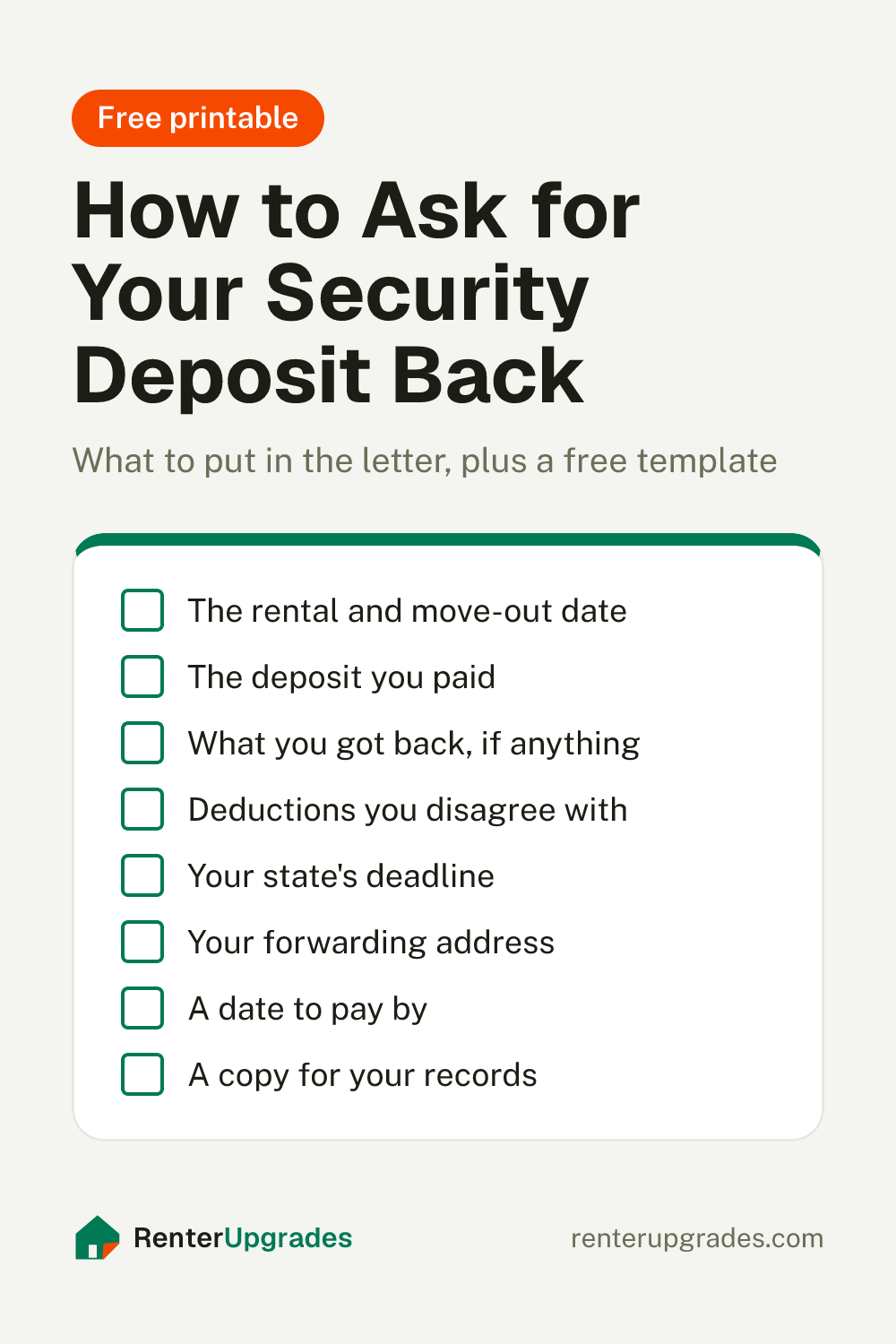
Save it for later
Pin this page so it's handy when you're ready to hang things.
Save to Pinterest (opens in a new tab)