
Move-In Checklist for Tenants
Pick your rooms, check each item and note any damage to make a move-in checklist you and your landlord can sign. Download the PDF or print it.
By Tess Mullins · Updated
Checklist preview
Move-in checklist
Tenant: [Your name]Address: [Your address]Move-in date: [Date]Landlord or manager: [Landlord's name]
Walk through every room before you unpack. Check each item, note any damage, wear or dirt, and take dated photos. Sign below, ask your landlord to sign, and both keep a copy.
Entry and hallway
- Front door and frame
- Locks, deadbolt and peephole
- Walls and paint
- Ceiling
- Floor or carpet
- Lights and switches
- Closet doors, shelves and rod
Living room
- Walls and paint
- Ceiling
- Floor or carpet
- Windows, screens and locks
- Blinds or window coverings
- Lights, switches and outlets
- Doors and trim
Kitchen
- Walls, ceiling and paint
- Floor
- Cabinets, doors and drawers
- Countertops and backsplash
- Sink, faucet and drain
- Under the sink: leaks or water stains
- Garbage disposal
- Stove, oven and burners
- Range hood, fan and light
- Refrigerator and freezer, seals and shelves
- Dishwasher, door and racks
- Microwave
- Lights, switches and outlets
Bedroom
- Door and handle
- Walls and paint
- Ceiling
- Floor or carpet
- Windows, screens and locks
- Blinds or window coverings
- Closet doors, shelves and rod
- Lights, switches and outlets
Bathroom
- Door, handle and lock
- Walls, ceiling and paint
- Signs of mold or water stains
- Floor
- Toilet: flush, base and seat
- Sink, faucet and drain
- Tub or shower, caulk and grout
- Shower head and water pressure
- Mirror, cabinet and towel bars
- Exhaust fan
- Lights and outlets
Safety and systems
- Smoke alarms: press the test button
- Carbon monoxide alarm
- Fire extinguisher, if provided
- Heating: turn it on
- Air conditioning: turn it on
- Thermostat
- Hot water at every faucet
- Circuit breaker panel: where it is
- Lead paint disclosure and the EPA pamphlet received (buildings built before 1978)
- Signs of pests
- Keys, fobs and remotes you received
- Mailbox and key
- Meter readings: gas, electric, water
Signatures
Signing confirms that this checklist describes the condition of the unit at move-in.
Tenant
[Your name]
Date
Landlord or property manager
Date
General information, not legal advice. Check your lease and your state's law before you rely on it.

When to use this checklist
Use it on move-in day, before your boxes and furniture hide the floors and walls. A move-in checklist is your record of the unit’s condition when you got it. When you move out, it’s what separates damage that was already there from damage your landlord might charge to your deposit. Once the record is done, the apartment cleaning checklist has a move-in clean for the empty rooms.
Ask about the move-in form while you’re still touring, with the apartment hunting checklist. Fill this one in even if your landlord gives you their own form. The more specific your notes, the less room there is for a disagreement later. For the weeks before the move itself, the moving checklist dates each step from your move date, and for a first place, the first apartment checklist lists what to buy and set up, room by room.
How to use the generator
- Add your name, the address and the move-in date, and your landlord’s or property manager’s name.
- Pick your layout: the number of bedrooms and bathrooms, plus a laundry area, balcony or storage if you have them. The checklist adds a section for each room.
- Walk through room by room. Check each item once you’ve looked at it, and type a short note for anything that isn’t in good shape.
- Download the PDF or print it. Items you haven’t noted get a blank line, so you can also fill in the printed copy by hand.
- Sign it, ask your landlord to sign it, and keep a copy each.
Your answers stay in your browser. A draft is saved on this device, so you can walk through one room at a time and come back. Press Clear to delete it.
Sample move-in checklist
Here’s a checklist filled in with the generator. The names, address and notes are made up.
Move-in checklist
Tenant: Jordan EllisAddress: 100 Main Street, Apt 2B, Anytown, ST 12345Move-in date: March 1, 2027Landlord or manager: Pat Morgan
Walk through every room before you unpack. Check each item, note any damage, wear or dirt, and take dated photos. Sign below, ask your landlord to sign, and both keep a copy.
Entry and hallway
- Done: Front door and frame
- Done: Locks, deadbolt and peephole
- Done: Walls and paintNote: Two scuffs by the light switch
- Ceiling
- Done: Floor or carpet
- Lights and switches
- Closet doors, shelves and rod
Living room
- Done: Walls and paintNote: Nail holes above the sofa wall
- Ceiling
- Done: Floor or carpetNote: Worn spot in the carpet by the door
- Done: Windows, screens and locksNote: Left screen torn in one corner
- Blinds or window coverings
- Lights, switches and outlets
- Doors and trim
Kitchen
- Walls, ceiling and paint
- Floor
- Cabinets, doors and drawers
- Countertops and backsplash
- Done: Sink, faucet and drain
- Done: Under the sink: leaks or water stainsNote: Old water stain, cabinet floor is dry
- Garbage disposal
- Done: Stove, oven and burnersNote: Back left burner slow to light
- Range hood, fan and light
- Done: Refrigerator and freezer, seals and shelves
- Dishwasher, door and racks
- Microwave
- Lights, switches and outlets
Bedroom
- Door and handle
- Walls and paint
- Ceiling
- Floor or carpet
- Windows, screens and locks
- Blinds or window coverings
- Closet doors, shelves and rod
- Lights, switches and outlets
Bathroom
- Door, handle and lock
- Walls, ceiling and paint
- Signs of mold or water stains
- Floor
- Toilet: flush, base and seat
- Sink, faucet and drain
- Done: Tub or shower, caulk and groutNote: Caulk discolored along the tub
- Shower head and water pressure
- Mirror, cabinet and towel bars
- Done: Exhaust fan
- Lights and outlets
Safety and systems
- Done: Smoke alarms: press the test buttonNote: Both alarms beep on test
- Carbon monoxide alarm
- Fire extinguisher, if provided
- Heating: turn it on
- Air conditioning: turn it on
- Thermostat
- Hot water at every faucet
- Circuit breaker panel: where it is
- Lead paint disclosure and the EPA pamphlet received (buildings built before 1978)
- Signs of pests
- Done: Keys, fobs and remotes you receivedNote: Two door keys, one mailbox key
- Mailbox and key
- Meter readings: gas, electric, water
Signatures
Signing confirms that this checklist describes the condition of the unit at move-in.
Tenant
Jordan Ellis
Date
Landlord or property manager
Date
What to look for in each room
- Be specific. “Two scuffs by the light switch” is more useful than “walls scuffed.” Say where the damage is and roughly how big.
- Test what works. Run every faucet, flush the toilet, turn on each stove burner, open and lock the windows, and press the test button on the smoke alarms.
- Look in the hidden spots: under the sinks, inside cabinets and closets, behind doors, and inside the oven and refrigerator.
- Check for moisture and pests. Water stains, soft spots, a musty smell, droppings or insects are worth noting and reporting right away.
- Write down what’s missing, such as a screen, a shelf or a bulb, not just what’s broken. Note which rooms have no ceiling light, too: the lumens calculator shows how many lamps they’ll need.
- Count your keys, fobs and remotes, and note the meter readings.
Take dated photos and video
The Federal Trade Commission tells renters to take photos as soon as they move in, send them to the landlord right away, especially if there’s damage, and take pictures again when they move out.
Take a wide shot of each room, then close-ups of every problem you noted, with something for scale such as a coin or a tape measure. Keep the files with their original dates, and back them up somewhere other than your phone.
While you’re at it, photograph your own things too. A home inventory helps settle a renters insurance claim, and the renters insurance calculator turns the same list into the coverage you need.
How to share it with your landlord and keep a record
- Do the walk-through together if you can, and both sign the same copy.
- If you do it alone, send your landlord a copy with the photos. Email gives you a dated record right away.
- By mail, proof helps. A Certificate of Mailing costs $2.45 and shows the date you mailed it. Certified Mail costs $5.55 plus postage, and a paper return receipt adds $4.65 (USPS prices from Oct 4, 2026).
- Keep the original with your lease, and keep it until your deposit is back.
California’s official tenant guide calls a checklist filled in by you and your landlord good practice even where the law doesn’t require one, and suggests you both sign, date and keep a copy.
What some states and programs require
Some states, and HUD for the housing it assists, set rules for a move-in checklist or inspection. A few examples:
- Washington: a landlord can't collect a deposit unless the lease is in writing and you get a written checklist of the unit's condition at the start, signed and dated by both of you. (RCW 59.18.260)
- Virginia: the landlord gives you a written move-in report within 5 days after you move in. It counts as correct unless you object in writing within 5 days after you get it. (Code of Virginia 55.1-1214)
- Maryland: you can ask, by certified mail within 15 days after you move in, for the landlord to inspect the unit with you and list the existing damage. (Real Property 8-203.1)
- Massachusetts: a landlord who takes a deposit gives you a statement of the unit's condition when you pay it or within 10 days after the tenancy starts, whichever is later. You can add the damage you find and return it within 15 days after you get it or move in, whichever is later. (General Laws c. 186, §15B)
- Georgia: before you pay a deposit, the landlord gives you a list of existing damage that you both sign. Some small landlords who manage their own units are exempt. (O.C.G.A. 44-7-33 and 44-7-36)
- California: for tenancies that begin on or after July 1, 2025, the landlord takes photos of the unit at move-in. (Civil Code 1950.5(g))
- New York: the landlord offers you a chance to inspect the unit before you move in, and you both sign a written agreement on its condition. Rent-regulated units follow other rules. (General Obligations Law 7-108(1-a))
- Minnesota: you can ask for a move-in inspection, and the landlord has to tell you about that right at the start of the tenancy or within 14 days after you move in. (Minnesota Statutes 504B.182)
- HUD-assisted housing: the owner and tenant inspect the unit together before the lease is signed, and the tenant has 5 days to report anything the inspection missed. (HUD Handbook 4350.3, paragraph 6-29)
These are examples, not a complete list. Your lease and your state’s law decide what applies to you, so check both, and look for a deadline to report problems.
Put a reminder in your calendar for the week before you move out to find this checklist and your photos. You’ll want them for the final walk-through and the move-out checklist.
Frequently asked questions
What should a move-in checklist include?
Every room's walls, ceilings, floors, doors, windows, lights and outlets, plus the kitchen appliances, bathroom fixtures and safety items like smoke alarms and locks. For each one, write down any damage, wear or dirt, and where it is.
Does my landlord have to sign the move-in checklist?
Not in every state, but ask anyway. Some states require a signed record: in Washington, a landlord can't collect a deposit without a written checklist signed and dated by both of you. Where it isn't required, a signed copy still shows you agreed on the condition.
How soon should I fill out a move-in checklist?
Before you unpack, ideally on move-in day. Some states give you only a short window to object to the landlord's report or ask for an inspection, so send your copy right away.
Should I take photos when I move in?
Yes. The Federal Trade Commission tells renters to take photos as soon as they move in and send them to the landlord right away, especially if there's damage. Dated photos back up what you wrote on the checklist.
What if my landlord won't do a walk-through?
Do it yourself anyway. Fill in the checklist, take dated photos, sign it and send a copy to your landlord in a way that leaves a record, such as email or mail with proof of mailing. Keep the original.
Is a move-in checklist the same as a rental inspection checklist?
It's the same idea: a room-by-room record of the unit's condition before you live there. If your landlord has a form, fill it in and attach this checklist for the details their form doesn't cover.
Next step
Will My Couch Fit Through the Door?Enter your sofa's measurements and your door, hallway or elevator to see whether it fits, and which way to carry it.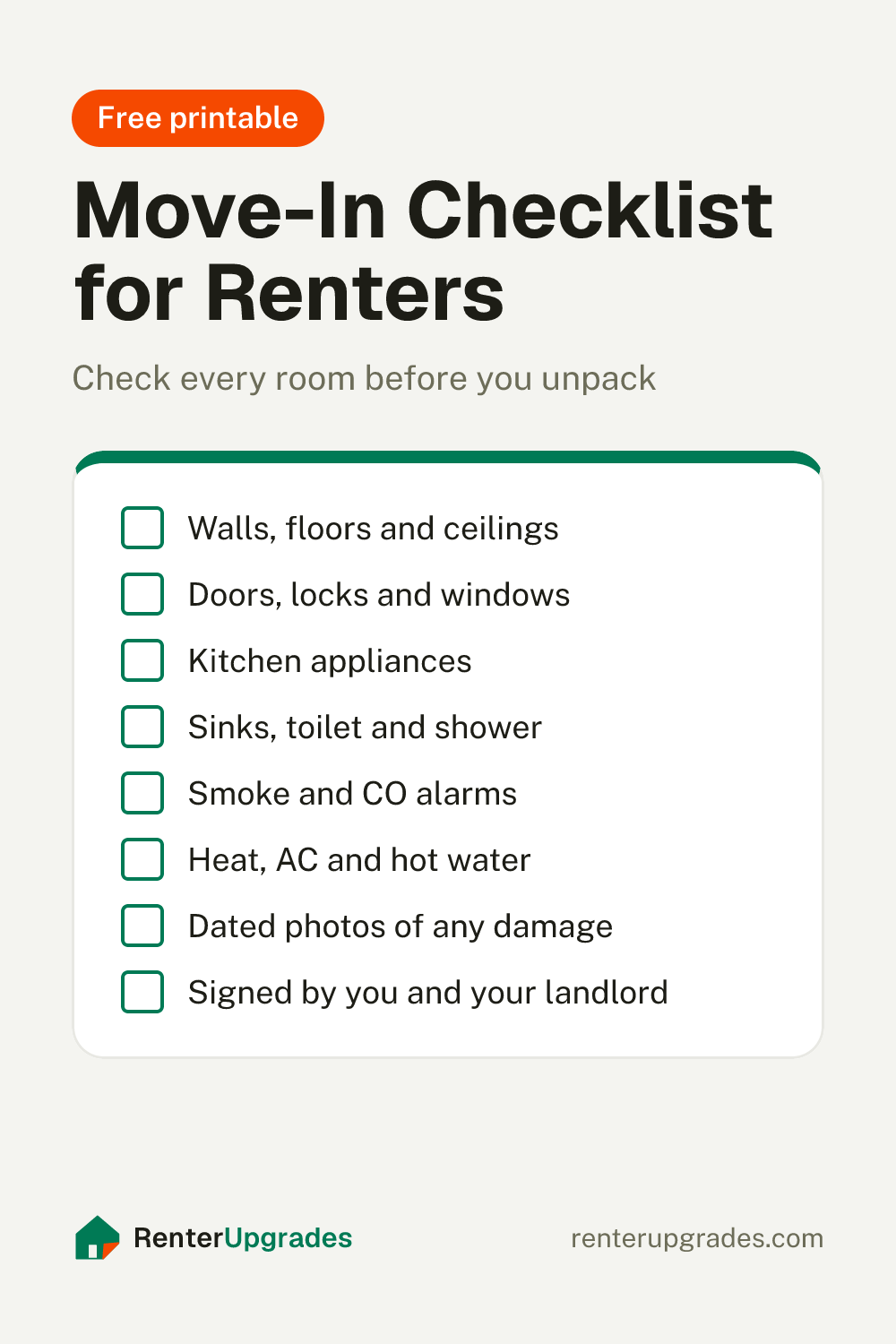
Save it for later
Pin this page so it's handy when you're ready to hang things.
Save to Pinterest (opens in a new tab)