
Break Lease Cost Calculator
Enter your rent, the months left and what your lease says to compare what leaving early could cost: paying a fee, paying rent until the unit is re-rented, or paying the rest of the lease.
By Tess Mullins · Updated
Your lease
Breaking your lease could cost
$4,000 to $12,000
The lowest is “pay rent until it's re-rented.” Your lease and your state's law decide which of these applies.
| If you | Cost | After deposit |
|---|---|---|
| Pay rent until it's re-rented (lowest) | $4,000 | $2,000 |
| Pay the rest of the lease | $12,000 | $10,000 |
| You find a replacement tenant | $0 | $0 |
- “After deposit” assumes the landlord applies your whole deposit to what you owe. They may not, and damage deductions come first.
- A replacement tenant only costs this little if they take over from the day you leave. If you sublet instead, you usually stay responsible for the rent.
General information, not legal advice. How we calculate
General information, not legal or financial advice.
The short answer
Breaking a lease usually costs one of three things: the early termination fee in your lease, rent until the landlord re-rents your place, or (at worst) the rest of the lease. With $2,000 rent and 6 months left, that’s about $4,000 if the unit is re-rented in 2 months, and up to $12,000 if it never is.
Which one applies depends on your lease and your state’s law. The calculator puts the scenarios side by side so you know the range before you talk to your landlord.
How to use the calculator
- Rent and months left. Count the full months between your move-out and the end of the lease.
- Early termination fee. Look for a buyout, early termination or liquidated damages clause in your lease. Leave it at $0 if there isn’t one.
- Months until it’s re-rented. This is your own estimate. Look at how long similar units nearby stay listed, or ask the landlord how fast they usually fill a vacancy.
- Re-renting costs. Only enter advertising or re-letting fees your lease says the landlord can charge you.
- Security deposit. The calculator shows what you’d owe if the whole deposit went toward the cost, as a separate column.
Use Copy link to save your numbers before you call or write to your landlord.
How we calculate
This is our own scenario model, not a legal formula:
- Pay the early termination fee: the fee in your lease. Your lease decides whether rent through a notice period or other charges come on top.
- Pay rent until it’s re-rented: monthly rent × the months the unit sits empty (never more than the months left), plus any re-renting costs.
- Pay the rest of the lease: monthly rent × the months left. This is the most you could owe in rent.
- You find a replacement tenant: only the re-renting costs, if someone takes over the lease from the day you leave.
The result highlights the lowest of the first three. It doesn’t decide which one your landlord can actually charge; your lease and your state’s law do.
Worked examples
Example: No fee in the lease, six months left
What we know
- Rent: $2,000 a month
- Months left after moving out: 6
- No early termination fee in the lease
- Months until re-rented (estimate): 2
How it works out
- Pay rent until it's re-rented: $2,000 × 2 months = $4,000.
- Pay the rest of the lease: $2,000 × 6 months = $12,000.
About $4,000 to $12,000, depending on the lease and how fast the unit is re-rented.
Example: A lease with a two-month fee
What we know
- Rent: $1,600 a month
- Months left after moving out: 8
- Early termination fee in the lease: $3,200
- Months until re-rented (estimate): 3
- Re-renting costs in the lease: $300
How it works out
- Pay the early termination fee: $3,200.
- Pay rent until it's re-rented: $1,600 × 3 months + $300 re-renting costs = $5,100.
- Pay the rest of the lease: $1,600 × 8 months = $12,800.
About $3,200 to $12,800, depending on the lease and how fast the unit is re-rented.
Example: Two months left on the lease
What we know
- Rent: $1,800 a month
- Months left after moving out: 2
- No early termination fee in the lease
- Months until re-rented (estimate): 3
How it works out
- Pay rent until it's re-rented: $1,800 × 2 months = $3,600.
- Pay the rest of the lease: $1,800 × 2 months = $3,600.
About $3,600 to $3,600, depending on the lease and how fast the unit is re-rented.
Does your landlord have to re-rent your place?
In many states, the landlord has to try. This is called the duty to mitigate damages:
- Texas law (Property Code 91.006) says a landlord “has a duty to mitigate damages if a tenant abandons the leased premises in violation of the lease,” and a lease clause that waives it is void.
- Illinois law (735 ILCS 5/9-213.1) says the landlord “shall take reasonable measures to mitigate the damages.”
- New York law (Real Property Law 227-e) requires reasonable and customary efforts to re-rent at fair market value. The state courts’ law librarians add that you keep paying rent until the landlord finds someone to take over.
- Minnesota law says that when a tenant abandons a unit during the lease, “the landlord shall make reasonable efforts to rent it at a fair rental value” (Minnesota Statutes 504B.154), and the Attorney General’s handbook adds that once a new tenant is found, the tenant who left owes no further rent.
- California limits what a landlord can recover to the rent loss that couldn’t reasonably have been avoided (Civil Code 1951.2), with exceptions the lease can set.
Not every state works this way. Georgia’s tenant handbook says that, unless the lease says otherwise, the landlord “can allow the unit to remain empty and hold the tenant responsible for rent through the end of the lease.” Florida law (Statutes 83.595) lets the landlord choose among several remedies, including an early termination fee of up to 2 months' rent, which you must have agreed to in a separately signed addendum with no more than 60 days of notice.
Ways to leave without paying the rest of the lease
- Military orders. Under the Servicemembers Civil Relief Act, a servicemember with orders for a permanent change of station or a deployment of at least 90 days can end a residential lease. Deliver written notice and a copy of the orders. A lease with monthly rent ends 30 days after the next rent due date, rent is prorated, and the landlord can’t charge an early termination fee.
- Domestic violence. The National Housing Law Project counted 40 states with early lease termination laws for survivors as of September 2023. The rules differ by state, so check your state’s statute or a local legal aid office. In housing covered by federal programs, the Violence Against Women Act also provides emergency transfers to another unit.
- A replacement tenant. Ask the landlord in writing to approve someone to take over the lease and to release you from it. A sublet usually leaves you responsible for the rent.
- A written agreement. You can offer to agree on a move-out date and a fixed payment. Get any deal in writing before you stop paying rent.
This is general information, not legal advice. Lease terms and state laws differ, and some cities add their own rules. For a big balance or a dispute, talk to a local legal aid office or a tenant lawyer before you sign anything.
Before you hand back the keys
Tell your landlord in writing that you’re leaving and when, and keep a copy: the break lease letter asks to leave early, or gives notice with military orders. Take dated photos of every room on the way out, return all keys and give a forwarding address for your deposit. Keep paying rent until you have a written agreement that says you can stop.
Frequently asked questions
How much does it cost to break a lease?
It depends on your lease and your state's law. The most you could owe in rent is the rest of the lease. If the landlord re-rents your place, you usually owe rent only until the new tenant moves in, plus any costs the lease allows. With $2,000 rent and 6 months left, that's about $4,000 if it takes 2 months to re-rent, or $12,000 if it's never re-rented.
Is there a penalty for breaking a lease early?
Only if your lease or your state's law sets one. Some leases have an early termination fee or buyout clause. Florida, for example, allows a fee of up to 2 months' rent if you agreed to it in a separately signed addendum. Without a fee clause, the usual cost is unpaid rent until the unit is re-rented.
Does my landlord have to re-rent my apartment?
In many states, yes. Texas, Illinois and New York law, for example, require landlords to make reasonable efforts to re-rent, and Minnesota's Attorney General says the same for Minnesota. Georgia's tenant handbook says a landlord there doesn't have to. Check your state's law.
Can I break a lease early without a penalty?
Sometimes. Servicemembers with qualifying orders can end a lease under the Servicemembers Civil Relief Act, which bans early termination charges. Many states let survivors of domestic violence end a lease early; the National Housing Law Project counted 40 states with such laws as of September 2023. You can also ask your landlord to let you go early or to approve a replacement tenant.
Do I get my security deposit back if I break my lease?
Not automatically. A landlord may be able to apply the deposit to unpaid rent and damage, and return what's left under your state's deposit rules. The calculator shows what you'd owe if the whole deposit went toward the cost, but don't count on it until you see the landlord's itemized list.
What if I find someone to take over my lease?
Ask the landlord in writing whether they'll accept a new tenant and release you from the lease. A sublet is different: Georgia's tenant handbook, for example, says the original tenant stays responsible to the landlord for the rent and any damage the subtenant causes.
How does the military clause work?
Under federal law, a servicemember who gets orders for a permanent change of station or a deployment of at least 90 days can end a residential lease. Give the landlord written notice and a copy of the orders. For a lease with monthly rent, it ends 30 days after the next rent due date; rent is prorated and no early termination charge is allowed.
Next step
Move-Out Checklist for TenantsPick your rooms to get a move-out checklist with the paperwork, cleaning and photos that help protect your deposit. Check off tasks as you go, then print it or download the PDF.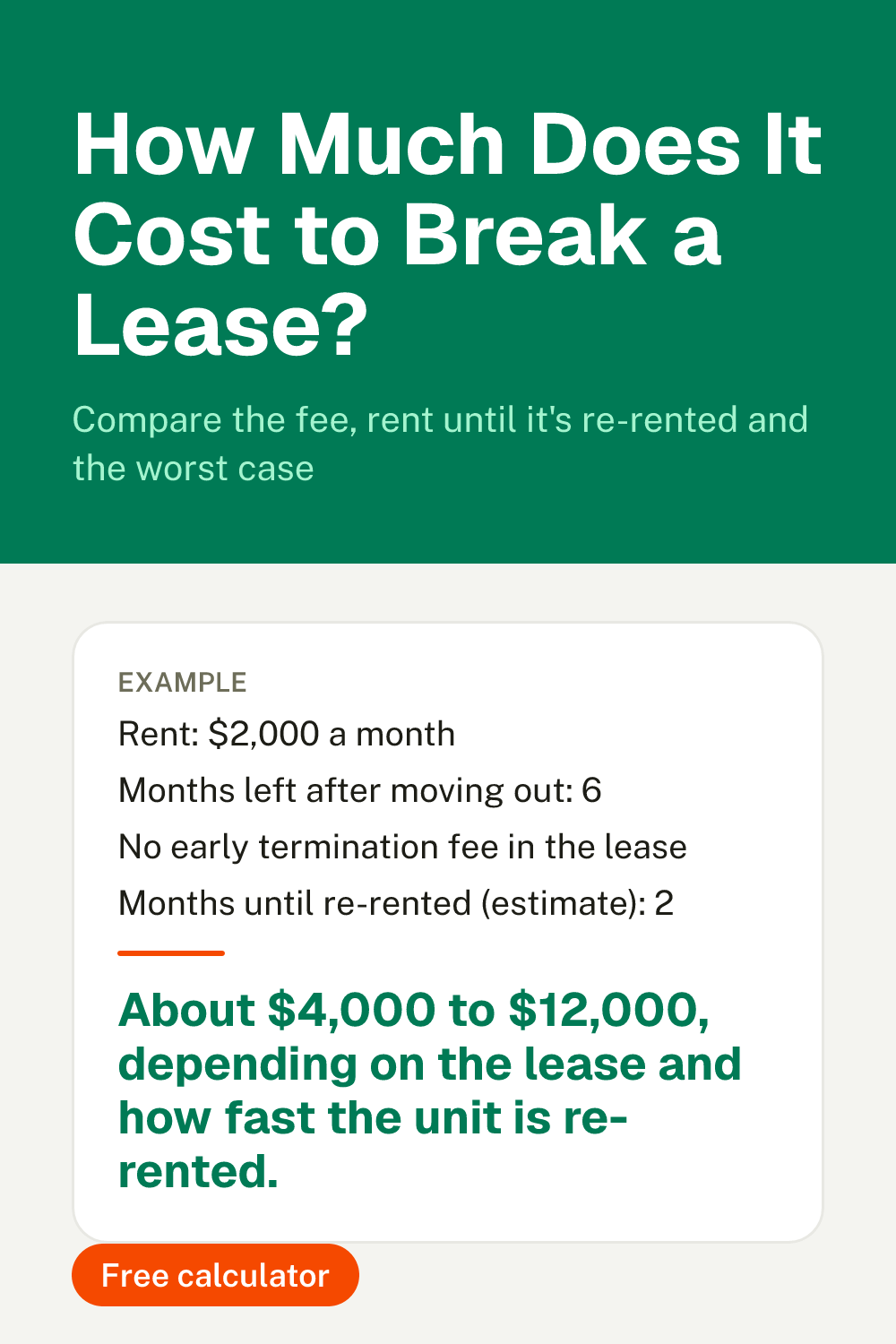
Save it for later
Pin this page so it's handy when you're ready to hang things.
Save to Pinterest (opens in a new tab)