
Rent Increase Calculator
Compare your current and new rent, add a percentage to it, or project yearly increases to see what a rent increase really costs you.
By Tess Mullins · Updated
Your rent
The change
7% increase
+$126 a month, +$1,512 over a year of rent.
The math only. Whether an increase is allowed depends on your lease and local law. How we calculate
General information, not legal or financial advice.

The short answer
To find the percentage, subtract your current rent from the new rent, divide by the current rent and multiply by 100. Going from $1,800 to $1,926 is $126 more a month, a 7% increase, or $1,512 over a year.
To add a percentage to your rent, multiply the rent by 1 plus the percentage as a decimal: a 4% increase turns $2,200 into $2,288.
How to use the calculator
- Pick what you want to work out: the change between two rents, the new rent after a percentage, or the rent after several yearly increases.
- Enter your current rent, then the new rent or the percentage.
- For several years, enter how many. The calculator applies one increase a year, at the same percentage.
The result shows the change a month and over a year. Use Copy link to keep the numbers next to your renewal offer.
Rent after a few years of increases
How a $1,500 rent grows with one increase a year:
| After | 3% a year | 5% a year | 7% a year |
|---|---|---|---|
| 1 year | $1,545 | $1,575 | $1,605 |
| 2 years | $1,591.35 | $1,653.75 | $1,717.35 |
| 3 years | $1,639.09 | $1,736.44 | $1,837.56 |
| 5 years | $1,738.91 | $1,914.42 | $2,103.83 |
| 10 years | $2,015.87 | $2,443.34 | $2,950.73 |
The gap between the columns widens every year, because each increase applies to a rent that already went up.
How we calculate
- Change: new rent minus current rent.
- Percent change: the change divided by the current rent, times 100.
- New rent from a percentage: current rent × (1 + percentage ÷ 100).
- Over several years: one increase a year, each applied to the rent after the last one, so the rent after year k is today’s rent × (1 + percentage ÷ 100) to the power of k. The extra paid is the sum of each year’s rent above today’s rent, times 12.
In the “current and new rent” mode, a decrease shows as a negative change; the percentage modes take increases only. We show amounts to the cent and don’t round between steps.
Worked examples
Example: A renewal offer
What we know
- Current rent: $1,800
- New rent: $1,926
How it works out
- Change: $1,926 − $1,800 = $126 a month.
- Percent: $126 ÷ $1,800 × 100 = 7%.
- Over a year: $126 × 12 = $1,512.
A 7% increase: $126 more a month.
Example: A 4% increase
What we know
- Current rent: $2,200
- Increase: 4%
How it works out
- New rent: $2,200 × (1 + 0.04) = $2,288.
- Change: $88 a month, $1,056 a year.
New rent: $2,288 a month.
Example: 5% a year for 5 years
What we know
- Current rent: $1,500
- Increase: 5% a year for 5 years
How it works out
- Year 1: $1,575 a month.
- Year 2: $1,653.75 a month.
- Year 3: $1,736.44 a month.
- Year 4: $1,823.26 a month.
- Year 5: $1,914.42 a month.
- Extra paid over the 5 years, compared with today's rent: $14,434.43.
After 5 years: $1,914.42 a month, $414.42 more than today.
Before you sign a renewal
- Get the new rent in writing, along with the lease length and the date it starts.
- Look at the yearly total, not just the monthly change. A small monthly increase adds up over a lease.
- Check your lease and local rules. Some states and cities limit how much and how often rent can go up, and require notice before an increase. This calculator doesn’t check that for you.
- Ask for less in writing. The rent increase letter answers the notice with the numbers, your record and the rent you’d like to pay.
Limits and notice rules: a few examples
There’s no federal limit on rent increases, and most states set none, but a lease can only be changed when it allows it, and every state has its own notice rules. Two states with statewide caps, as examples:
- California: for most rentals, an increase can’t take the rent more than 5% plus the change in the cost of living, or 10%, whichever is lower, above the lowest rent charged in the previous 12 months (Civil Code 1947.12). Newer buildings and some single-family homes are exempt.
- Oregon: no increase in the first year of a tenancy, at least 90 days of written notice, no more than one increase in 12 months, and a cap of 7% plus inflation or 10%, whichever is lower, published each year by the state (9.5% for 2026, 10% for 2027). Buildings less than 15 years old are exempt (ORS 90.323 and 90.324).
These are examples, not a complete list, and cities can add their own rules. HUD’s tenant rights page links to each state’s rules and local tenant organizations.
Run the numbers for a few years, not just the next one. Seeing what the same increase does over the length of your stay makes it easier to decide whether to renew, negotiate or start looking.
Frequently asked questions
How do I calculate a rent increase percentage?
Subtract your current rent from the new rent, divide the difference by the current rent and multiply by 100. Going from $1,800 to $1,926 is a $126 increase, or 7%.
How do I add a percentage increase to my rent?
Multiply your rent by 1 plus the percentage written as a decimal. A 4% increase on $2,200 is $2,200 × 1.04 = $2,288.
How much more will I pay over a year?
Multiply the monthly increase by 12. A $126 increase adds $1,512 over a year of rent.
How do rent increases add up over several years?
Each increase applies to the rent after the last one, so they compound. At 5% a year, $1,500 becomes $1,914.42 after 5 years, and you pay $14,434.43 more in total than you would at today's rent.
Is my rent increase allowed?
This calculator does the math only. Whether an increase is allowed, and how much notice you're owed, depends on your lease, your state and sometimes your city. Most states set no limit, but some do: California caps most increases at 5% plus inflation or 10%, whichever is lower, and Oregon publishes a yearly maximum (9.5% for 2026) and requires 90 days of written notice. HUD's tenant rights page links to each state's rules.
Next step
Net Effective Rent CalculatorEnter the gross rent, the lease length and the free time on offer to see the net effective rent, what you pay over the whole lease and what the concession is worth.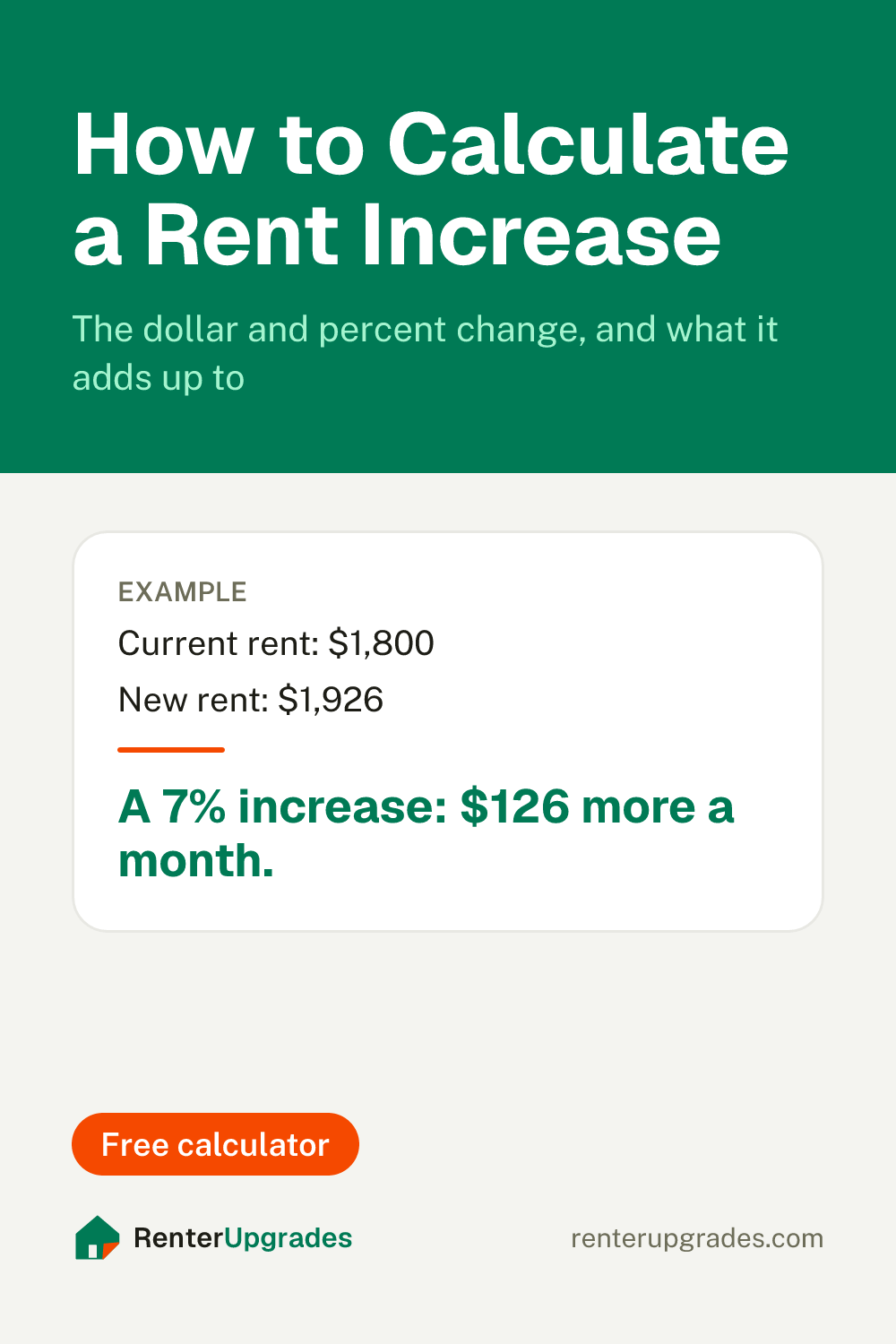
Save it for later
Pin this page so it's handy when you're ready to hang things.
Save to Pinterest (opens in a new tab)