
Letter to Landlord About a Rent Increase
Enter the rent now and the new rent, then what you'd like to pay and why. The generator works out the increase and writes a polite counteroffer you can copy or download as a PDF.
By Tess Mullins · Updated
Letter preview
[Your name][Your address]
[Date]
[Landlord's name][Landlord's address]
Re: Rent increase for [Your address]
Dear [Landlord's name],
Thank you for your notice that the rent for [Your address] will go from [current rent] to [new rent] a month. I've always paid rent on time, and I'd like to stay.
I'd like to ask you to consider a rent of [rent you propose] a month instead.
Please let me know in writing. Thank you for considering it.
Sincerely,
Signature
[Your name]
General information, not legal advice. Check your lease and your state's law before you rely on it.

When to use this letter
Use it when your landlord tells you the rent is going up, usually with a lease renewal, and you’d like to stay at a lower rent. It’s a request: your landlord can agree, meet you partway or say no. A short, polite letter with numbers and something to offer gives you the best chance.
To check the math first, the rent increase calculator works out the increase in dollars and percent, and what it adds up to over a few years.
How to use the generator
- Add your details and your landlord’s. Use the address your lease gives for notices, if it has one.
- Enter the rent now and the new rent, with the date of the notice and when the new rent starts. The generator shows the increase as you type.
- Choose what to ask for: a smaller increase, with the rent you’d propose, or no increase. Add a lease length if you’d sign a longer lease in return.
- Make your case: how long you’ve lived there, your on-time record, what similar units rent for, and, if you like, your state’s median rent.
- Pick a date for an answer, then download the PDF or copy the text and send it the way your lease asks.
The letter’s date is today’s date unless you change it. Your answers stay in your browser, and a draft is saved on this device until you press Clear.
Sample letter
Here’s a finished letter answering an increase from $1,450 to $1,595 a month: 10%, or $1,740 more over a year. The renter, there for 3 years, asks for $1,520 (4.8% more than now) and offers a lease of 18 months. The names and addresses are made up.
Jordan Ellis100 Main Street, Apt 2BAnytown, ST 12345jordan@example.com
April 5, 2027Sent by email
Pat MorganMorgan Property Management200 Oak AvenueAnytown, ST 12345
Re: Rent increase for 100 Main Street, Apt 2B
Dear Pat Morgan,
Thank you for your notice of April 1, 2027 that the rent for 100 Main Street, Apt 2B will go from $1,450 to $1,595 a month starting June 1, 2027. That's $145 more a month, an increase of 10%, or $1,740 more over a year. I've lived here for 3 years and have always paid rent on time, and I'd like to stay.
Similar units nearby are listed for about $1,525 a month. In the Census Bureau's 2024 American Community Survey, the median rent for a 1-bedroom in Texas, utilities included, was $1,312 a month.
I'd like to ask you to consider a rent of $1,520 a month instead, an increase of 4.8%.
In return, I'd be glad to sign an 18-month lease.
Please let me know in writing by April 20, 2027. Thank you for considering it.
Sincerely,
Signature
Jordan Ellis
What to include
- The numbers: the rent now, the new rent, when it starts, and the increase in dollars and percent.
- Why you’d like to stay, and why you’re a tenant worth keeping: how long you’ve lived there and your on-time rent.
- What similar units rent for, from listings nearby.
- The rent you’re asking for, or a request to keep it the same.
- Something in return, such as a longer lease.
- A date for a written answer, early enough to give notice or plan a move if the answer is no.
How to make your case
- Use real listings. Look for units like yours nearby: the same number of bedrooms, a similar building, similar amenities. A few current listings at lower rents are your strongest evidence.
- Use the state median with care. The generator can add the median rent for your size of home in your state from the Census Bureau’s 2024 American Community Survey. It includes the utilities renters pay and covers the whole state, so it’s a rough guide: rents in your city can be well above or below it. In the sample, the median for a 1-bedroom in Texas was $1,312.
- Offer what you can keep. A longer lease fixes your rent for longer, but only offer a length you’re sure you’ll stay. The break lease cost calculator shows what leaving early could cost.
- Stay polite and factual. Mention a repair that’s still waiting if it matters, but keep the letter about the rent.
Is the increase allowed?
That depends on your lease, your state and sometimes your city. A lease usually fixes the rent until it ends, and most states set no limit on increases after that. Two states with statewide limits, as examples:
- California caps most increases at 5% plus the change in the cost of living, or 10%, whichever is lower (Civil Code 1947.12).
- Oregon requires at least 90 days of written notice and publishes a yearly maximum, 9.5% for 2026 (ORS 90.323 and 90.324).
Both have exemptions, and some cities add their own rules. HUD’s tenant rights page links to each state’s rules and local tenant organizations. If an increase seems to break a rule, ask a local tenant organization or legal aid office before you answer.
How to send it and keep a record
- Answer soon, while there’s time to plan either way.
- Email is fine for a request like this and leaves a dated record. Save the reply.
- Mail with proof shows when you sent it. Certified Mail costs $5.55 on top of postage, plus $4.65 for a paper return receipt (USPS prices from Oct 4, 2026).
- Get any new rent in writing before you sign the renewal.
If the answer is no
Decide whether to renew at the new rent or move. The rent affordability calculator checks the new rent against your income, and the moving cost calculator shows what a move would cost. If you decide to leave, give notice in writing with the 30-day notice letter.
Run the numbers over the whole lease before you answer. An increase that sounds small a month can add up to more than a move would cost, or less, and knowing which helps you decide how hard to push.
Frequently asked questions
How do I negotiate a rent increase?
Answer in writing soon after the notice. Restate the numbers, say how long you've lived there and that you pay on time, show what similar units rent for, and propose a rent. Offer something in return, such as a longer lease, and ask for an answer by a date that still leaves you time to plan.
What should I say in a letter about a rent increase?
Keep it short and polite: thank your landlord for the notice, give the current and new rent, explain why you'd like to stay, back your request with what similar units rent for, name the rent you're asking for and what you'll offer, and ask for a written answer.
Can my landlord raise my rent?
It depends on your lease, your state and sometimes your city. Most states set no limit, but some do: California caps most increases at 5% plus inflation or 10%, whichever is lower, and Oregon requires 90 days of written notice. A lease usually fixes the rent until it ends. HUD's tenant rights page links to each state's rules.
How do I find out what similar apartments rent for?
Look at current listings for units like yours nearby: the same number of bedrooms, a similar building and similar amenities. The generator can also add your state's median rent from the Census Bureau's 2024 American Community Survey, a rough guide that includes utilities and covers the whole state.
Should I offer to sign a longer lease?
It's one of the few things a renter can offer in return, and it gives you a fixed rent for longer. Only offer a length you're sure you'll stay, since breaking a longer lease can cost more.
What if my landlord says no?
Decide whether to renew at the new rent or move. Check whether you can afford the new rent, compare it with the cost of moving, and if you leave, give notice in writing the way your lease asks.
Next step
How Much Rent Can I Afford?Enter your pay before taxes and the utilities you'll pay to see the most rent that keeps housing within 30% of your income, what landlords' income rules allow, and how that compares with what renters in your state pay.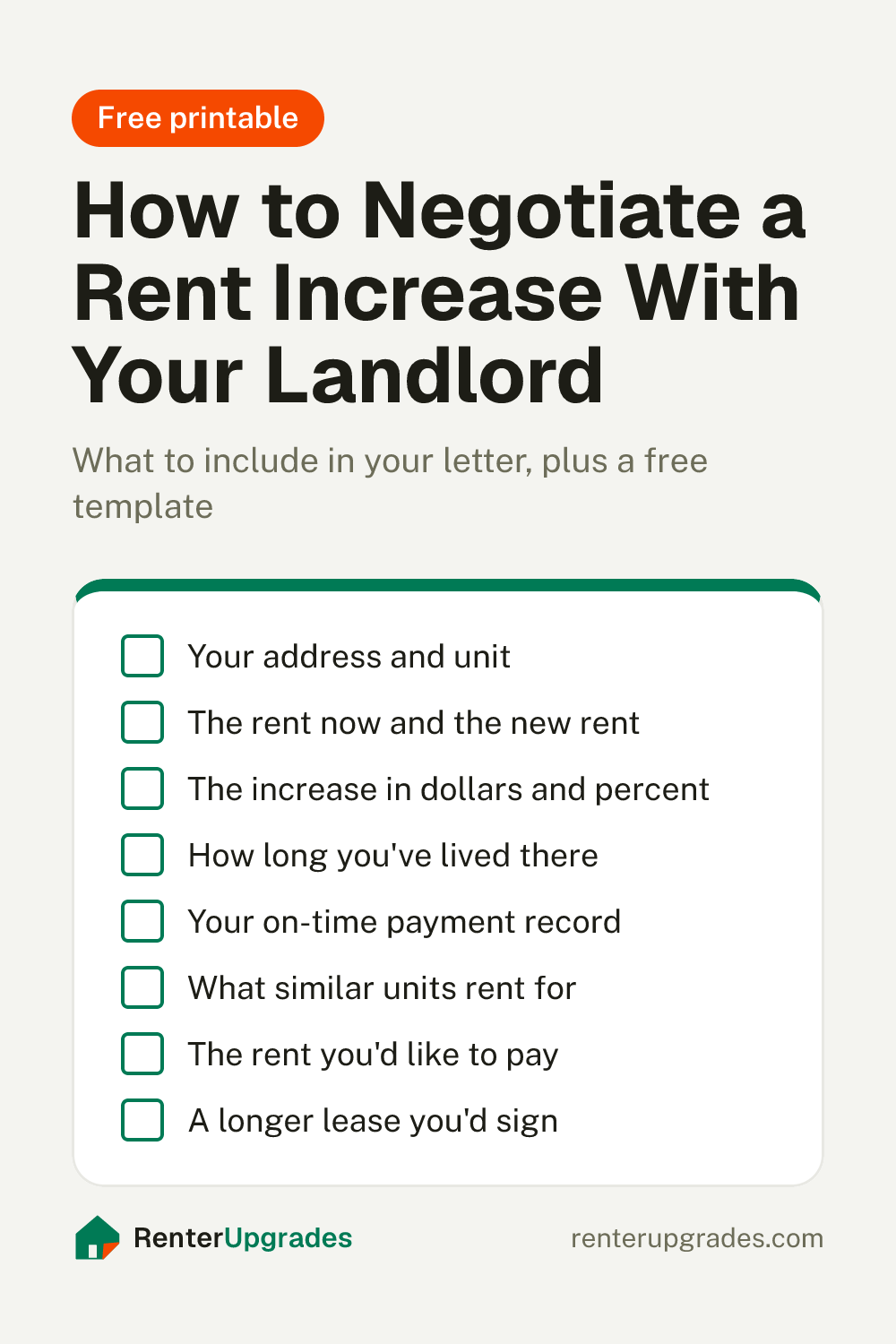
Save it for later
Pin this page so it's handy when you're ready to hang things.
Save to Pinterest (opens in a new tab)