
TV Size & Viewing Distance Calculator
Enter the distance from your seat to the screen to see which sizes Samsung's rules point to (2 times the size to 1.2 times, a 40° field of view), or check a size for its width, its fit and the height to hang it (42 in to the center, SANUS's seated eye level).
By Tess Mullins · Updated
Your room
For your seat
A 50 to 75 in TV
From 8 ft away, Samsung's guide picks a screen of half the distance, 48 in, and calls 80 in the most immersive (the seat at 1.2 times the size, the screen across 40° of your view). The common sizes between them: 50, 55, 65, 75 in. For 4K anything from 38 to 96 in stays inside its 1 to 2.5 times band.
| TV | Screen | Fits 60 in | Fills |
|---|---|---|---|
| 50 in | 43.6 × 24.5 in | Yes | 26° |
| 55 in | 47.9 × 27 in | Yes | 28° |
| 65 in | 56.7 × 31.9 in | Yes | 33° |
| 75 in | 65.4 × 36.8 in | No | 38° |
Up to 65 in fits the 60 in you have (56.7 in wide before its bezel); the larger sizes don't.
Getting it home? The will it fit calculator checks the box through your door, and the gallery wall generator plans frames around it.
Samsung's buying guide for the sizes and SANUS's for the height, not a standard. Screen sizes are the 16:9 picture without the bezel; the feet and frame add an inch or two. How we calculate
- Deposit Risk: Low
- Landlord Permission: Check your lease
- Take It With You: Yes
The short answer
Measure from your seat to the wall. Samsung’s buying guide gives two rules: pick a screen of half that distance, and sit at 1.2 times the screen size for the most immersive picture, which puts the screen across 40° of your view. From 8 ft that’s 48 in to 80 in, so A 50 to 75 in TV in the sizes stores carry (32, 43, 50, 55, 65, 75, 85, 98 in). For 4K, anything from 1 to 2.5 times the size is inside its band.
A 55 in screen is 47.9 in wide and 27 in tall before its frame. Hang it with its center at your seated eye height, 42 in on SANUS’s average: the bottom edge 28.5 in above the floor, the top 55.5 in.
How to use the calculator
- Picking a size: enter the distance from your seat to the screen and the width of wall or stand you have. The result lists the common sizes between Samsung’s two rules, each with its screen width, whether it fits, and the share of your view it fills.
- Checking a size: enter the TV size you have in mind. The result gives its screen’s width and height, whether it fits, how your seat distance rates against Samsung’s band, and where its edges land on the wall or a stand against your seated eye height.
- Measure your eyes, not just the room: sit where you’ll watch and have someone measure from the floor to your eyes. SANUS’s 42 in is an average.
Copy link keeps a room’s numbers for the store; Print takes the table along.
Sizes against the seat
Each common size’s screen and the seat distance Samsung’s two rules give it:
| TV size (in) | Screen width × height (in) | Seat for the most immersive picture (1.2×) | Seat Samsung's size rule gives (2×) |
|---|---|---|---|
| 32 | 27.9 × 15.7 | 3.2 ft | 5.3 ft |
| 43 | 37.5 × 21.1 | 4.3 ft | 7.2 ft |
| 50 | 43.6 × 24.5 | 5 ft | 8.3 ft |
| 55 | 47.9 × 27 | 5.5 ft | 9.2 ft |
| 65 | 56.7 × 31.9 | 6.5 ft | 10.8 ft |
| 75 | 65.4 × 36.8 | 7.5 ft | 12.5 ft |
| 85 | 74.1 × 41.7 | 8.5 ft | 14.2 ft |
| 98 | 85.4 × 48 | 9.8 ft | 16.3 ft |
How we calculate
- The screen. The advertised size is the diagonal. A 16:9 screen’s width is the diagonal × 16 ÷ √337 and its height the diagonal × 9 ÷ √337 (√337 is the diagonal of a 16 by 9 rectangle). The bezel and the feet aren’t included.
- Picking a size. Samsung’s guide: “use your room’s viewing distance divided by two to pick the right TV size”, and “sit at roughly 1.2× your screen size for the best viewing experience”, when “40° of your field of view is taken up by the screen”. The calculator lists the common sizes from the first figure to the second, and the 4K band, “1 to 2.5 times your TV’s screen size”, as the outer limits. When no common size falls between the two rules (a seat very close to the wall), it names the nearest.
- The field of view. Twice the arctangent of half the screen’s width over the seat distance. At 1.2 times the size it comes to 40°, Samsung’s immersive target.
- Checking a seat. The seat distance divided by the size, placed against Samsung’s figures: under 1 is closer than the 4K band, under 1.2 is closer than the immersive distance, up to 2 is inside its range, up to 2.5 is far but inside the 4K band, and beyond that the screen will look small.
- The height. On a wall, the center of the screen at your seated eye height (42 in on SANUS’s average), so the bottom edge is the center less half the screen’s height and the top edge the center plus it. On a stand, the center is the stand’s height plus half the screen’s height, compared with your eye height; the feet add an inch or two.
Samsung’s guide and SANUS’s are makers’ advice, named here because each figure comes from one of them. Neither is a standard, and a seat that’s comfortable for you beats both.
Worked examples
Example: Picking a size for a sofa 8 ft from the wall
What we know
- Seat to screen: 8 ft
- Wall or stand width: 60 in
- On the wall; seated eye height 42 in
How it works out
- From 8 ft away, Samsung's guide picks a screen of half the distance, 48 in, and calls 80 in the most immersive (the seat at 1.2 times the size, the screen across 40° of your view). The common sizes between them: 50, 55, 65, 75 in. For 4K anything from 38 to 96 in stays inside its 1 to 2.5 times band.
- Up to 65 in fits the 60 in you have (56.7 in wide before its bezel); the larger sizes don't.
A 50 to 75 in TV.
Example: Checking a 65 in TV on a 60 in wide wall, 8 ft from the sofa
What we know
- Seat to screen: 8 ft
- TV: 65 in
- Wall or stand width: 60 in
- On the wall; seated eye height 42 in
How it works out
- A 65 in TV screen is 56.7 in wide and 31.9 in tall. It fits the 60 in you have with 3.3 in to spare, before the bezel and the feet.
- From 8 ft, 1.5 times the size, the screen fills 33° of your view: inside its range. Samsung's guide puts the seat at 78 in for the most immersive picture (1.2 times the size) and picks this size for a seat 130 in away (twice the size).
- On the wall, center the 65 in TV at your seated eye height, 42 in (SANUS's average is 42 in): its bottom edge 26.1 in and its top 57.9 in above the floor.
A 65 in TV is 56.7 × 31.9 in.
Example: A 43 in TV on a 30 in dresser, 6 ft from the bed
What we know
- Seat to screen: 6 ft
- TV: 43 in
- Wall or stand width: 36 in
- On a 30 in stand; seated eye height 42 in
How it works out
- A 43 in TV screen is 37.5 in wide and 21.1 in tall. It's 1.5 in too wide for the 36 in you have, before the bezel.
- From 6 ft, 1.7 times the size, the screen fills 29° of your view: inside its range. Samsung's guide puts the seat at 51.6 in for the most immersive picture (1.2 times the size) and picks this size for a seat 86 in away (twice the size).
- On a 30 in stand, the 43 in TV's center is 40.5 in above the floor, 1.5 in below your seated eye height (42 in), with its bottom edge 30 in and its top 51.1 in above the floor; the TV's feet add an inch or two.
A 43 in TV is 37.5 × 21.1 in.
Placing a TV in a rental
- A stand needs no holes. A TV on a console, a dresser or a corner stand leaves the wall alone; strap it to a stud with the anti-tip kit in the box, which is one small hole instead of four lag bolts.
- Ask before you mount. A wall mount goes into the studs. Get the OK in writing and keep the patch kit for move-out.
- Check the way in. A boxed 65 in TV is wider than most doors are tall; the will it fit calculator runs the box through the door and up the stairs.
- Frame it. The gallery wall generator lays frames out around a screen, and the command strip calculator hangs them without holes.
- Light the room, not the screen. A lamp behind or beside the TV cuts the contrast at night; the lumens calculator sizes it.
Why this gets a Low deposit risk
The calculator measures and picks; nothing is drilled. A TV on a stand leaves with you; a wall mount is a separate decision with the holes to match.
Tape the screen’s width and height on the wall at the heights the calculator gives, then sit down and look. If you turn your head to follow the action, step down a size or push the sofa back.
Frequently asked questions
What size TV should I get for my room?
Measure from your seat to where the screen will be. Samsung's buying guide picks a screen of half that distance and calls the seat at 1.2 times the screen size the most immersive, with the picture across 40° of your view. From 8 ft, that's 48 in to 80 in: A 50 to 75 in TV in the common sizes. Its room-led picks are 32 to 43 in for bedrooms and compact spaces, 55 to 65 in for living rooms and 75 to 98 in for a home cinema.
How far should you sit from a 55 inch TV?
By Samsung's rules, 66 in for the most immersive picture (1.2 times the size) and 110 in if you follow its size rule the other way (twice the size); for 4K it says anything from 1 to 2.5 times the size works. From 8 ft a 55 in screen fills 28° of your view.
How wide is a 55 inch TV?
47.9 in wide and 27 in tall for the screen itself: the advertised size is the diagonal, and a 16:9 screen's width is the diagonal times 16 divided by the square root of 337 (about 0.87). The frame around the screen and the feet add an inch or two; measure the model you want before you measure the wall.
How high should a TV be mounted?
Center it at your seated eye height. SANUS, which makes mounts, puts the average at 42 in from the floor to the center of the screen and notes that seated heights vary far less than standing ones. For a 55 in TV that's a bottom edge 28.5 in and a top edge 55.5 in above the floor. Furniture under the TV can push it higher, which is where a tilting mount earns its keep.
Can I mount a TV in a rental?
A wall mount needs lag bolts into the studs, which most leases count as more than a nail hole, so ask in writing first and plan to patch at move-out. A TV on a stand or dresser needs no holes, and an anti-tip strap still ought to go into a stud. The calculator gives the stand's screen height against your eyes either way.
Does the screen size include the bezel?
No. The calculator's widths and heights are the 16:9 picture from the diagonal. The frame adds up to an inch each side on most sets and the feet or stand add height below, so leave a little more than the result when the space is tight.
Next step
Will My Couch Fit Through the Door?Enter your sofa's measurements and your door, hallway or elevator to see whether it fits, and which way to carry it.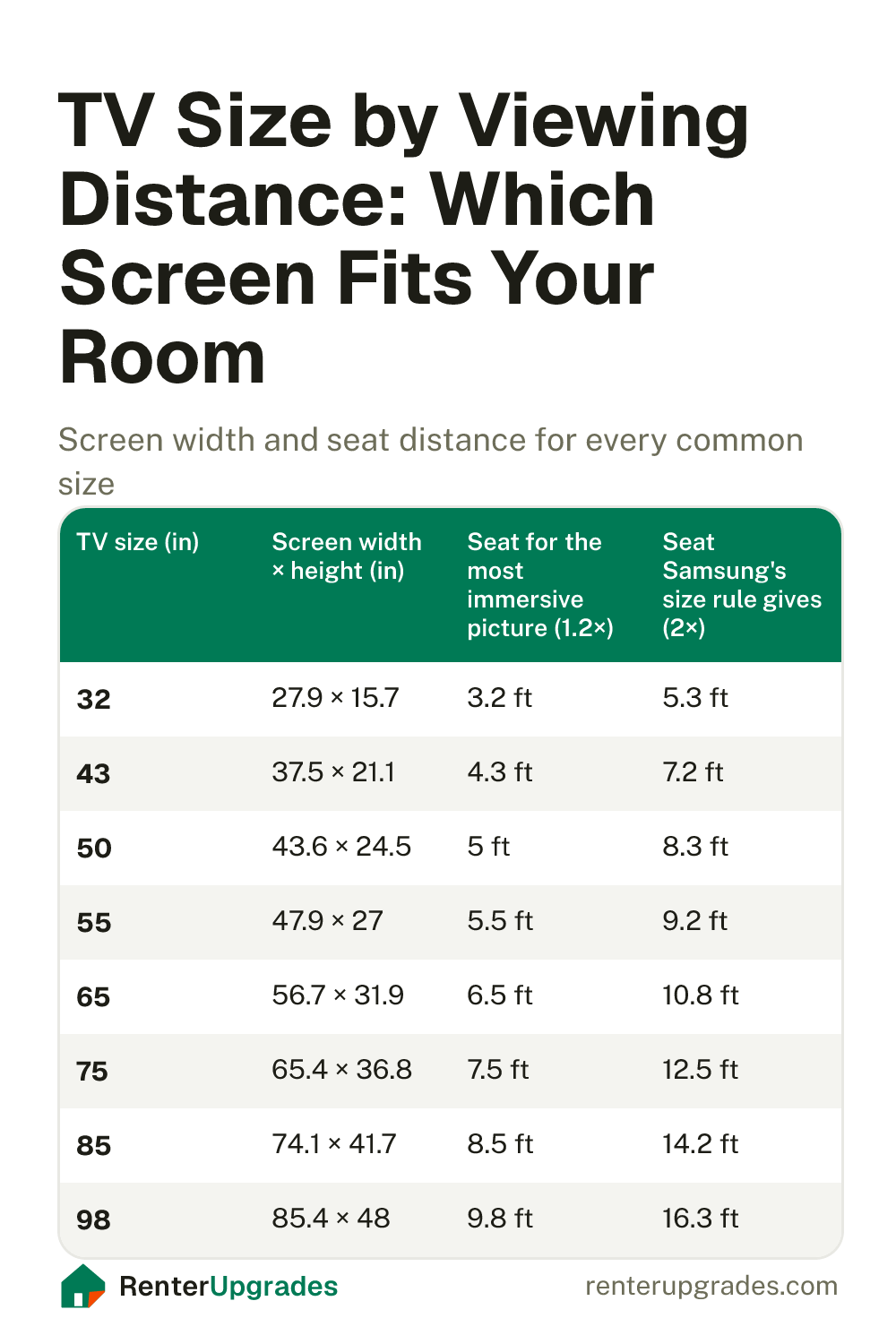
Save it for later
Pin this page so it's handy when you're ready to hang things.
Save to Pinterest (opens in a new tab)