
Lumens Calculator
Pick the room and enter its size to see how many lumens it needs, how many bulbs that takes in plug-in lamps, and how much light to aim at a desk, a counter or a book.
By Tess Mullins · Updated
Your room
Light for the whole room
1,200 to 2,400 lumens
DOE's guide for bedrooms and living areas is 10 to 20 lumens per square foot. For 120 sq ft, that's 1,200 to 2,400 lumens. Use 2 to 3 bulbs of 800 lumens (60 W equivalent), spread over as many lamps as suit the room.
| The room needs | 1,200 to 2,400 lumens |
|---|---|
| Bulbs of 800 lumens | 2 to 3 bulbs |
Task light
- Reading: 40 foot-candles (430 lux)
IES's levels (the VA's for reading) for light landing on the surface, from a lamp close to the task, on top of the room's total.
Color: DOE's guide gives 2,200 to 3,000 K for bedrooms and living areas, the warm white ENERGY STAR calls ideal for most indoor uses.
A guide, not a measurement: dark walls and furniture take more light, and every lamp spreads its light differently. How we calculate
- Deposit Risk: Low
- Landlord Permission: Not usually needed
- Take It With You: Yes
The short answer
The U.S. Department of Energy’s guide gives 10 to 20 lumens per square foot for bedrooms and living areas, and 75 to 80 for kitchens and bathrooms. Multiply by the room’s square feet: a 120 sq ft living room needs 1,200 to 2,400 lumens, or 2 to 3 bulbs of 800 lumens (the old 60-watt kind).
Tasks need more light where you work: the IES table gives 20 foot-candles (220 lux) on a desk and 50 foot-candles (540 lux) on a kitchen prep counter. A lamp close to the task gives that without lighting the whole room to the same level.
How to use the calculator
- Pick the room and enter its length and width.
- Pick the bulbs your lamps will take. The lumens are printed on the box and on the base of most LED bulbs.
- Add the lights already there. If the room has a ceiling fixture or other light that stays, add up its bulbs’ lumens. The calculator takes them off the total.
The result shows the room’s total in lumens, how many bulbs of your size that takes, the light levels for the room’s tasks and the color temperature to look for. Use Copy link to keep the numbers when you shop for lamps.
Lumens by room size
What a room needs in all, from the Department of Energy’s lumens per square foot:
| Room size (sq ft) | Bedrooms, living areas | Kitchens, bathrooms |
|---|---|---|
| 50 | 500 to 1,000 | 3,750 to 4,000 |
| 100 | 1,000 to 2,000 | 7,500 to 8,000 |
| 150 | 1,500 to 3,000 | 11,250 to 12,000 |
| 200 | 2,000 to 4,000 | 15,000 to 16,000 |
| 300 | 3,000 to 6,000 | 22,500 to 24,000 |
HUD’s inspection standard for assisted housing asks for a permanently installed light in the kitchen and the bathroom, but lets a bedroom or living room have outlets instead of a ceiling light. In many rentals, plug-in lamps provide most of a room’s light: spread the total over the lamps around the room.
Light for tasks
IES, the Illuminating Engineering Society, publishes recommended light levels. Its residential table gives the light that should land on each surface, in foot-candles (lumens per square foot of the surface) and lux:
| Room | Task | Foot-candles | Lux |
|---|---|---|---|
| Living room | Reading | 40 | 430 |
| Bedroom | Dressing | 5 | 50 |
| Bedroom | Reading in bed | 40 | 430 |
| Dining room | The dining table | 10 | 110 |
| Dining room | Homework at the table | 20 | 220 |
| Home office | The desk | 20 | 220 |
| Hallway or entry | The floor | 3 | 30 |
| Kitchen | The prep counter | 50 | 540 |
| Kitchen | The sink | 30 | 320 |
| Kitchen | The cooktop | 30 | 320 |
| Bathroom | The vanity mirror | 30 | 320 |
| Bathroom | The toilet | 10 | 110 |
| Bathroom | The shower or tub | 5 | 50 |
The reading levels come from the VA’s lighting design manual, which recommends table and floor lamps for rooms meant to feel like home. ENERGY STAR’s specification required certified desk lamps to give at least 200 lumens.
Watts to lumens
LED bulbs are sold by lumens. The FTC’s equivalents for the old incandescent bulbs:
| Old incandescent bulb | Lumens to look for |
|---|---|
| 40 W | 450 |
| 60 W | 800 |
| 75 W | 1,100 |
| 100 W | 1,600 |
| 150 W | 2,600 |
How we calculate
- Area. The room’s length times its width, in square feet.
- The room’s light. The area times the Department of Energy’s lumens per square foot: 10 to 20 for bedrooms and living areas, which we also use for dining rooms, home offices and hallways, and 75 to 80 for kitchens and bathrooms. The guide is from DOE’s weatherization program (2024).
- Lights already there. Their lumens come off the total, and the result says when the room already has enough.
- Bulbs. What’s left, divided by your bulb’s lumens and rounded up to whole bulbs.
- Tasks. IES’s residential light levels (The Lighting Handbook, 10th edition, as the Department of Energy reproduced it in 2012), and the VA’s level for reading. They’re light on the surface, so they don’t add to the room’s total: they tell you where to aim a lamp.
- Color. The Department of Energy’s color temperature ranges for the two kinds of room, with ENERGY STAR’s names for them.
The two sources measure different things. The lumens per square foot count the light bulbs give off, while IES’s foot-candles count the light that reaches a surface, after some is absorbed by walls, shades and furniture. That’s why a room’s lumens are much higher than its foot-candles would suggest. Dark walls and furniture take more light, as the Department of Energy and GSA note, so aim for the top of the range in a dark room.
Worked examples
Example: A 12 × 10 ft living room with only plug-in lamps
What we know
- Living room, 12 ft by 10 ft (120 sq ft)
- Bulbs: 800 lumens (60 W equivalent)
How it works out
- DOE's guide for bedrooms and living areas is 10 to 20 lumens per square foot. For 120 sq ft, that's 1,200 to 2,400 lumens.
- Use 2 to 3 bulbs of 800 lumens (60 W equivalent), spread over as many lamps as suit the room.
- For tasks, the VA's lighting manual gives 40 foot-candles (430 lux) for reading: light landing on the surface, from a lamp or light close to it, on top of the room's total.
- Color: DOE's guide gives 2,200 to 3,000 K for bedrooms and living areas, the warm white ENERGY STAR calls ideal for most indoor uses.
1,200 to 2,400 lumens in all: add 2 to 3 bulbs of 800 lumens.
Example: An 11 × 12 ft bedroom with a ceiling light
What we know
- Bedroom, 11 ft by 12 ft (132 sq ft)
- Bulbs: 800 lumens (60 W equivalent)
- Lights already there: 800 lumens
How it works out
- DOE's guide for bedrooms and living areas is 10 to 20 lumens per square foot. For 132 sq ft, that's 1,320 to 2,640 lumens.
- With the 800 lumens already there, add 520 to 1,840 lumens: 1 to 3 bulbs of 800 lumens (60 W equivalent).
- For tasks, IES gives 5 foot-candles (50 lux) for dressing, and the VA's lighting manual gives 40 foot-candles (430 lux) for reading in bed: light landing on the surface, from a lamp or light close to it, on top of the room's total.
- Color: DOE's guide gives 2,200 to 3,000 K for bedrooms and living areas, the warm white ENERGY STAR calls ideal for most indoor uses.
1,320 to 2,640 lumens in all: add 1 to 3 bulbs of 800 lumens.
Example: A 10 × 7 ft galley kitchen with a ceiling fixture
What we know
- Kitchen, 10 ft by 7 ft (70 sq ft)
- Bulbs: 1,600 lumens (100 W equivalent)
- Lights already there: 1,600 lumens
How it works out
- DOE's guide for kitchens and bathrooms is 75 to 80 lumens per square foot. For 70 sq ft, that's 5,250 to 5,600 lumens.
- With the 1,600 lumens already there, add 3,650 to 4,000 lumens: 3 bulbs of 1,600 lumens (100 W equivalent).
- For tasks, IES gives 50 foot-candles (540 lux) on the prep counter, 30 (320 lux) at the sink and 30 (320 lux) on the cooktop: light landing on the surface, from a lamp or light close to it, on top of the room's total.
- Color: DOE's guide gives 2,700 to 5,000 K for kitchens and bathrooms; ENERGY STAR calls neutral and cool white good for kitchens and work spaces.
5,250 to 5,600 lumens in all: add 3 bulbs of 1,600 lumens.
Lighting a rental without wiring
- Layer the light. The Department of Energy and GSA describe three layers: ambient light for the room, task light where you work, and accent light. Plug-in floor lamps cover the first, and desk, table and clip lamps the second. The floor lamp guide compares bright LED lamps, lamps you can aim and shade lamps for a corner.
- Use what’s there. Swap the bulbs in the ceiling fixture for brighter LEDs that fit it before you add lamps, and keep the old bulbs to put back when you move.
- Hang a plug-in pendant where a lamp can’t go. A swag pendant over the table or the reading chair plugs into the wall; the pendant light height calculator gives its hanging height and the cord to buy.
- Take it with you. Lamps and bulbs move to your next place, so they count as an upgrade you keep. The upgrade cost calculator shows what that means per month of your lease.
Stay within each lamp’s maximum bulb wattage. An LED gives the same light with far fewer watts: the FTC notes that an 800-lumen LED uses about 9 watts.
Frequently asked questions
How many lumens do I need for a room?
The U.S. Department of Energy's guide gives 10 to 20 lumens per square foot for bedrooms and living areas, and 75 to 80 for kitchens and bathrooms. A 120 sq ft living room needs 1,200 to 2,400 lumens; a 40 sq ft bathroom, 3,000 to 3,200. Count the lights already in the room toward the total.
How many lumens is a 60-watt bulb?
About 800 lumens, according to the FTC. A 40-watt bulb gives about 450, a 75-watt about 1,100, a 100-watt about 1,600 and a 150-watt about 2,600. LED bulbs list the lumens on the box, so shop by lumens, not watts.
How many lumens do I need for reading?
Reading needs much more light on the page than the room needs overall: the VA's lighting design manual gives 40 foot-candles (430 lux) for reading. Put a lamp close to the page rather than brightening the whole room.
How many lumens do I need for a desk?
IES's residential table gives 20 foot-candles (220 lux) on a home office desk. A desk lamp close to the work does it best: ENERGY STAR's specification required certified desk lamps to give at least 200 lumens.
What's the difference between lumens and foot-candles?
Lumens measure the light a bulb gives off. Foot-candles measure the light that lands on a surface: one foot-candle is one lumen on each square foot, or about 10.76 lux. Light spreads and is absorbed on the way, so a lamp needs more lumens than the foot-candles you want on the desk would suggest.
What color temperature should I use?
The Department of Energy's guide gives 2,200 K to 3,000 K for bedrooms and living areas, and 2,700 K to 5,000 K for kitchens and bathrooms. ENERGY STAR calls soft and warm white ideal for most indoor uses, and neutral and cool white good for kitchens and work spaces.
Next step
Renter Upgrade Cost CalculatorEnter what an upgrade costs, how long you'll stay and what you'll keep when you move to see its real cost per month, with the deposit risk spelled out.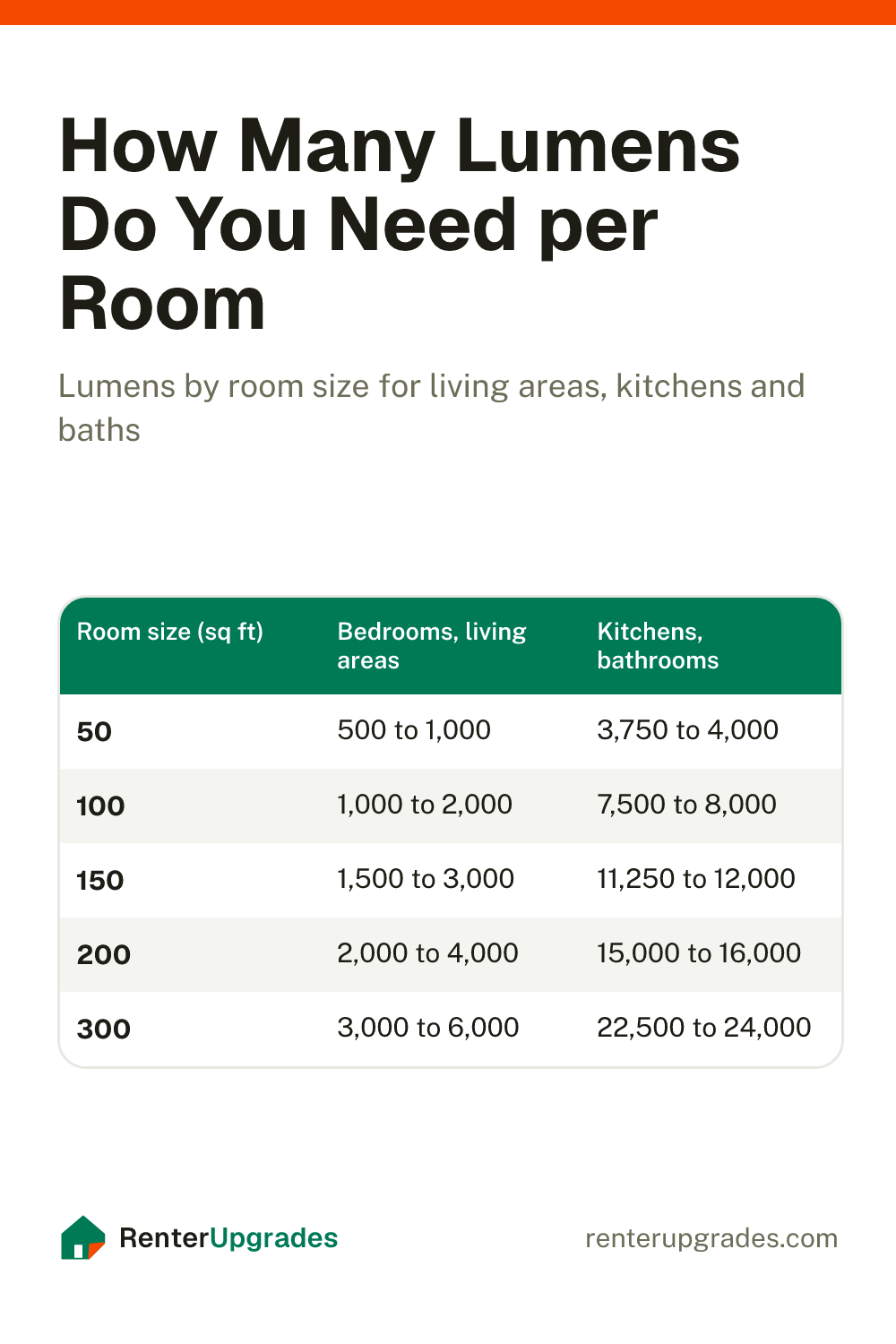
Save it for later
Pin this page so it's handy when you're ready to hang things.
Save to Pinterest (opens in a new tab)