
Air Purifier Size Calculator
Enter your room's size and ceiling height to see the minimum smoke CADR an air purifier needs, for everyday use or wildfire smoke, or check a purifier you already have in mind.
By Tess Mullins · Updated
Your room
Look for a smoke CADR of at least
112 cfm
Or a purifier whose AHAM label lists a room size of at least 174 sq ft.
- Your room: 168 sq ft with an 8 ft ceiling.
- During wildfire smoke, AHAM suggests more: at least 168 cfm.
- Use the smoke CADR: it covers the smallest particles. How we calculate
- Deposit Risk: Low
- Landlord Permission: Not usually needed
- Take It With You: Yes
The short answer
Go by the smoke CADR on the box. AHAM’s rule of thumb is a smoke CADR of at least two-thirds of your room’s area in square feet, so a 168 sq ft bedroom needs at least 112 cfm. For wildfire smoke, AHAM recommends more: a smoke CADR equal to the room’s area, which is 168 cfm for that same bedroom.
Both rules assume a ceiling height of 8 ft. The calculator scales the number up for taller rooms and turns it into the room size to look for on the label, so you can compare purifiers in the store or online.
How to use the calculator
- Measure the room wall to wall, length and width. If the room opens into another space with no door between them, measure the whole open area, since the purifier has to clean all of that air.
- Measure the ceiling height. Purifier labels assume 8 ft. A taller ceiling means more air to clean.
- Pick what it’s for: everyday air cleaning, or wildfire smoke.
- Read the result: the minimum smoke CADR, plus the room size to look for on an AHAM label.
Already have a purifier in mind? Switch to Check a purifier and enter its smoke CADR. You’ll see how many air changes per hour it gives in your room, whether it meets both rules, and the largest room it suits.
Switch to metric with the toggle at the top, and use Copy link to save your result or send it to a roommate.
Where to find the CADR
Purifiers certified through AHAM’s program carry the AHAM Verifide seal. It lists three clean air delivery rates (CADRs), in cubic feet per minute: one for tobacco smoke, one for pollen and one for dust. The seal also shows a suggested room size, which AHAM bases on the smoke CADR.
The calculator uses the smoke CADR. EPA’s guide says to look for a high smoke CADR if you want to remove small particles, because smoke stands for the smallest ones, and EPA’s technical summary calls it the most conservative of the three.
Air purifier size chart
The minimum smoke CADR for common room sizes, with a ceiling height of 8 ft:
| Room size | Everyday (smoke CADR) | Wildfire smoke (smoke CADR) |
|---|---|---|
| 100 sq ft | 67 cfm | 100 cfm |
| 150 sq ft | 100 cfm | 150 cfm |
| 200 sq ft | 134 cfm | 200 cfm |
| 250 sq ft | 167 cfm | 250 cfm |
| 300 sq ft | 200 cfm | 300 cfm |
| 400 sq ft | 267 cfm | 400 cfm |
| 500 sq ft | 334 cfm | 500 cfm |
EPA’s sizing table asks for 65 cfm for every 100 sq ft. That’s the same rule as the room size on AHAM’s label (smoke CADR × 1.55). We use AHAM’s two-thirds rule of thumb, which asks for slightly more, so a purifier that meets our number also meets EPA’s table.
How we calculate
- Everyday air cleaning: smoke CADR of at least the room’s area in square feet × two-thirds. This is AHAM’s rule of thumb. AHAM’s own example: a 120 sq ft room needs a smoke CADR of at least 80 cfm.
- Wildfire smoke: smoke CADR of at least the room’s area in square feet, AHAM’s recommendation for wildfire smoke.
- Taller ceilings: both rules assume a ceiling height of 8 ft, and AHAM notes that with a higher ceiling a purifier covers less floor than its label shows. We multiply by your ceiling height ÷ 8 ft. That step is ours, based on AHAM’s own formula, in which CADR = air changes per hour ÷ 60 × room volume. Ceilings lower than 8 ft don’t reduce the result.
- Rounding: the minimum rounds up to a whole cfm.
- Room size on the label: AHAM works it out as smoke CADR × 1.55, for a ceiling height of 8 ft. We show the label size that goes with your minimum CADR.
- Air changes per hour (Check a purifier): CADR × 60 ÷ the room’s volume in cubic feet. AHAM’s suggested room size is based on 4.8 air changes per hour, enough to remove at least 80% of smoke particles. The two-thirds rule works out to about 5 air changes per hour at a ceiling height of 8 ft, and the wildfire rule to 7.5, which AHAM’s white paper puts at about 86% removal.
- Largest room (Check a purifier): the smoke CADR × 1.5 for everyday use, or the CADR itself for wildfire smoke, then divided by the ceiling adjustment.
CADR is usually measured on the purifier’s highest speed, so treat the result as the minimum with the purifier running on high. These are guidelines from AHAM and EPA, not a guarantee of air quality.
Worked examples
Example: A bedroom, everyday air cleaning
What we know
- Room: 12 ft by 14 ft (168 sq ft)
- Ceiling: 8 ft
- For: everyday air cleaning
How it works out
- Two-thirds rule: 168 × 2/3 = 112 cfm.
- Rounded up: 112 cfm.
- Room size on the label: 112 × 1.55 = 173.6, so look for at least 174 sq ft.
A smoke CADR of at least 112 cfm, or a label room size of at least 174 sq ft.
Example: A living room with a high ceiling, wildfire smoke
What we know
- Room: 15 ft by 20 ft (300 sq ft)
- Ceiling: 9 ft
- For: wildfire smoke
How it works out
- Wildfire smoke: a smoke CADR equal to the area, 300 cfm.
- Ceiling: 9 ft ÷ 8 ft = 1.125, so 300 × 1.125 = 337.5 cfm, rounded up to 338 cfm.
- Room size on the label: 338 × 1.55 = 523.9, so look for at least 524 sq ft.
A smoke CADR of at least 338 cfm, or a label room size of at least 524 sq ft.
Example: Checking a purifier for a bedroom
What we know
- Room: 12 ft by 14 ft (168 sq ft)
- Ceiling: 8 ft
- Purifier: smoke CADR of 130 cfm
How it works out
- Room volume: 168 sq ft × 8 ft = 1,344 cu ft.
- Air changes per hour: 130 × 60 ÷ 1,344 = 5.8. AHAM's label room size is based on 4.8.
- Everyday air cleaning needs 112 cfm: enough.
- Wildfire smoke needs 168 cfm: not enough.
Big enough for everyday air cleaning.
What an air purifier costs
In its 2025 review for the ENERGY STAR specification, EPA priced several models in each size. The averages, from units at the federal minimum to ENERGY STAR certified ones:
| Size | Average price | A year of electricity (14.6¢/kWh) | Same at 18.19¢/kWh |
|---|---|---|---|
| Smoke CADR 30 to 99 | $117 | $14 to $32 | $17 to $40 |
| Smoke CADR 100 to 149 | $117 to $193 | $20 to $46 | $25 to $57 |
| Smoke CADR 150 to 199 | $343 to $398 | $43 to $82 | $54 to $102 |
The last column restates EPA’s electricity cost at the US average price for January to August 2026, from the U.S. Energy Information Administration. Replacement filters add to the yearly cost, so check their price before you buy. Prices are approximate and change with sales and models.
Choosing and using a purifier as a renter
A portable purifier is about as renter-friendly as an upgrade gets: it plugs into an outlet, needs no permission and moves with you. A few things to check before you buy and once it’s running:
- Skip anything that makes ozone on purpose. EPA says to avoid air cleaners that intentionally produce ozone, a lung irritant, and notes that no federal agency has approved ozone generators for use in occupied spaces.
- In California, look for CARB certification. Every portable indoor air cleaner sold in California must be certified by the California Air Resources Board, which limits ozone output to 0.05 ppm.
- Put it where you spend your time. EPA suggests the rooms you use most, kept away from curtains or anything else that blocks the airflow. CARB adds: away from doors, windows and foot traffic, but not pushed right against a wall or into a corner.
- Don’t go far bigger than you need. CARB notes that bigger units usually make more noise and use more energy than smaller ones. A purifier you switch off because it’s loud doesn’t clean anything.
- Check the noise rating. EPA notes that about 50 dB is roughly how loud a modern refrigerator runs, which gives you something to compare against.
- Keep up with the filter. Follow the maker’s schedule for replacing or cleaning filters, and check the cost of replacements before you buy.
During wildfire smoke, EPA suggests running the purifier continuously on its highest setting if you can, and its clean room guide explains how to set up one room in your home for it. Size for wildfire smoke in the calculator if that’s what you’re planning for.
If smoke or odors drift in from a neighbor or a shared hallway, a purifier helps with the symptom, not the source. Let your landlord or building manager know in writing, and keep a copy.
Frequently asked questions
What size air purifier do I need?
Go by the smoke CADR. AHAM's rule of thumb is a smoke CADR of at least two-thirds of the room's area in square feet, for a ceiling up to 8 ft. A 168 sq ft bedroom needs at least 112 cfm. Taller rooms need more, and the calculator adjusts for that.
What is CADR?
CADR stands for clean air delivery rate: how much clean air a purifier delivers, in cubic feet per minute (cfm). AHAM-certified purifiers list three, for smoke, pollen and dust. Use the smoke number, which stands for the smallest particles. It's usually measured on the highest speed.
What does the room size on an air purifier label mean?
On AHAM-certified models, the suggested room size is the smoke CADR × 1.55, for a ceiling height of 8 ft. It's based on 4.8 air changes per hour, enough to remove at least 80% of smoke particles. With a higher ceiling, the purifier covers less floor than the label says.
What size air purifier do I need for wildfire smoke?
AHAM recommends a smoke CADR equal to the room's area in square feet, so a 168 sq ft room needs at least 168 cfm. EPA suggests running it continuously on its highest setting if you can. Pick wildfire smoke in the calculator to size for it.
Is a bigger air purifier better?
Up to a point. A higher CADR cleans the air faster, but the California Air Resources Board notes that larger units usually make more noise and use more energy, and advises against an oversized one. Pick one that meets your room's number and is quiet enough to leave running.
How many air changes per hour do I need?
The room size on AHAM's label is based on 4.8 air changes per hour. The two-thirds rule works out to about 5 at a ceiling height of 8 ft, and the wildfire rule to 7.5. Switch the calculator to Check a purifier to see what a model gives in your room.
Are air purifiers that make ozone safe?
EPA says to avoid air cleaners that intentionally produce ozone, because ozone is a lung irritant, and notes that no federal agency has approved ozone generators for use in occupied spaces. In California, portable air cleaners must be certified by CARB, which limits their ozone output to 0.05 ppm.
Do I need my landlord's permission for an air purifier?
No. A portable air purifier plugs into an outlet and moves with you, so it's one of the easiest upgrades a renter can make. If smoke or odors come in from elsewhere in the building, tell your landlord or building manager as well.
Next step
Dehumidifier Size CalculatorEnter your room size and how damp it feels to see what dehumidifier capacity to buy, based on ENERGY STAR's sizing chart. You can also convert an older pint rating to today's labels.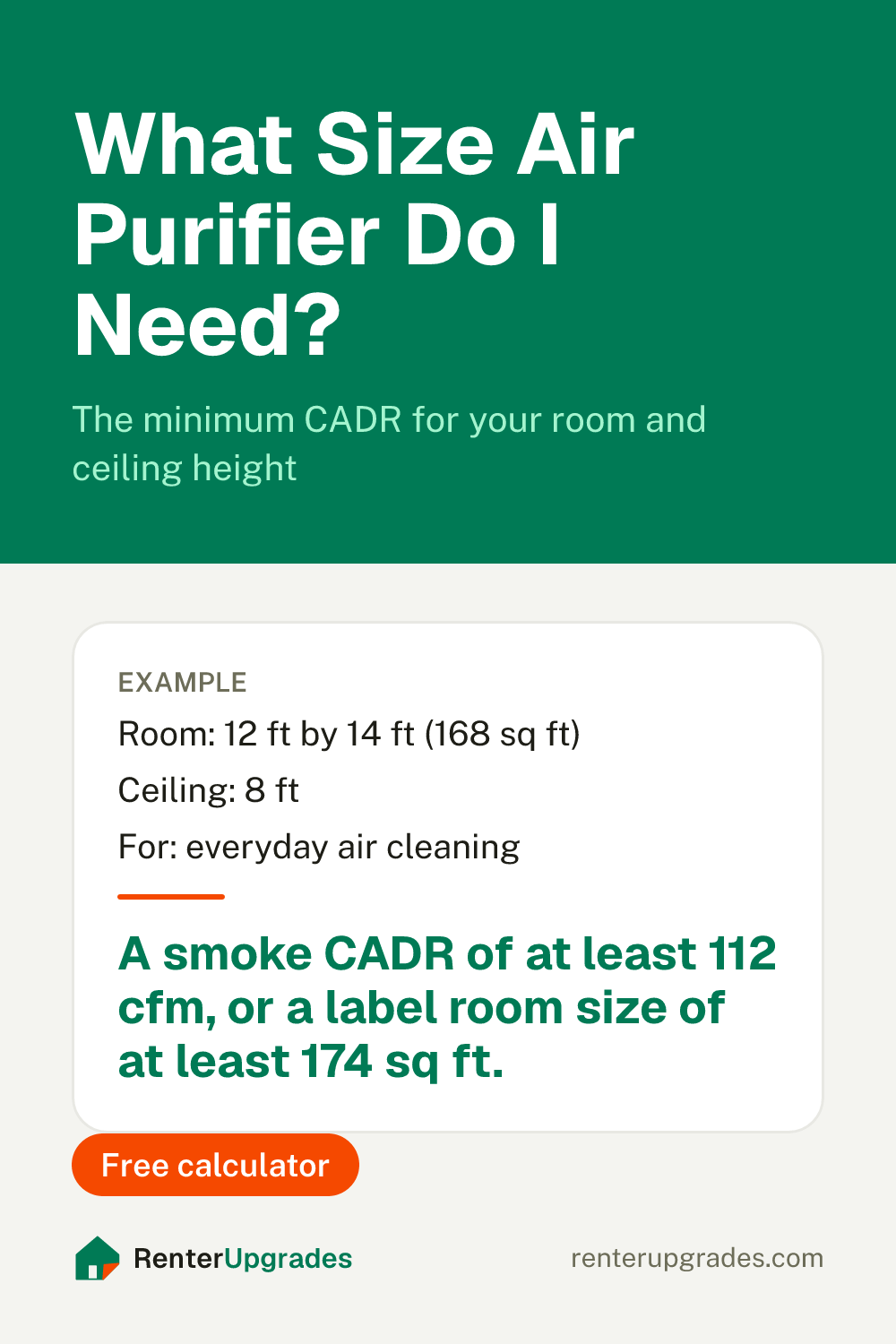
Save it for later
Pin this page so it's handy when you're ready to hang things.
Save to Pinterest (opens in a new tab)