
Dehumidifier Size Calculator
Enter your room size and how damp it feels to see what dehumidifier capacity to buy, based on ENERGY STAR's sizing chart. You can also convert an older pint rating to today's labels.
By Tess Mullins · Updated
Your space
Look for
20 to 30 pints a day
That's ENERGY STAR's range for a space up to 2,000 sq ft in this condition. Your space is about 300 sq ft.
- Not sure? Go toward the top of the range: ENERGY STAR says it's better to oversize than undersize.
- The chart uses current ratings (2020 and later). An older unit's label shows a bigger number for the same capacity; switch to "Convert an old rating" to compare.
- Aim for indoor humidity below 60%, ideally 30% to 50%, as EPA recommends.
- In a room colder than 65°F, frost can form on the coils, so check the unit's lowest operating temperature for a cold basement. How we calculate
- Deposit Risk: Low
- Landlord Permission: Not usually needed
- Take It With You: Yes
The short answer
Size a dehumidifier by how damp the space is. For a space under 2,000 sq ft, ENERGY STAR recommends 20 to 30 pints a day when it’s slightly to moderately damp, 25 to 40 pints when it’s very damp and 30 to 50 pints when it’s wet. From 2,000 sq ft up, it’s 30 pints or more, 40 pints or more and 50 pints or more.
Those numbers are for dehumidifiers rated in 2020 or later. Older labels show bigger numbers for the same capacity, because the test changed, so the calculator can also convert an old rating into today’s terms.
How to use the calculator
- Pick a mode. “Size a new one” finds the capacity for your space. “Convert an old rating” translates the number on an older unit, or in an older sizing guide, into a current rating.
- Measure the space. Measure the room, or the whole basement or open area you want to dry, wall to wall.
- Pick how damp it is. Go by how it feels and smells, or by a reading from a hygrometer (a small humidity meter).
- Read the result. You get a range in pints per day. If you’re not sure, go toward the top of it.
Switch to metric with the toggle at the top. Use Copy link to save your result or send it to a roommate.
Dehumidifier size chart
ENERGY STAR’s recommended capacity in pints per day, for current ratings:
| How damp it is | Under 2,000 sq ft | At least 2,000 sq ft |
|---|---|---|
| Slightly to moderately damp (50% to 75% humidity) | 20 to 30 pints | 30 pints or more |
| Very damp (75% to 90% humidity) | 25 to 40 pints | 40 pints or more |
| Wet (90% to 100% humidity) | 30 to 50 pints | 50 pints or more |
How ENERGY STAR describes each condition:
- Slightly to moderately damp: the space feels damp and has a musty smell that may come and go.
- Very damp: it always feels and smells damp, and damp spots show up on walls and floors.
- Wet: the walls or floor sweat, or water seeps in. Drying laundry indoors counts here too.
Old ratings vs. new ratings
Through 2019, dehumidifier labels came from a test at 80°F and 60% humidity. Under DOE’s current test procedure, portable dehumidifiers are tested at 65°F, with the same humidity. Colder air gives up less water, so DOE expected the same unit to measure lower. AHAM, the appliance makers’ association, estimated the drop at about 35% on average.
ENERGY STAR’s conversion table for portable dehumidifiers:
| Old label (through 2019) | Current label (2020 and later) |
|---|---|
| 30 pints | 20 pints |
| 40 pints | 25 pints |
| 50 pints | 30 pints |
| 55 pints | 30 to 35 pints |
| 60 pints | 35 pints |
| 70 pints | 40 to 45 pints |
| 90 pints | 55 pints |
ENERGY STAR notes that the actual change varies from model to model, so for one specific unit, the manufacturer’s listing is the better guide. If an older guide tells you to buy a 50 pints dehumidifier, look for about 30 pints on a current label.
How we calculate
- Area: room length × width.
- Size column: ENERGY STAR’s chart has two columns, small to medium spaces (under 2,000 sq ft) and large spaces (over 2,000 sq ft). It doesn’t place a space of exactly 2,000 sq ft, so we count that as large, because ENERGY STAR says it’s better to oversize than undersize.
- Capacity: we show ENERGY STAR’s range for your condition and column as it is. We don’t narrow it with a formula of our own, because the chart doesn’t say how. For large spaces, the chart gives a minimum only.
- Converting: we look up your old rating in ENERGY STAR’s table for portable units. The table lists set ratings, so we don’t estimate anything in between, and whole-home units aren’t covered.
The chart doesn’t ask about ceiling height or temperature, so the calculator doesn’t either. Treat the result as a starting point and check how the room feels after a few days.
Worked examples
Example: A damp bedroom
What we know
- Space: 14 ft by 12 ft
- Condition: Slightly to moderately damp (50% to 75% humidity)
How it works out
- Area: 14 ft × 12 ft = 168 sq ft.
- 168 sq ft is under 2,000 sq ft, so it's a small to medium space on the chart.
- ENERGY STAR's range for that space and condition: 20 to 30 pints a day.
Look for 20 to 30 pints a day on a current label, toward the top of the range if you're not sure.
Example: A very damp basement apartment
What we know
- Space: 30 ft by 25 ft
- Condition: Very damp (75% to 90% humidity)
How it works out
- Area: 30 ft × 25 ft = 750 sq ft.
- 750 sq ft is under 2,000 sq ft, so it's a small to medium space on the chart.
- ENERGY STAR's range for that space and condition: 25 to 40 pints a day.
Look for 25 to 40 pints a day on a current label, toward the top of the range if you're not sure.
Example: An older 70-pint dehumidifier
What we know
- Old label: 70 pints a day (rated in 2019 or earlier)
How it works out
- Find 70 pints a day in ENERGY STAR's conversion table for portable dehumidifiers.
- The same capacity under the current test: 40 to 45 pints a day.
About 40 to 45 pints a day on a current label.
Bucket or hose?
Most portable dehumidifiers collect water in a removable bucket and shut off automatically when it’s full, ENERGY STAR explains. Some have a hose fitting, so you can drain the water into a floor drain or sump instead of emptying the bucket.
If you use a hose, put the unit close to the drain so the hose stays short and out of walkways. ENERGY STAR’s own tip: don’t create a tripping hazard. Replacing an old dehumidifier? ENERGY STAR suggests judging the new size by how much water you empty each day.
An ENERGY STAR certified model removes the same moisture with about 20% less energy than a standard one, according to ENERGY STAR, which matters if it runs all summer.
In a room colder than 65°F, frost can form on a dehumidifier’s coils, ENERGY STAR notes. For a cold basement, check the lowest operating temperature on the listing before you buy.
What a dehumidifier costs
In its 2024 review for the ENERGY STAR specification, EPA priced several portable models. The averages, from units at the federal minimum to ENERGY STAR certified ones:
| Size | Average price | First-year electricity (14.6¢/kWh) | Same at 18.19¢/kWh |
|---|---|---|---|
| Up to 25 pints a day | $145 to $163 | $53 to $68 | $66 to $85 |
| Over 25 to 50 pints a day | $245 to $263 | $98 to $122 | $121 to $152 |
The last column restates EPA’s electricity cost at the US average price for January to August 2026, from the U.S. Energy Information Administration. Prices are approximate and change with sales and models, so treat them as a starting point.
Renters: leaks, mold and your landlord
A dehumidifier dries the air. It doesn’t fix where the water comes from. EPA advises renters to report plumbing leaks and moisture problems to the building owner, manager or superintendent right away. If a persistent water problem isn’t fixed, EPA says you may want to contact local, state or federal health or housing authorities.
Damp spots, sweating walls and seepage are worth reporting before you buy anything. Keep a dated photo of the problem and a copy of your message.
The dehumidifier itself is about as low risk as an upgrade gets: it plugs in, it doesn’t touch the walls and it comes with you when you move.
Put a hygrometer in the room to see whether it’s working. EPA’s ideal indoor range is 30% to 50%. If the reading stays high with the dehumidifier running, look for a leak or a bigger unit.
Frequently asked questions
What size dehumidifier do I need?
On ENERGY STAR's chart, how damp the space is matters most. For a space under 2,000 sq ft, it recommends 20 to 30 pints a day when it's slightly to moderately damp, 25 to 40 pints when it's very damp and 30 to 50 pints when it's wet. If you're not sure, go toward the top of the range.
What size dehumidifier do I need for a basement?
Measure the whole basement. Under 2,000 sq ft, ENERGY STAR recommends 20 to 30 pints, 25 to 40 pints or 30 to 50 pints a day, depending on how damp it is. From 2,000 sq ft up, it's 30 pints or more, 40 pints or more or 50 pints or more. If the walls or floor sweat or water seeps in, use the wet range.
Why do new dehumidifiers have lower pint ratings?
The test changed. Labels through 2019 came from a test at 80°F. The current test runs portable units at 65°F, both at 60% humidity. Colder air gives up less water, so the same capacity gets a lower number. By ENERGY STAR's table, an old 70 pints rating is about 40 to 45 pints today.
Is it better to get a bigger dehumidifier?
ENERGY STAR says it's better to oversize than undersize. If you're between sizes or not sure how damp the space really is, pick the higher end of the range.
What humidity should my apartment be?
EPA recommends keeping indoor humidity below 60%, ideally between 30% to 50%. ENERGY STAR adds that in colder climates, during the heating season, 30% to 40% helps prevent condensation on windows.
Will a dehumidifier work in a cold basement?
Check the lowest operating temperature on the listing before you buy. ENERGY STAR notes that frost can form on the coils when the air is colder than 65°F.
Do I need my landlord's permission to use a dehumidifier?
Usually not. A portable dehumidifier plugs into a regular outlet and moves with you. If the dampness comes from a leak, though, report it to your landlord or building manager: the dehumidifier dries the air but doesn't fix the source.
Next step
Air Purifier Size CalculatorEnter your room's size and ceiling height to see the minimum smoke CADR an air purifier needs, for everyday use or wildfire smoke, or check a purifier you already have in mind.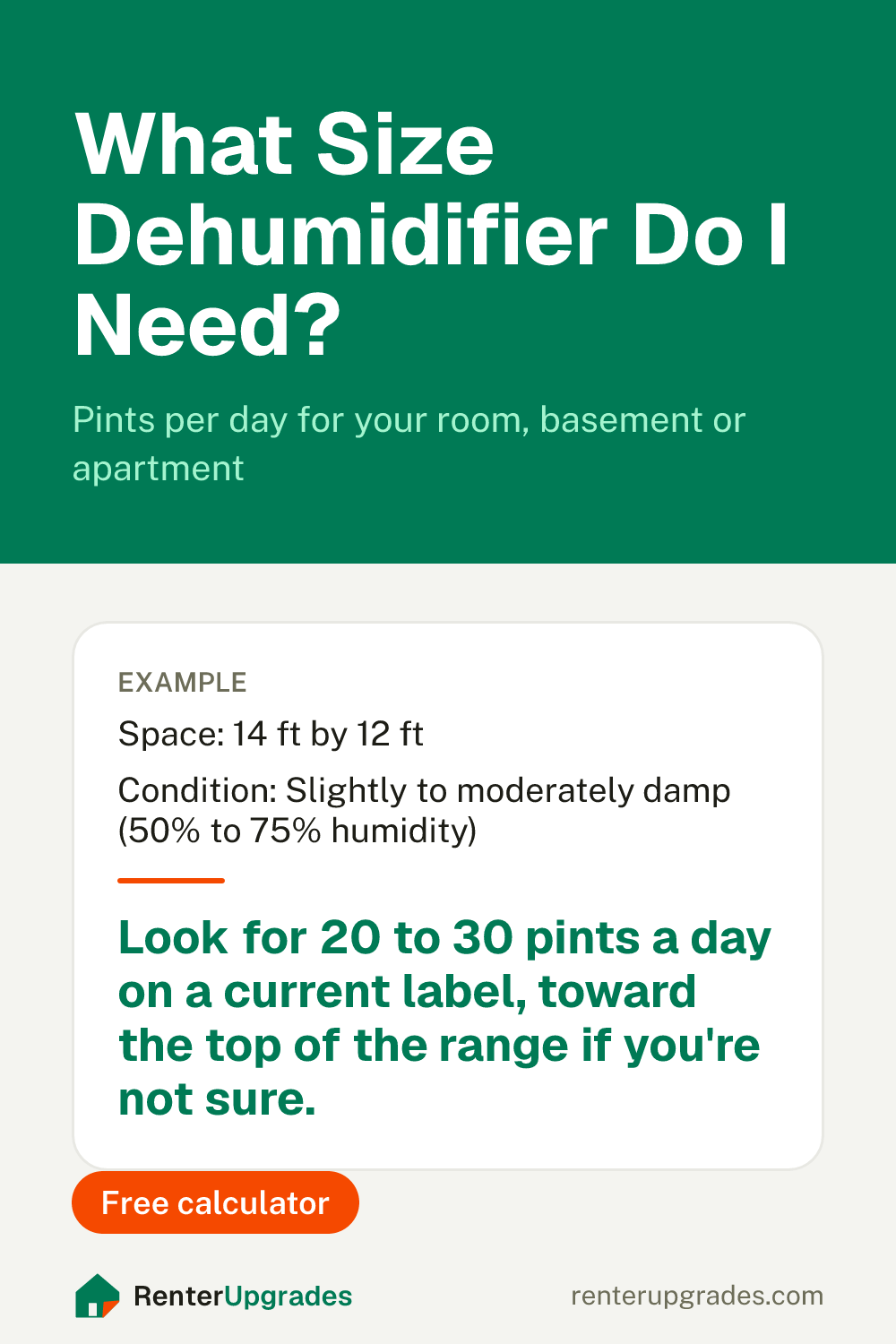
Save it for later
Pin this page so it's handy when you're ready to hang things.
Save to Pinterest (opens in a new tab)