
Portable AC BTU Calculator
Enter your room size, sun and household to see the SACC rating a portable air conditioner needs, the number on the box that tells you how much it really cools.
By Tess Mullins · Updated
Your room
Look for
At least 6,000 BTU SACC
Compare this with the SACC rating on the box (also called the DOE rating), not the bigger ASHRAE number.
- 180 sq ft is in the 150 to 250 sq ft row: 6,000 BTU.
Single-hose units pull outside air into the room to replace the air they blow out, which cuts how much they cool. The SACC rating already counts that loss.
Sizes follow the ENERGY STAR room AC chart. How we calculate
- Deposit Risk: Low
- Landlord Permission: Check your lease
- Take It With You: Yes
The short answer
Size a portable air conditioner by its SACC rating, not the bigger ASHRAE number that’s often printed next to it. Work out the cooling your room needs from ENERGY STAR’s room chart, then look for a portable unit whose SACC rating is at least that much. A studio apartment that needs 8,000 BTU needs a portable AC rated at least 8,000 BTU SACC.
The calculator works out the room’s needs, with ENERGY STAR’s adjustments for sun, people and kitchens, and tells you the SACC rating to look for.
How to use the calculator
- Measure the room wall to wall at floor level, and measure the ceiling height. The chart assumes 8 ft.
- Pick the sun the room gets and count the people who regularly use it at the same time.
- Tick the kitchen box if the unit will cool a kitchen. Cooking adds 4,000 BTU to what the room needs.
- Pick the hose type if you know it. It changes the advice, not the number, because the SACC rating already accounts for it.
- Compare the result with the SACC rating on the box or spec sheet. It may also be called the DOE rating.
SACC ratings by room size
The SACC rating to look for in a room with average sun and up to 2 people, from ENERGY STAR’s room chart:
| Room size | Look for at least |
|---|---|
| 100 to 150 sq ft | 5,000 BTU SACC |
| 150 to 250 sq ft | 6,000 BTU SACC |
| 250 to 300 sq ft | 7,000 BTU SACC |
| 300 to 350 sq ft | 8,000 BTU SACC |
| 350 to 400 sq ft | 9,000 BTU SACC |
| 400 to 450 sq ft | 10,000 BTU SACC |
| 450 to 550 sq ft | 12,000 BTU SACC |
| 550 to 700 sq ft | 14,000 BTU SACC |
Add 10% for a very sunny room, 600 BTU for each extra person and 4,000 BTU for a kitchen, or let the calculator do it.
SACC vs ASHRAE: which number to trust
Portable air conditioners often list two cooling ratings, and they can be far apart.
- ASHRAE is the older rating. It measures the cooling the unit produces at its vents.
- SACC (seasonally adjusted cooling capacity) is the rating the US Department of Energy requires. Its test subtracts the heat that leaks back into the room from the hot exhaust hose and from the warm outside air the unit pulls in to replace the air it blows out. It also blends results at two outdoor temperatures.
The Department of Energy found that the real cooling of portable units is “generally significantly lower” than the older test suggested, mostly because of that outside air. It also says there’s no fixed way to convert one rating into the other, because airflow and heat losses vary between models. As an example of the gap, LG notes that the DOE rating can be up to 42% lower than the ASHRAE rating for the same product.
So when two portable units both say “8,000 BTU” in big type, check which rating that is. Only the SACC number fits the chart.
On May 16, 2025, the Department of Energy proposed dropping portable air conditioners from its efficiency program. As of Oct 18, 2026, that proposal hasn’t become a final rule, and SACC is still the rating federal rules require on portable units. We recheck it whenever we update this page.
How we calculate
- Room needs. We use ENERGY STAR’s room air conditioner chart and adjustments, the same way as our window AC BTU calculator: the chart capacity for your floor area, 10% less for heavy shade or 10% more for strong sun, 600 BTU for each person beyond 2 and 4,000 BTU for a kitchen.
- Tall ceilings. Above 8 ft, we scale the floor area by your ceiling height divided by 8 ft. That’s our own step; ENERGY STAR only says you may want a bigger unit.
- Matching the rating. ENERGY STAR’s chart is written for room air conditioners, and ENERGY STAR doesn’t publish one for portable units. We match it against the SACC rating because SACC is the Department of Energy’s measure of the cooling a portable unit actually delivers to the room. That pairing is our choice, and we say so here.
We don’t round up to store sizes for portable units, because we couldn’t find a reliable list of the SACC ratings on sale. Pick a unit at or above the number the calculator gives.
Worked examples
Example: A studio apartment
What we know
- Room: 20 ft by 15 ft (300 sq ft), 8 ft ceiling
- Sun: Average
- People: 2
How it works out
- Chart: 300 sq ft is in the 300 to 350 sq ft row, which calls for 8,000 BTU.
- Compare that with the SACC rating on the box, not the bigger ASHRAE number.
A portable AC with a SACC rating of at least 8,000 BTU.
Example: A sunny bedroom
What we know
- Room: 14 ft by 12 ft (168 sq ft), 8 ft ceiling
- Sun: Very sunny
- People: 2
How it works out
- Chart: 168 sq ft is in the 150 to 250 sq ft row, which calls for 6,000 BTU.
- Very sunny: + 10% of 6,000 BTU = 600 BTU.
- Needed: 6,600 BTU.
- Compare that with the SACC rating on the box, not the bigger ASHRAE number.
A portable AC with a SACC rating of at least 6,600 BTU.
Example: A room with a high ceiling
What we know
- Room: 15 ft by 12 ft (180 sq ft), 10 ft ceiling
- Sun: Average
- People: 2
How it works out
- Ceiling: the chart assumes an 8 ft ceiling, so we count 180 sq ft × 10 ft ÷ 8 ft = 225 sq ft.
- Chart: 225 sq ft is in the 150 to 250 sq ft row, which calls for 6,000 BTU.
- Compare that with the SACC rating on the box, not the bigger ASHRAE number.
A portable AC with a SACC rating of at least 6,000 BTU.
What it costs to run
Portable air conditioners made since Oct 1, 2022 carry a yellow EnergyGuide label with an estimated yearly energy cost. Use it to compare models of the same size. The FTC’s label assumes 13¢ per kWh and 8 hours a day for 3 months, so at the US average of 18.19¢ per kWh (January to August 2026, from the U.S. Energy Information Administration), expect about 40% more than the label says, and more again if your utility charges above the average.
Single hose or dual hose?
A single-hose unit blows hot air out through its hose, and the room replaces that air with warm air from outside, through gaps around doors and windows. The Department of Energy notes that single-hose units “typically generate higher rates of infiltration air” than comparable dual-hose units, and that this affects how much they cool. A dual-hose unit draws outside air through a second hose to cool its parts, though the Department of Energy notes it typically still takes a portion of that air from the room.
The SACC test measures that effect, so you don’t need to adjust for it yourself. Compare SACC numbers, whichever type you’re looking at.
Renter tips for portable units
- Venting. The exhaust hose has to vent outside, usually through a window kit that fills the gap around the hose.
- Fire escapes. Don’t vent through a window you’d need as a fire escape. New York City’s Department of Buildings gives the same rule for air conditioners in general.
- Your lease. Nothing is fixed to the building, but some standard leases, such as the Real Estate Board of New York’s form, require the owner’s written consent for any air conditioning unit, so check yours. Oregon and Washington limit when a landlord can stop a tenant from using a portable cooling device.
No window you can use? A portable unit still needs to vent outside, so it won’t work in a windowless room. Ask your landlord what cooling options the building allows.
Check the spec sheet for the SACC number before you compare prices. Two units with the same big number on the front can cool very differently.
Frequently asked questions
How many BTUs do I need for a portable air conditioner?
Use the same chart as for window units, then compare it with the portable's SACC rating. A studio apartment that needs 8,000 BTU needs a portable AC rated at least 8,000 BTU SACC. A sunny bedroom might need 6,600 BTU. The calculator adds the adjustments for sun, people and kitchens.
What's the difference between SACC and ASHRAE BTU ratings?
The ASHRAE number measures the cooling the unit produces. SACC (seasonally adjusted cooling capacity) is the US Department of Energy's rating, and it subtracts the heat that leaks back into the room from the hot exhaust hose and the warm outside air the unit pulls in. That's why the SACC number is lower and closer to what you'll feel.
Why does my portable AC have two BTU ratings?
Federal rules require the SACC rating, but some boxes and listings still show the older ASHRAE rating too, and it's the bigger number. LG, for example, notes that the DOE rating can be up to 42% lower than the ASHRAE rating for the same product. Size by the SACC number.
Can I convert an ASHRAE rating to SACC?
Not reliably. The Department of Energy says airflow and heat losses vary too much between portable units for a fixed conversion. If a listing only shows an ASHRAE number, look for the SACC or DOE rating on the box or the spec sheet.
Is a single-hose or dual-hose portable AC better?
Dual-hose units usually pull less warm outside air into the room, which the Department of Energy says affects how much a single-hose unit cools. Either way, the SACC rating already includes that effect, so compare SACC numbers rather than the number of hoses.
Do I need my landlord's permission for a portable AC?
Check your lease. Nothing is fixed to the building, but some standard leases, such as the Real Estate Board of New York's form, require the owner's written consent for any air conditioning unit. Oregon and Washington limit when a landlord can stop you from using one. Never vent it through a window you'd need as a fire escape.
Next step
Dehumidifier Size CalculatorEnter your room size and how damp it feels to see what dehumidifier capacity to buy, based on ENERGY STAR's sizing chart. You can also convert an older pint rating to today's labels.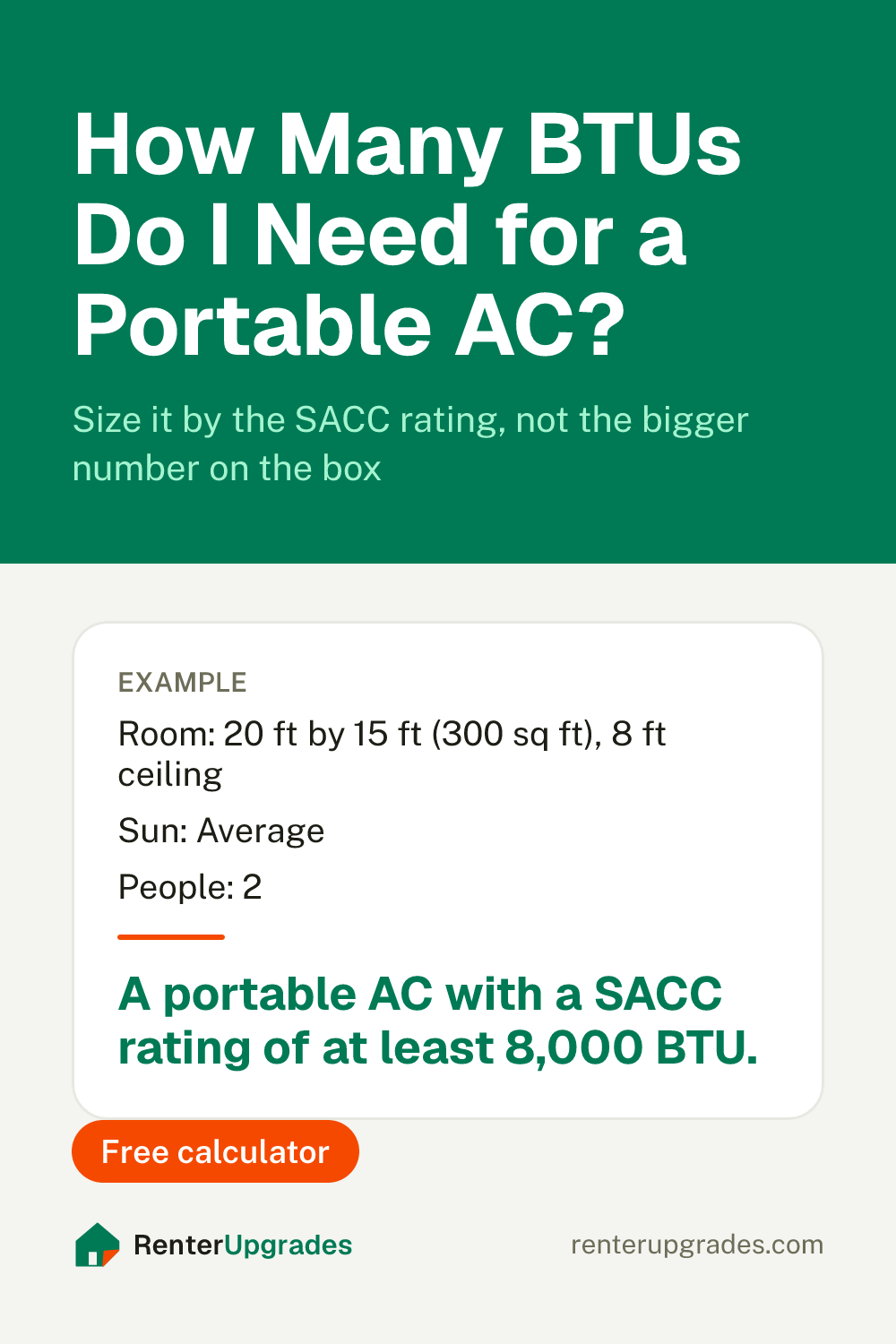
Save it for later
Pin this page so it's handy when you're ready to hang things.
Save to Pinterest (opens in a new tab)