
Window AC BTU Calculator
Enter your room size, how sunny it is and how many people use it to see how many BTUs your window air conditioner needs and which common size to buy.
By Tess Mullins · Updated
Your room
You need
A 6,000 BTU window AC
Your room needs about 6,000 BTU of cooling. 6,000 BTU is a certified window AC size.
- 180 sq ft is in the 150 to 250 sq ft row: 6,000 BTU.
To run: a certified 6,000 BTU unit uses about 329 kWh over a cooling season (the 750 hours in DOE's test), about $60 at 18.19¢ per kWh.
Plug it straight into a wall outlet, not an extension cord, and check the window opening against the unit's size.
Sizes follow the ENERGY STAR chart. How we calculate
- Deposit Risk: Medium
- Landlord Permission: Get written permission
- Take It With You: Yes
The short answer
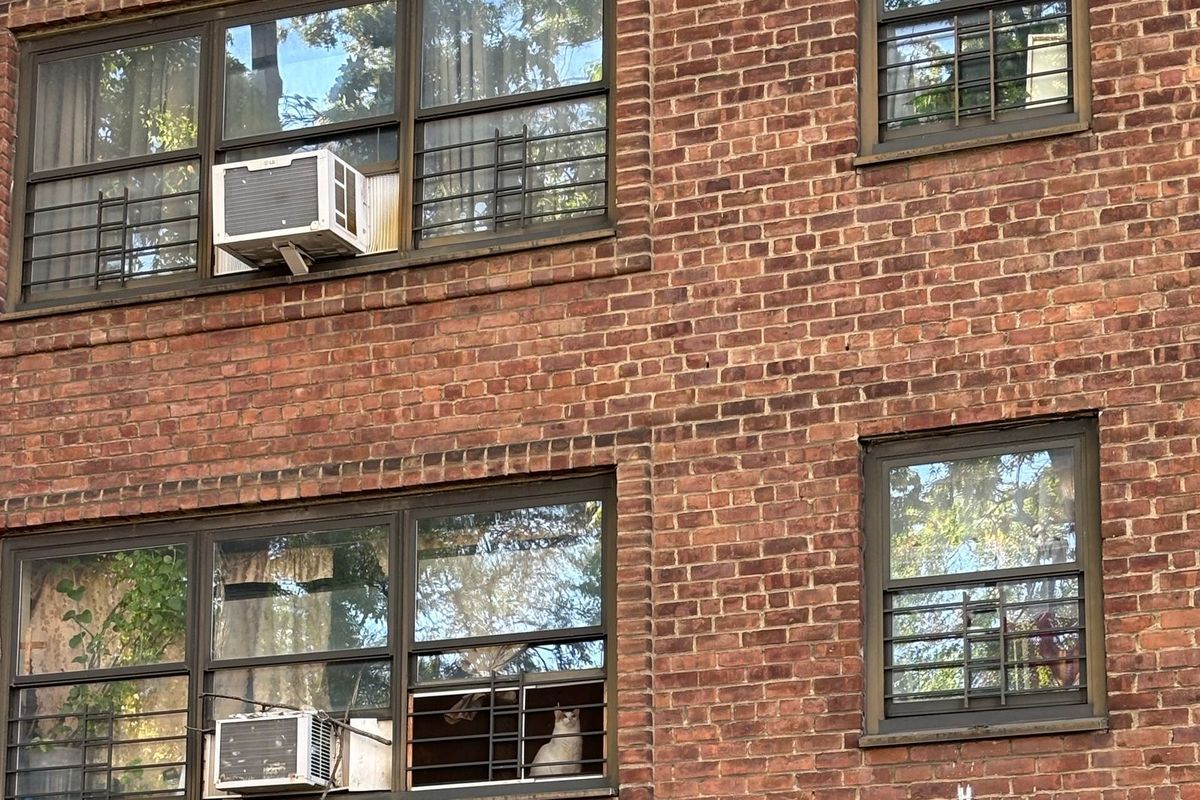
Size a window air conditioner by the floor area it has to cool. ENERGY STAR’s chart starts at 5,000 BTU for 100 to 150 sq ft and climbs from there: 10,000 BTU covers 400 to 450 sq ft. Then adjust for the room: take off 10% if it’s heavily shaded, add 10% if it’s very sunny, add 600 BTU for each person beyond 2 and add 4,000 BTU for a kitchen.
The calculator does that math and picks the closest size you can actually buy, so you don’t end up comparing a 9,400 BTU answer with store shelves that jump from one size to the next.
How to measure your room
- Length and width. Measure wall to wall at floor level. If the room is open to another space you also want to cool, include that area too.
- Ceiling height. Measure from the floor to the ceiling. The chart assumes 8 ft.
- Sun. Pick “Sunny” if the room gets strong direct sun for much of the day, and “Shaded” if trees or buildings keep it shaded.
- People. Count the people who regularly use the room at the same time, like a couple in a bedroom or roommates in a living room.
Switch to meters with the toggle at the top if that’s what your tape measure shows. Use Copy link to save the result for shopping.
Window AC sizes by room size
ENERGY STAR’s sizing chart for rooms up to 1,000 sq ft, with the common window unit size at or above each capacity:
| Room size | Capacity needed | Closest certified size |
|---|---|---|
| 100 to 150 sq ft | 5,000 BTU | 5,000 BTU |
| 150 to 250 sq ft | 6,000 BTU | 6,000 BTU |
| 250 to 300 sq ft | 7,000 BTU | 7,800 BTU |
| 300 to 350 sq ft | 8,000 BTU | 8,000 BTU |
| 350 to 400 sq ft | 9,000 BTU | 8,000 BTU |
| 400 to 450 sq ft | 10,000 BTU | 10,000 BTU |
| 450 to 550 sq ft | 12,000 BTU | 12,000 BTU |
| 550 to 700 sq ft | 14,000 BTU | 14,000 BTU |
| 700 to 1,000 sq ft | 18,000 BTU | 18,000 BTU |
ENERGY STAR’s chart goes up to 2,500 sq ft, but the biggest common window unit is 24,000 BTU. A space that needs more than that is past what one window unit can cool.
How we calculate
- Chart capacity. We find the row of the ENERGY STAR chart that your floor area falls in. ENERGY STAR writes each row as running “up to” the next one (“150 up to 250”), so a room right at a boundary belongs to the higher row; only the chart’s top area, 2,500 sq ft, stays in the last row. A room smaller than 100 sq ft uses the chart’s smallest size.
- Tall ceilings. The chart assumes 8 ft ceilings. For a higher ceiling, we multiply the floor area by your ceiling height divided by 8 ft before using the chart. ENERGY STAR only says you may want a bigger unit, so this step is our own.
- Adjustments. We apply ENERGY STAR’s adjustments: 10% less for a heavily shaded room or 10% more for a very sunny one (a percentage of the chart capacity), plus 600 BTU for each person beyond 2 and 4,000 BTU for a kitchen.
- Size to buy. We pick the closest of the capacities most often listed among ENERGY STAR certified window units, the “certified sizes”: 5,000, 6,000, 7,800, 8,000, 10,000, 12,000, 14,000, 15,000, 18,000, 24,000 BTU. Stores round some of them on the shelf label, so check the capacity on the spec sheet. When two sizes are equally close, we pick the smaller one, because GE’s buying guide says a slightly undersized unit is better than an oversized one. When the closest size is under what the room needs, the calculator also shows the next size up. In the certified list, every unit over 15,000 BTU runs on 230 V, so the calculator flags those sizes.
Worked examples
Example: A small bedroom
What we know
- Room: 12 ft by 12 ft (144 sq ft), 8 ft ceiling
- Sun: Average
- People: 2
How it works out
- Chart: 144 sq ft is in the 100 to 150 sq ft row, which calls for 5,000 BTU.
- 5,000 BTU is a certified window AC size.
A 5,000 BTU window air conditioner.
Example: A sunny living room for three
What we know
- Room: 20 ft by 15 ft (300 sq ft), 8 ft ceiling
- Sun: Very sunny
- People: 3
How it works out
- Chart: 300 sq ft is in the 300 to 350 sq ft row, which calls for 8,000 BTU.
- Very sunny: + 10% of 8,000 BTU = 800 BTU.
- People: 1 person beyond 2 × 600 BTU = + 600 BTU.
- Needed: 9,400 BTU.
- The closest certified window AC size is 10,000 BTU.
A 10,000 BTU window air conditioner.
Example: A small kitchen
What we know
- Room: 12 ft by 10 ft (120 sq ft), 8 ft ceiling
- Sun: Average
- People: 2
- Used in a kitchen
How it works out
- Chart: 120 sq ft is in the 100 to 150 sq ft row, which calls for 5,000 BTU.
- Kitchen: + 4,000 BTU.
- Needed: 9,000 BTU.
- 8,000 BTU and 10,000 BTU are equally close, and GE's sizing guide says to pick the slightly smaller unit, so 8,000 BTU. If the room runs warm, go up to 10,000 BTU.
An 8,000 BTU window air conditioner.
What it costs to run
Running cost depends on the unit’s size, its efficiency and how many hours it runs. ENERGY STAR’s data gives a typical figure: certified 8,000 BTU window units use a median of about 400 kWh over the 750 hours of cooling in DOE’s test. At the US average of 18.19¢ per kWh (January to August 2026, from the U.S. Energy Information Administration), that’s about $73 a season. The calculator shows the same estimate for the size it picks.
The yellow EnergyGuide label on the box shows a yearly cost too. The FTC’s label assumes 13¢ per kWh and 8 hours a day for 3 months. At today’s average price, the cost is about 40% higher than the label says, and more if your utility charges above the average.
Before you buy: window, outlet and lease
Your window. Measure the window opening’s width and height and compare them with the minimum and maximum window size on the box. Standard window units are made for windows that slide up and down. Windows that slide sideways or crank open (casements) need a unit made for them; federal efficiency rules even treat casement units as a separate class.
Your outlet. Plug the unit straight into a wall outlet. LG’s room AC manual, for example, says to use a dedicated circuit and not to use an extension cord. Units over 15,000 BTU run on 230 V, which needs a different outlet than a regular one, so check before you buy a big unit.
Your lease. A window unit changes how the window works and hangs outside the building, so ask before you install one. Standard leases such as the Real Estate Board of New York’s form require the owner’s written consent for air conditioning units, and New York City’s Department of Buildings tells residents to get permission from building management. Ask in writing and keep the reply.
State rules. Oregon and Washington limit when a landlord can stop a tenant from using a portable cooling device, window units included. Landlords there can still set conditions, such as safe brackets and a clear way out of the window, and Washington requires at least 2 days notice before you install a window unit. Check your state’s rules and your lease.
The install. The Department of Buildings also says to support the unit from underneath or fasten it from inside with angles, brackets or mounting rails, and never to prop it up with loose objects like wood blocks, bricks or books. Don’t install a unit in a window you’d need as a fire escape.
In New York City, apartments where a child aged 10 or younger lives must have window guards. HPD says tenants can’t remove a window guard to install an air conditioner, and the city’s rules let a permanent unit stand in for a guard only after the building owner inspects and approves it. Talk to your building management first.
Can’t use a window unit?
If your lease doesn’t allow window units or your windows don’t fit one, a portable air conditioner sits on the floor and vents through a window kit. Portable units are rated differently, so use the portable AC BTU calculator to size one.
Buy the size the calculator gives, not the next one up “just in case.” ENERGY STAR warns that an oversized unit costs more, wastes energy and cools the room before it removes the humidity, so the room ends up feeling damp and clammy.
Frequently asked questions
How many BTU window AC do I need?
Start with your room's floor area. ENERGY STAR's chart calls for 5,000 BTU for 100 to 150 sq ft, 6,000 BTU for 150 to 250 sq ft and 8,000 BTU for 300 to 350 sq ft. Then adjust: 10% less for a heavily shaded room, 10% more for a very sunny one, 600 BTU for each person beyond 2 and 4,000 BTU more in a kitchen.
How many square feet will a 10,000 BTU window air conditioner cool?
ENERGY STAR pairs 10,000 BTU with rooms of 400 to 450 sq ft. That assumes 8 ft ceilings, average sun and no more than 2 people. A very sunny room, extra people or a kitchen all lower the area it can handle.
What size window AC do I need for a kitchen?
Add 4,000 BTU to the chart size for the room, because cooking adds heat. A small kitchen that would need 5,000 BTU as a regular room needs about 9,000 BTU, so the closest common size is 8,000 BTU, or 10,000 BTU if the kitchen still runs warm.
Do I need a bigger AC for high ceilings?
ENERGY STAR's chart assumes 8 ft ceilings and says you may want a bigger unit if yours are higher, without giving a number. The calculator scales your floor area by your ceiling height divided by 8 ft. That step is our own, not an ENERGY STAR rule.
Can I plug a window AC into an extension cord?
Check your unit's manual, but expect a no. LG's room AC manual, for example, says not to use an extension cord and to use a dedicated circuit. Window units over 15,000 BTU run on 230 V and need a matching outlet.
Do I need my landlord's permission to install a window AC?
Ask first, in writing. Standard leases such as the Real Estate Board of New York's form require the owner's written consent before you install an air conditioning unit, and New York City's Department of Buildings tells residents to get permission from building management. Oregon and Washington limit when a landlord can say no, but even there the landlord can set safety conditions, and Washington requires at least 2 days notice before you install a window unit.
How do I keep a window AC from falling out?
Support it from underneath or fasten it from inside with angles, brackets or mounting rails, as New York City's Department of Buildings advises. Never prop it up with loose objects like wood blocks, bricks or books, and never put one in a window you need as a fire escape.
Next step
Dehumidifier Size CalculatorEnter your room size and how damp it feels to see what dehumidifier capacity to buy, based on ENERGY STAR's sizing chart. You can also convert an older pint rating to today's labels.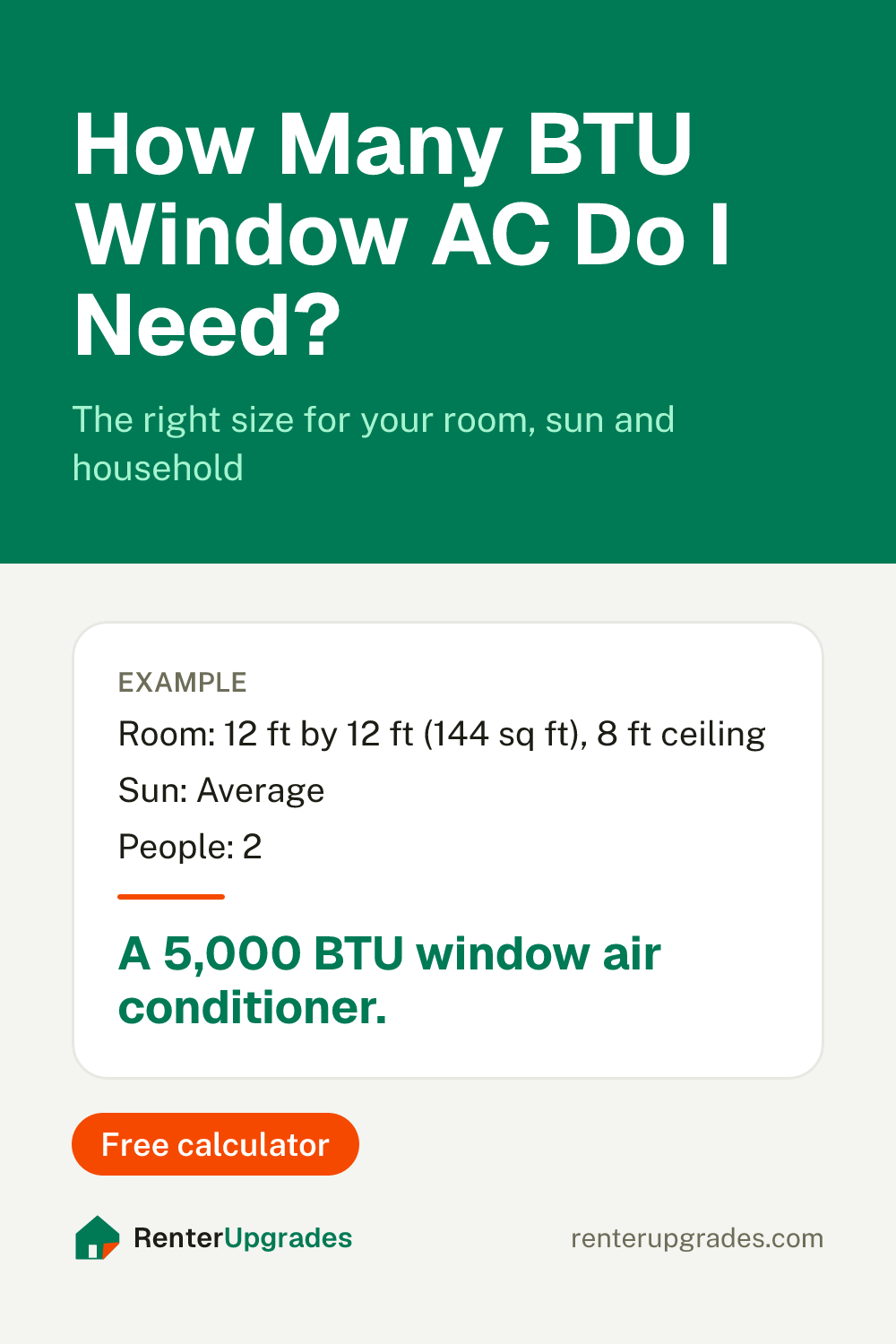
Save it for later
Pin this page so it's handy when you're ready to hang things.
Save to Pinterest (opens in a new tab)