
Renter Friendly Room Dividers: Which Kind Splits Your Studio
To hide a bed from the door or the couch, a fabric folding screen blocks the view and folds away. A screen on wheels suits a divider you move every day. Wood, bamboo and paper screens mark off a corner and let light through. For a split that runs floor to ceiling, a tension frame holds a curtain between the floor and the ceiling, with nothing screwed in.
By Tess Mullins · Updated
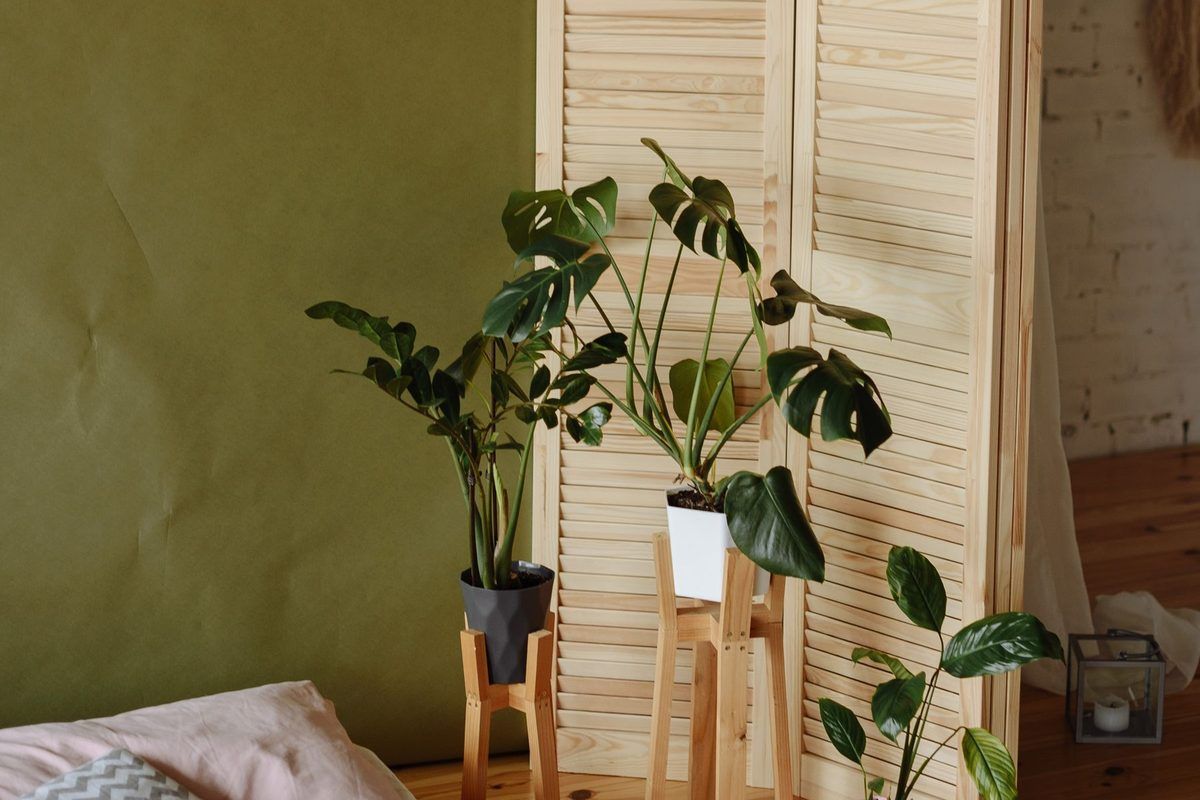
Which one fits your studio?
| If you have | Look at | Deposit Risk |
|---|---|---|
| A bed you want hidden from the door or the couch | Fabric folding screens | Low |
| A divider you move every day, like a desk you hide after work | Screens on wheels | Low |
| A softer split that lets light through, like a reading corner | Wood, bamboo and paper screens | Low |
| A full-height split with curtains you choose, like a sleeping nook | Floor-to-ceiling curtain frames | Low |
Fabric folding screens
Good for: A bed you want hidden from the door or the couch
- Deposit Risk: Low
- Landlord Permission: Not usually needed
- Take It With You: Yes
Panels of opaque fabric on a steel frame stand on their own feet. Set them straight across the room or in a zigzag around a bed, and fold them flat against a wall when you want the floor back.
Check before you buy
Stand where people sit or come in, and check that the screen's height hides what you want hidden: a folding screen stops short of the ceiling. A zigzag takes more floor than a straight line, so measure the depth it needs too, and keep the feet out of the walkway.
At move-out
Fold it flat and carry it out. Nothing is attached to the apartment, and it goes with you.
Examples on Amazon
HOMSCREENER Room Divider, 4 Panel, 88 Inch Wide
Four fabric panels on a steel frame, with hinges and feet
- Size
- 88 in wide and 71.3 in tall when open; folds to 22 in wide and 6.3 in thick
- Privacy
- Non-see-through 240 g polyester with a PA coating, per the maker
- Powder-coated steel frame with long, wide feet pads
- Wipe the fabric clean with water
Wide enough to screen the side of a bed. Triple-buckle hinges turn each panel either way, and the maker says you can join more than one screen for a longer wall.
See it on Amazon: HOMSCREENER Room Divider, 4 Panel, 88 Inch WideFCCRETA Room Divider Privacy Screen, 72 x 72 Inch
One fabric panel on a steel frame, with folding legs and leveling feet
- Size
- About 72 in wide and 72 in tall, per the title (the product details say 73 by 75 in); roll up part of the fabric for a narrower screen
- Privacy
- Three layers of opaque fabric that block views and cut the light, per the maker
- Legs swivel and fold for storage
- Adjustable feet for an uneven floor
One straight panel rather than a zigzag, for blocking a single view, like the bed from the front door. Roll up part of the fabric before you set it up if you want less width.
See it on Amazon: FCCRETA Room Divider Privacy Screen, 72 x 72 Inch
Screens on wheels
Good for: A divider you move every day, like a desk you hide after work
- Deposit Risk: Low
- Landlord Permission: Not usually needed
- Take It With You: Yes
Hinged fabric panels on wheels that lock, so you roll the screen out when you need it and back against the wall when you don't, without lifting it.
Check before you buy
Wheels roll best on a hard, level floor, so check the path you'll roll it along. Lock them once it's in place. Check the height and width as you would for any screen.
At move-out
Fold it flat and roll or carry it out, then look at the floor where it stood. Nothing is attached to the apartment, and it goes with you.
An example on Amazon
SUNALLY Room Divider Privacy Screens, 4 Panels with Wheels
Four fabric panels on a steel frame, with locking wheels
- Size
- 88 in wide and 72 in tall when open
- Privacy
- Non-see-through 240 gsm polyester with a PA coating, per the maker
- PE wheels, each with a locking brake
- Powder-coated steel frame with plastic double hinges
- Wipe the fabric with a damp cloth
It rolls aside after work instead of being lifted. The maker says marks on new fabric fade if you leave the screen in a well-aired room for a while.
See it on Amazon: SUNALLY Room Divider Privacy Screens, 4 Panels with Wheels
Wood, bamboo and paper screens
Good for: A softer split that lets light through, like a reading corner
- Deposit Risk: Low
- Landlord Permission: Not usually needed
- Take It With You: Yes
Panels of wood slats, bamboo or rice paper in a wood frame. They mark off a corner and block most direct views, but light passes through, and air through slats, so the far side of the room doesn't go dark.
Check before you buy
These block less than opaque fabric, so look through the gaps from where you'd be seen before you rely on one for a bed. Rice paper is more delicate than wood, so keep it out of a busy path. Check the open width: six panels cover more than four.
At move-out
Fold it flat and carry it out. Nothing is attached to the apartment, and it goes with you.
Examples on Amazon
Roundhill Furniture Japanese 4-Panel Screen, Plum Blossom
Four rice paper panels in a black wood frame, ready to use
- Size
- About 71 in wide and 71 in tall when open; each panel about 18 in wide
- Privacy
- Thick rice paper blocks the view and lets light in, per the maker
- Hardwood frame; wipe with a dry cloth
- About 11 lb, per the listing
A shoji-style screen with a printed plum branch. It arrives ready to use and folds flat, so it's easy to set up in a corner and put away.
See it on Amazon: Roundhill Furniture Japanese 4-Panel Screen, Plum BlossomFurnnylane 6 Panel Bamboo Room Divider
Six bamboo panels in a pine frame with metal hinges, no assembly
- Size
- 92.1 in wide and 67 in tall when open; each panel 15.35 in wide
- Privacy
- Bamboo panels; the listing names blackout as a feature without a figure
- Solid pinewood frame with non-slip base pads
- Under 21 lb, per the maker
The widest screen here, with six panels you can open fully or fold partly to fit a corner. The maker says it stays steady on hardwood, tile or carpet.
See it on Amazon: Furnnylane 6 Panel Bamboo Room DividerSvimi Wood Louvered Room Divider, 4 Panels
Four louvered wood panels with two-way metal hinges
- Size
- About 60 in wide and 67 in tall when open (the product details say 63 in wide); each panel 16 in wide
- Privacy
- Louvers block most direct light and let air through, per the maker
- Paulownia wood, which the maker says is about 40% lighter than common wood
- Hinges come off with a screwdriver, so you can add or take away panels
Louvers like a closet door, in a white-washed finish. Take a panel off with a screwdriver if you need a narrower screen.
See it on Amazon: Svimi Wood Louvered Room Divider, 4 Panels
Floor-to-ceiling curtain frames
Good for: A full-height split with curtains you choose, like a sleeping nook
- Deposit Risk: Low
- Landlord Permission: Not usually needed
- Take It With You: Yes
Two poles press between the floor and the ceiling and hold a rod across the top, so a curtain runs from floor to ceiling with nothing screwed into the wall or the ceiling. The curtains are sold separately, so you pick how much light and privacy they block.
Check before you buy
Measure from the floor to the ceiling and compare it with the frame's range. The poles need a solid, flat spot to press on: a drop ceiling won't hold them, and a textured ceiling may show a mark. Add up the weight of your curtains and keep it under the rating.
At move-out
Take the curtains down, loosen the poles and take the frame apart. Look at the ceiling and the floor where the poles pressed, and wipe off any marks. It goes with you.
Examples on Amazon
SUNALLY Room Divider, 28 to 114 Inch Wide
Two tension poles and a rod across the top; curtains not included
- Size
- 4 to 10 ft tall and 28 to 114 in wide
- Privacy
- Up to your curtains; the frame takes up to 45 lb of them
- Stainless steel; no tools to set up
- Sets up straight across a room or in an L around a corner
- Extra rod sections change the size in steps of about 14.2 in
Wide enough to close off one side of a studio, or to bend into an L around a bed. The maker says to clean the spots where the poles press and make sure they're flat and dry.
See it on Amazon: SUNALLY Room Divider, 28 to 114 Inch WideSUNALLY Room Divider Curtain Rod, 28 to 70 Inch Wide
Two tension poles and a rod across the top; curtains not included
- Size
- 4 to 10 ft tall and 28 to 70 in wide
- Privacy
- Up to your curtains; the frame takes up to 45 lb of them
- Stainless steel; no tools to set up
- Sets up straight or in an L
The narrower version, for an alcove, a closet opening or one side of a bed. Measure the width first: a wider space needs the wider frame.
See it on Amazon: SUNALLY Room Divider Curtain Rod, 28 to 70 Inch Wide
Compare them side by side
Every size and rating is the maker's own. Swipe sideways on a phone to see every column.
| Product | Kind | Size | Privacy | Deposit Risk | Permission | Take it with you |
|---|---|---|---|---|---|---|
| HOMSCREENER Room Divider, 4 Panel, 88 Inch Wide | Fabric folding screens | 88 in wide and 71.3 in tall when open; folds to 22 in wide and 6.3 in thick | Non-see-through 240 g polyester with a PA coating, per the maker | Low | Not usually needed | Yes |
| FCCRETA Room Divider Privacy Screen, 72 x 72 Inch | Fabric folding screens | About 72 in wide and 72 in tall, per the title (the product details say 73 by 75 in); roll up part of the fabric for a narrower screen | Three layers of opaque fabric that block views and cut the light, per the maker | Low | Not usually needed | Yes |
| SUNALLY Room Divider Privacy Screens, 4 Panels with Wheels | Screens on wheels | 88 in wide and 72 in tall when open | Non-see-through 240 gsm polyester with a PA coating, per the maker | Low | Not usually needed | Yes |
| Roundhill Furniture Japanese 4-Panel Screen, Plum Blossom | Wood, bamboo and paper screens | About 71 in wide and 71 in tall when open; each panel about 18 in wide | Thick rice paper blocks the view and lets light in, per the maker | Low | Not usually needed | Yes |
| Furnnylane 6 Panel Bamboo Room Divider | Wood, bamboo and paper screens | 92.1 in wide and 67 in tall when open; each panel 15.35 in wide | Bamboo panels; the listing names blackout as a feature without a figure | Low | Not usually needed | Yes |
| Svimi Wood Louvered Room Divider, 4 Panels | Wood, bamboo and paper screens | About 60 in wide and 67 in tall when open (the product details say 63 in wide); each panel 16 in wide | Louvers block most direct light and let air through, per the maker | Low | Not usually needed | Yes |
| SUNALLY Room Divider, 28 to 114 Inch Wide | Floor-to-ceiling curtain frames | 4 to 10 ft tall and 28 to 114 in wide | Up to your curtains; the frame takes up to 45 lb of them | Low | Not usually needed | Yes |
| SUNALLY Room Divider Curtain Rod, 28 to 70 Inch Wide | Floor-to-ceiling curtain frames | 4 to 10 ft tall and 28 to 70 in wide | Up to your curtains; the frame takes up to 45 lb of them | Low | Not usually needed | Yes |
Before you buy
Decide what it should block. A divider can hide a view, cut light or just mark where one part of the room ends. Opaque fabric hides the most, slats and paper let light through, and a curtain blocks whatever its fabric blocks.
Measure the space and the ceiling. Measure the width you want to cover and, for a screen, the depth a zigzag takes. For a tension frame, measure from the floor to the ceiling where the poles will stand, and look up for a drop ceiling, a beam or a sprinkler in the way.
Look from where people will be. Stand at the front door and sit on the couch, then check what a screen of that height still shows. A screen that hides the bed from the couch may still show it from the doorway.
Keep the walkway and the exits clear. Leave room to walk past, keep the divider away from a heater or a radiator, and don’t block a window you’d use to get out in an emergency.
At move-out
Fold the screens flat for the move. For a tension frame, take the curtains down, loosen the poles and take the rod apart. Then look at the ceiling and the floor where the poles pressed and wipe off any marks, and check the floor for scuffs where a screen’s feet or wheels stood.
A rug under each zone makes the split feel finished: the rug size calculator works out the size for a bed or a seating area. Before a bigger screen arrives, the will it fit calculator checks it against doorways and hallways.
Hanging curtains on the windows too? The no-drill curtain rod guide matches each kind of rod to a window, and the guide to hanging curtains without drilling shows how to put one up step by step.
How we chose the examples
- Stands on its own feet or presses between the floor and the ceiling, so nothing is screwed into a wall or the ceiling.
- Sizes published by the maker, so you can check the height against what you want to hide and the width against the space.
- A mix of looks and privacy: opaque fabric, wood slats, bamboo, rice paper and curtains you choose yourself.
- Folds flat or comes apart for a move.
Each kind shows three badges: Deposit Risk, whether you'll usually need Landlord Permission, and whether you can Take It With You. They're general guidance, and leases differ, so check yours. We describe products from the makers' own specs and instructions. Unless this page says otherwise, we haven't tested them ourselves.
The links to Amazon are plain links: we earn nothing when you buy, and no brand pays to be here.
Frequently asked questions
Which room divider is best for a studio apartment?
It depends on what you want to hide. A fabric screen blocks the view of a bed and folds away, a screen on wheels moves every day, a slatted screen lets light through, and a curtain on a floor-to-ceiling frame gives you full height. Each kind above says the situation it suits.
Can I divide a room without drilling?
Yes. Folding screens stand on their own feet, and a tension frame presses between the floor and the ceiling to hold a curtain. A curtain track fixed to the ceiling usually goes up with screws, so get written permission before you put one up.
How tall should a room divider be?
Tall enough to hide what you want hidden from where people sit or come in. Most folding screens stop short of the ceiling, which hides a bed but not the whole corner. For full height, a tension frame reaches the ceiling.
What curtains work on a tension rod room divider?
Any curtains whose tops fit the rod, such as rod pocket or grommet panels, as long as their total weight stays under the frame's rating. Blackout curtains block the most light, and sheer ones only soften the split. Measure from the rod to the floor for the length.
Do room dividers block sound?
Not much. A screen or a curtain blocks the view and some light, but sound travels over and around it.
Do I need my landlord's permission for a room divider?
Usually not for a freestanding screen or a tension frame, since nothing is fixed to the apartment. Ask first before anything is screwed into a wall or the ceiling.
Next step
Rug Size CalculatorPick a room, sofa, bed or dining table and get the standard rug size that fits, using the spacing guidelines rug makers recommend.
Save it for later
Pin this page so it's handy when you're ready to hang things.
Save to Pinterest (opens in a new tab)