
Renter Friendly Ways to Hang Curtains Without Drilling
Start with what's already there: if your window has a rod, clip rings let almost any curtain hang from it. With no rod, a tension rod fits inside a recessed frame, brackets clip onto blinds you already have, and a magnetic rod holds on a steel door. Adhesive hooks made for curtain rods and tap-in brackets for wood trim cover the rest, with more risk to the wall.
By Tess Mullins · Updated
Which way fits your window?
Swipe sideways on a phone to see every column.
| If you have | Try | Deposit Risk | Permission | Take it with you |
|---|---|---|---|---|
| A rod or brackets already on the window | Use the rod that's already there, with clip rings | Low | Not usually needed | Yes |
| A recessed window with a flat frame on both sides | Fit a tension rod inside the frame | Low | Not usually needed | Yes |
| Blinds already at the top of the window | Clip brackets onto your blinds | Low | Not usually needed | Yes |
| A steel door that a magnet sticks to | Hang a magnetic rod on a steel door | Low | Not usually needed | Yes |
| A smooth wall, a short rod and light curtains | Stick up adhesive hooks made for curtain rods | Medium | Not usually needed | Partly |
| Wood trim around the window | Tap brackets into wood trim | High | Check your lease | Yes |
Measure first
A tension rod is sized to the inside of the frame; a rod on brackets or hooks is the window width plus some extra on each side. The curtain size calculator works out the rod length and the panels for either setup.
Use the rod that's already there, with clip rings
Good for: A rod or brackets already on the window
- Deposit Risk: Low
- Landlord Permission: Not usually needed
- Take It With You: Yes
What you need
- Curtain rings with clips, sized for your rod
- Curtain panels of any top style, including flat-top panels
Steps
- Measure across the rod's thickness. Choose rings whose opening is larger than the rod, so they slide; IKEA gives that rule for its clip rings.
- Lift the rod off its brackets, or take off one finial, so the rings can slide on.
- Slide the rings onto the rod and put it back on its brackets.
- Clip the top edge of each panel into the rings, spacing the clips evenly across the panel.
Watch out: The rod and brackets belong to your landlord. If they're loose or bent, report it instead of loading them with heavier curtains.
At move-out
Unclip the curtains and slide the rings off. The rod stays where it was, and the rings and curtains go with you.
Fit a tension rod inside the frame
Good for: A recessed window with a flat frame on both sides
- Deposit Risk: Low
- Landlord Permission: Not usually needed
- Take It With You: Yes
What you need
- A tension rod whose length range covers the inside width of the frame
- Curtains with a rod pocket, grommets or clip rings
Steps
- Check the inside of the frame: Target says the inside of the frame must be flat, without decorative molding, for its Room Essentials tension rod.
- Measure the inside width of the frame, and pick a rod whose range covers it.
- Slide the curtains onto the rod before you put it up.
- Set the rod inside the frame and extend it until both end pads press against the sides.
- Hold the rod near the middle and twist to tighten, as Kenney's instructions describe; twist the other way to loosen it.
Watch out: Check the weight rating on the package. Kenney, for one, recommends its twist-to-fit rod for light to medium weight curtains.
At move-out
Twist the rod to loosen it and lift it out. The end pads press on the frame instead of going into it, and the rod goes with you.
Clip brackets onto your blinds
Good for: Blinds already at the top of the window
- Deposit Risk: Low
- Landlord Permission: Not usually needed
- Take It With You: Yes
What you need
- Brackets made for your blinds' top rail (headrail), in the right size and mount type
- A curtain rod that fits the brackets
- Grommet or tab-top curtains
Steps
- Make sure the blinds' top rail is firmly attached. NoNo Bracket, one maker, says not to install its brackets on a loose or damaged rail.
- Take off the plastic valance on the front of the rail, if there is one. It's usually held on with plastic clips.
- Measure the rail itself, then choose brackets for its size and for an inside or outside mount.
- Add the non-slip strips that come with the brackets, slide each bracket onto the rail and tighten its screw.
- Use two brackets for a window up to 5 ft wide and three for wider windows or sliding doors, as the same maker advises. Then hang the rod and curtains as usual.
Watch out: The weight hangs on blinds that belong to your landlord, and how much they hold depends on how well the rail is mounted. Rod-pocket curtains may not reach far enough to hide the rail, so the maker suggests grommet or tab-top curtains.
At move-out
Take the rod down, loosen each bracket's screw and slide it off the rail. Put the valance back. Nothing touched the wall, and the brackets go with you.
Hang a magnetic rod on a steel door
Good for: A steel door that a magnet sticks to
- Deposit Risk: Low
- Landlord Permission: Not usually needed
- Take It With You: Yes
What you need
- A magnetic curtain rod sized to the door window
- Light curtains or a door panel
Steps
- Hold a magnet to the door first. Magnetic rods are made for steel surfaces, such as steel doors.
- Slide the curtain onto the rod and set the rod in place above the door window.
Watch out: Rod Desyne describes its magnetic rod for lightweight drapery. Keep heavier panels for a sturdier mount.
At move-out
Pull the rod off the door. Nothing is screwed or stuck on, and the rod goes with you.
Stick up adhesive hooks made for curtain rods
Good for: A smooth wall, a short rod and light curtains
- Deposit Risk: Medium
- Landlord Permission: Not usually needed
- Take It With You: Partly
What you need
- Adhesive hooks made to hold a curtain rod
- A short, thin rod within the hooks' limits on the package
- Rubbing alcohol and a cloth
Steps
- Check the rod against the package. These hooks fit only thin, short rods, and 3M says they're best on smooth painted walls, tile, metal and glass, not wallpaper, textured walls, brick, concrete or unfinished wood.
- Clean the spot with rubbing alcohol, not household cleaners. That's in 3M's directions for its Large hooks, which use the same Large strips.
- Press each hook's base firmly for 30 seconds, then wait 1 hour before hanging anything, as those directions say.
- Place the hooks level with each other, and set the rod so its weight is spread evenly between them.
- Open and close the curtains by sliding them across. Don't pull down on them.
Watch out: Two hooks don't hold twice as much. 3M's directions for its curtain rod hooks say that when more than one hook holds an item, the total weight capacity stays the same as one hook. Keep to light curtains.
At move-out
Lift the rod off. Then hold each hook's base against the wall and pull the strip's tab straight down, slowly, stretching it along the wall instead of pulling it toward you. The hooks can go with you and take new strips at the next place.
Tap brackets into wood trim
Good for: Wood trim around the window
- Deposit Risk: High
- Landlord Permission: Check your lease
- Take It With You: Yes
What you need
- Tap-in curtain rod brackets
- A hammer
- A curtain rod that fits the brackets
Steps
- Check the trim: Kwik-Hang says its brackets need traditional wood trim 1/2 to 1 in wide, and aren't for hardwoods like oak, PVC, crown molding, MDF or metal trim.
- Hold a bracket at a top corner of the window, where the trim meets the wall.
- Tap it into the top of the trim with a hammer, then do the same on the other side.
- Thread the curtains onto the rod and set the rod in the brackets.
- On a window wider than 60 in, add a center support bracket, as Kwik-Hang recommends.
Watch out: The brackets' pins go into the trim the way a thumbtack goes into a board, so expect tiny pin holes. Check your lease before you use them.
At move-out
Take the rod down and lift each bracket up off the trim. Ask your landlord whether you should fill the pin holes. The brackets go with you.
Before you start
Look at what the window already has. A rod, blinds, a recessed frame, wood trim or a steel door each points to a different method in the table above, and the ones that use what’s there carry the least risk.
Measure first. A tension rod is sized to the inside of the frame. A rod on hooks or brackets is the window width plus some extra on each side, so the curtains can open past the glass. The curtain size calculator works out both, and its tension rod setting sizes a rod inside the frame.
Match the curtains to the mount. Every method here has a limit, set by the rod, the hooks, the brackets or the blinds they hang on. Sheers and light panels suit all of them; lined and blackout panels need the sturdier ones. Check the curtains’ weight against the limit for the way you’ll actually mount them.
When none of these fit
Some windows have no frame to press against, no trim, no blinds and a wall that adhesive won’t hold on, such as textured paint or wallpaper. Then the dependable answer is a rod on screws. Ask your landlord first, in writing, and keep the reply with your lease: some landlords would rather install hardware themselves.
Take dated photos of the window and the wall around it before you hang anything, and again after it comes down. The move-in checklist and the move-out checklist cover the rest of the room.
Choosing the hardware itself? The no-drill curtain rod guide compares example rods and brackets of each kind, with their sizes and load ratings. For a shade under the curtains, the no-drill blinds guide compares cellular, roller and stick-on shades. To hang a curtain across a studio rather than a window, the room divider guide compares floor-to-ceiling tension frames and folding screens. For frames and mirrors on the same wall, the command strip calculator works out how many strips to use.
Frequently asked questions
How do you hang curtains in a rental without drilling?
Use the rod that's already there if there is one, with clip rings. Otherwise, fit a tension rod inside a recessed frame, clip brackets onto your blinds, or use a magnetic rod on a steel door. Adhesive hooks made for curtain rods and tap-in brackets for wood trim work too, with more risk to the wall.
Do two adhesive hooks hold twice the weight?
No. 3M's directions for its curtain rod hooks say that when more than one hook holds an item, the total weight capacity stays the same as one hook. Keep the hooks level and spread the weight evenly between them.
Can you hang curtains over vertical blinds?
Yes, with brackets that clip onto the blinds' top rail, as long as the rail is firmly attached. One maker recommends grommet or tab-top curtains, since rod-pocket curtains may not reach far enough to cover the rail.
Will tap-in curtain brackets leave holes in the trim?
Expect tiny ones. The brackets' pins go into the top of the wood trim the way a thumbtack does, so check your lease before you use them, and ask your landlord whether to fill the holes when you move out.
What size clip rings do I need?
Rings whose opening is larger than your rod, so they slide freely; IKEA gives that rule for its clip rings. Measure the rod's thickness before you buy.
Do magnetic curtain rods work on any door?
Only on steel. If a magnet doesn't stick to the door, the rod won't either. Rod Desyne, one maker, describes its magnetic rod for lightweight drapery.
Next step
Renter Upgrade Cost CalculatorEnter what an upgrade costs, how long you'll stay and what you'll keep when you move to see its real cost per month, with the deposit risk spelled out.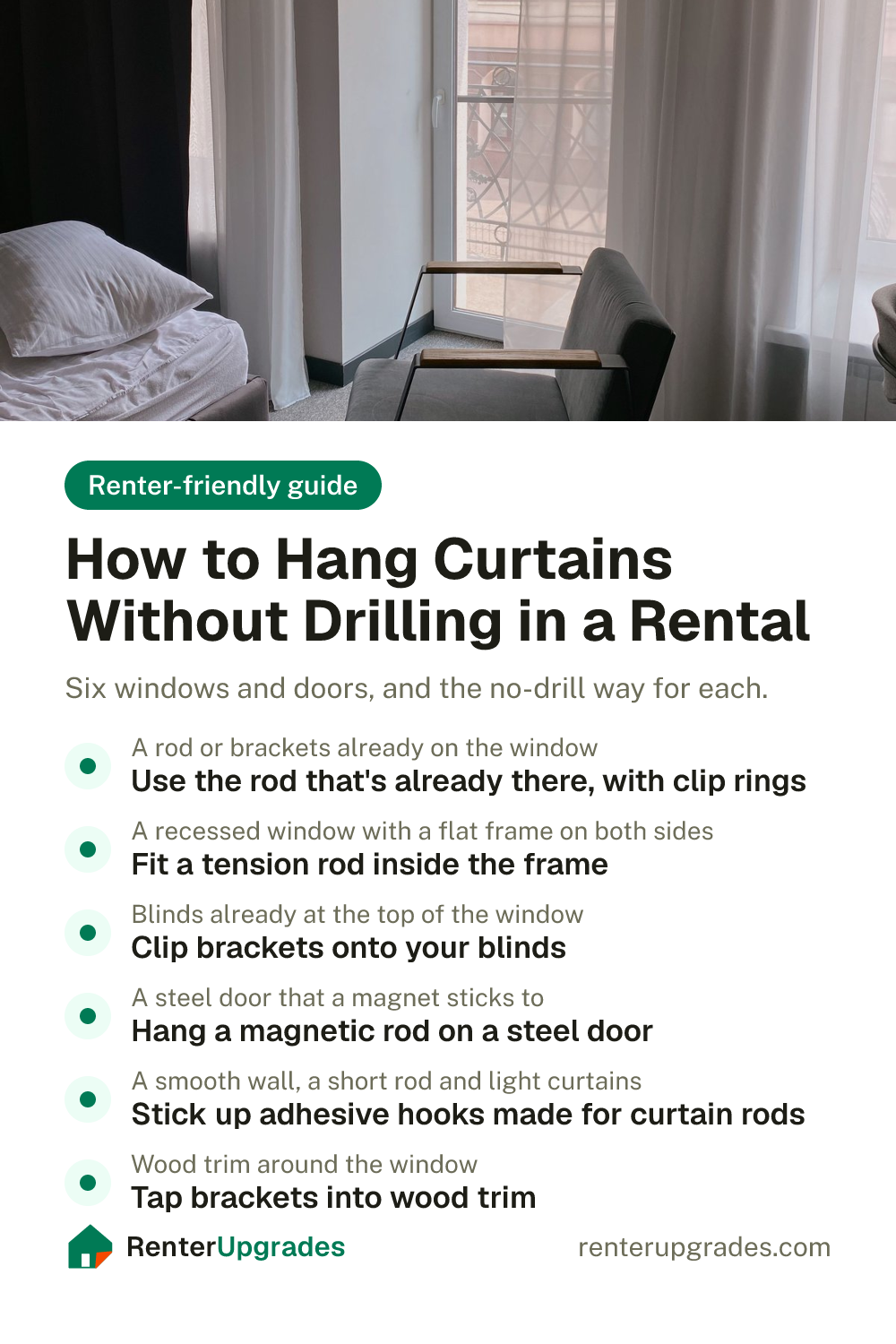
Save it for later
Pin this page so it's handy when you're ready to hang things.
Save to Pinterest (opens in a new tab)