
Renter Upgrade Cost Calculator
Enter what an upgrade costs, how long you'll stay and what you'll keep when you move to see its real cost per month, with the deposit risk spelled out.
By Tess Mullins · Updated
Your upgrade
It costs you
$6.25 a month
That's $75 over 12 months: about $1.44 a week, or $0.21 a day.
- You pay $150 and get back about $75 when you move.
- It can mark paint or finishes if it goes on or comes off wrong. Check your lease and follow the removal instructions.
| If you stay | Per month |
|---|---|
| 3 months | $25 |
| 6 months | $12.50 |
| 12 months (your stay) | $6.25 |
| 24 months | $3.13 |
| 36 months | $2.08 |
A rough guide to help you decide, not financial advice. How we calculate
- Deposit Risk: Medium
- Landlord Permission: Check your lease

The short answer
An upgrade’s real cost is what you lose on it, spread over the months you get to enjoy it. Add the price and what it costs to undo at move-out, subtract what you’ll keep or resell, and divide by the months you’ll stay. A $120 peel-and-stick backsplash you leave behind after 12 months works out to about $10 a month.
Whether that’s worth it is your call. The calculator gives you a number to weigh against how much you’ll use and enjoy the upgrade, and it spells out the deposit risk, so a cheap-looking option doesn’t turn into a deduction from your deposit.
How to use the calculator
- Upgrade cost. Add up everything you’ll buy: the product, supplies, any tool you don’t already own and delivery.
- Months you expect to stay. Count the months left on your lease, plus a renewal if you’re fairly sure you’ll sign one.
- Share you keep or resell. If the upgrade moves with you as it is, like a rug or a lamp, you keep all of it. If it stays behind or goes in the trash, you keep none. For things you’d sell, estimate what they’d fetch secondhand as a share of what you paid.
- Cost to undo it. Paint, filler, a cleaning product or a handyman’s visit at move-out. Leave it at zero if the upgrade simply comes off. For a repaint, the paint calculator tells you how many gallons to price.
- Deposit risk. Pick how the upgrade comes off. It doesn’t change the math, but it changes the advice and the badges under the result.
The result shows the cost per month, per week and per day, plus a table of the monthly cost for stays of 3, 6, 12, 24 and 36 months, and your own stay. Use Copy link to save one upgrade, then try another and compare.
Cost per month by upgrade budget
What common upgrade budgets cost per month when you leave the upgrade behind and it costs nothing to undo:
| Upgrade cost | 6 months | 12 months | 24 months |
|---|---|---|---|
| $50 | $8.33 | $4.17 | $2.08 |
| $100 | $16.67 | $8.33 | $4.17 |
| $250 | $41.67 | $20.83 | $10.42 |
| $500 | $83.33 | $41.67 | $20.83 |
| $1,000 | $166.67 | $83.33 | $41.67 |
Anything you keep or resell brings these numbers down. Anything you pay to undo the upgrade pushes them up.
How we calculate
This is our own method, kept simple on purpose:
- Net cost = upgrade cost + cost to undo it − (upgrade cost × share you keep or resell)
- Per month = net cost ÷ months you expect to stay
- Per week and per day use the average month, 30.44 days long.
A few assumptions to know about:
- No interest or inflation. We treat a dollar today and a dollar at move-out the same. For small home upgrades over a typical lease, that changes little.
- The share you keep is your estimate. Secondhand prices vary a lot, so be realistic rather than hopeful.
- Deposit risk isn’t turned into dollars. Only you can judge how likely a deduction is. The calculator shows the risk as a badge and gives advice, and you can add your own estimate to the cost to undo it.
The result is a rough guide to help you decide, not financial advice.
Worked examples
Example: A peel-and-stick backsplash
What we know
- Cost: $120
- Staying: 12 months
- Kept or resold at move-out: 0%
- Cost to undo: $0
How it works out
- What you keep: 0% of $120 = $0.
- Net cost: $120 + $0 to undo − $0 kept = $120.
- Per month: $120 ÷ 12 months = $10.
About $10 a month, or $0.33 a day.
Example: A rug you'll take with you
What we know
- Cost: $300
- Staying: 24 months
- Kept or resold at move-out: 70%
- Cost to undo: $0
How it works out
- What you keep: 70% of $300 = $210.
- Net cost: $300 + $0 to undo − $210 kept = $90.
- Per month: $90 ÷ 24 months = $3.75.
About $3.75 a month, or $0.12 a day.
Example: Painting an accent wall
What we know
- Cost: $80
- Staying: 12 months
- Kept or resold at move-out: 0%
- Cost to undo: $60
How it works out
- What you keep: 0% of $80 = $0.
- Net cost: $80 + $60 to undo − $0 kept = $140.
- Per month: $140 ÷ 12 months = $11.67.
About $11.67 a month, or $0.38 a day.
How deposit risk changes the answer
The same monthly cost can be a good deal or a bad one, depending on how the upgrade comes off. We rate upgrades across this site with the same three levels:
- Low: fully reversible, with no holes or residue when removed as instructed. Think tension rods, freestanding shelves, plug-in lamps, rugs and furniture.
- Medium: reversible, but it can damage paint or finishes if it’s installed wrong, left up too long or used on the wrong surface. Think adhesive strips and hooks, peel-and-stick wallpaper or tile and removable contact paper.
- High: leaves holes or a permanent change, or commonly breaks lease terms without permission. Think painting, drilling, hardwired fixtures, changing locks and replacing hardware.
For Medium and High upgrades, put a realistic number in the cost to undo it. If you’d hire someone to patch and repaint, use a quote rather than a guess.
The badges are general guidance, and leases differ. Check yours, and get anything High risk approved in writing before you start.
Ways to make an upgrade cheaper per month
- Pick upgrades that move with you. A rug, lamps, curtains and freestanding storage keep their value at your next place, so only the part you lose counts.
- Light with a plug. A plug-in swag pendant over the table costs a hook and a cord, not an electrician; the pendant light height calculator gives the height and the cord length.
- Choose the reversible version. A tension rod instead of brackets, adhesive strips instead of nails, peel-and-stick tile instead of new tile, click-lock vinyl planks that come apart instead of a glued floor. They usually cost little or nothing to undo.
- Start early. An upgrade bought at the start of a lease spreads over more months than the same one bought just before you move.
- Keep what you swap out. Store original cabinet pulls, a shower head or a light cover in a labeled bag, so putting things back at move-out costs nothing. New pulls that fit the old holes keep the swap reversible: the cabinet hardware calculator gives the hole spacing to shop for.
Before you start, take dated photos of the spot you’re changing, and keep the receipt with your lease. You’ll know exactly what to put back, and you’ll have a record of how it looked before.
Run the numbers for two or three options before you buy. The cheapest upgrade up front isn’t always the cheapest per month.
Frequently asked questions
Is it worth upgrading a rental?
It can be, if the cost per month feels fair for what the upgrade adds to your daily life. Add the price and what it costs to undo, take off what you'll keep or resell, and spread the rest over the months you'll live there. The calculator does that math and shows how a shorter or longer stay changes it.
How do I work out the cost per month of an apartment upgrade?
Add the price and the cost to undo it at move-out, subtract the share you'll keep or resell, then divide by the months you expect to stay. For example, a $120 peel-and-stick backsplash you leave behind after 12 months costs about $10 a month.
Which renter-friendly upgrades are cheapest per month?
Usually the ones you take with you. A rug, lamps, curtains on a tension rod or freestanding shelves keep much of their value when you move, so only the part you lose counts. A $300 rug that still has 70% of its value after 24 months costs you about $3.75 a month.
Should I count the cost of undoing an upgrade?
Yes. Paint, filler or a handyman's visit at move-out is part of the price. Painting an accent wall for $80 and paying $60 to repaint it before you leave makes it a $140 upgrade.
What does deposit risk mean?
It's our rating for how an upgrade comes off. Low means fully reversible, with no holes or residue when removed as instructed. Medium means reversible, but it can damage paint or finishes if it goes on or comes off wrong. High means holes or a permanent change, or something leases commonly ban without permission.
Do I need my landlord's permission for renter upgrades?
It depends on the upgrade and your lease. Upgrades that come off cleanly usually don't need it. Adhesive products and peel-and-stick wallpaper are worth checking against your lease. Anything that leaves holes or a permanent change needs written permission first. Leases differ, so yours is the final word.
Does the calculator count interest or inflation?
No. It treats a dollar today and a dollar at move-out the same, which is close enough for small home upgrades over a typical lease. It's a rough guide to help you decide, not financial advice.
Next step
Command Strip CalculatorEnter your item's weight and size to see which adhesive strip size to use and how many pairs, based on the manufacturer's published ratings.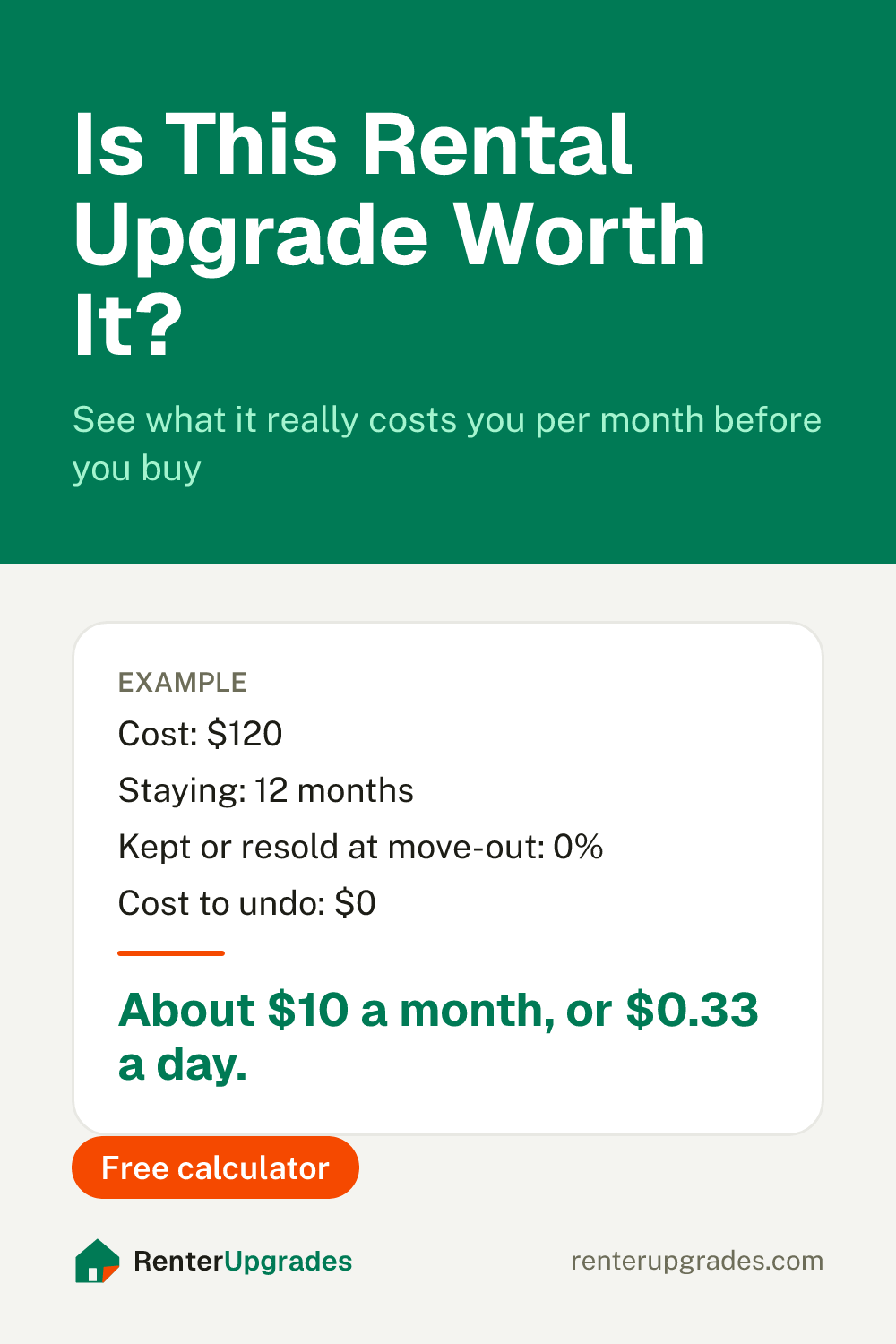
Save it for later
Pin this page so it's handy when you're ready to hang things.
Save to Pinterest (opens in a new tab)