
Letter to Landlord Asking Permission to Paint
Fill in the rooms, colors and your plan to write a clear request to paint, with a spot for your landlord to sign their approval. Copy it or download a PDF.
By Tess Mullins · Updated
Letter preview
[Your name][Your address]
[Date]
[Landlord's name][Landlord's address]
Re: Permission to paint at [Your address]
Dear [Landlord's name],
I'm writing to ask for your written permission to paint [rooms or walls] in my home at [Your address]. Here is what I have in mind:
- Colors: I'll share them with you for approval before I start.
- I'll do the painting myself.
- I'll use low-VOC interior paint.
- I'll cover the floors, trim and fixtures, and clean up when the work is done.
- I'll pay for the paint and supplies.
Before I move out, I'll repaint these walls to the original color, or pay for that repainting.
If you have conditions, such as approved colors or a particular paint, please let me know and I'll follow them.
Could you reply in writing? I won't start painting until I have your written approval.
Thank you for considering my request.
Sincerely,
Signature
[Your name]
Landlord's approval
I approve the painting described in this letter. Conditions, if any: ______________________________
Landlord or property manager
Date
General information, not legal advice. Check your lease and your state's law before you rely on it.

When to use this letter
Send it before you buy paint. Most leases treat painting as a change to the unit, and many say you need your landlord’s written consent first. A short letter that answers their questions up front (which rooms, what colors, who does the work, what happens when you move out) makes a yes easier to give.
The generator fills in the letter as you type. Blank parts show in brackets, so you can see what’s still missing before you copy it or download the PDF.
How to use the generator
- Add your details and your landlord’s. Use the name and address your lease gives for notices, if it has one.
- Describe the request: the rooms or walls, the colors, and who will paint.
- Pick what happens at move-out. Offering to repaint to the original color is often what gets a yes.
- Keep the approval section so your landlord can sign and date their answer on the same page.
- Download the PDF or copy the text, then send it the way your lease asks.
Your answers stay in your browser. A draft is saved on this device until you press Clear.
Sample letter
Here’s a finished letter made with the generator. The names and addresses are made up.
Jordan Ellis100 Main Street, Apt 2BAnytown, ST 12345jordan@example.com
March 1, 2027Sent by email
Pat MorganMorgan Property Management200 Oak AvenueAnytown, ST 12345
Re: Permission to paint at 100 Main Street, Apt 2B
Dear Pat Morgan,
I'm writing to ask for your written permission to paint the living room and the smaller bedroom in my home at 100 Main Street, Apt 2B. Here is what I have in mind:
- Colors: a warm white in the living room and a pale green in the bedroom.
- I'll do the painting myself.
- I'll use low-VOC interior paint.
- I'll cover the floors, trim and fixtures, and clean up when the work is done.
- I'll pay for the paint and supplies.
Before I move out, I'll repaint these walls to the original color, or pay for that repainting.
If you have conditions, such as approved colors or a particular paint, please let me know and I'll follow them.
Could you reply in writing by March 15, 2027? I won't start painting until I have your written approval.
Thank you for considering my request.
Sincerely,
Signature
Jordan Ellis
Landlord's approval
I approve the painting described in this letter. Conditions, if any: ______________________________
Landlord or property manager
Date
What makes the request easy to approve
- Be specific. “The living room and the smaller bedroom” is easier to approve than “a few rooms.”
- Name the colors, or offer to share swatches first. Light, neutral colors are usually an easier yes than dark or bold ones.
- Show how you’ll protect the unit: drop cloths, painter’s tape, covered fixtures, and low-VOC paint.
- Settle move-out now. Say whether you’ll repaint to the original color, or leave it if your landlord prefers the new one.
- Know how much paint it takes. The paint calculator works out the gallons for the rooms in your letter, and the same walls again if you’ll repaint at move-out.
- Ask for a written answer. A signed approval protects you if there’s a question about the walls when you move out.
How to send it and keep a record
- Follow your lease. Some leases say how notices and requests must be delivered.
- Email gives you a dated copy right away. Save the reply.
- Mail with proof gives you a record that it was sent. Certified Mail costs $5.55 on top of postage, plus $4.65 for a paper return receipt that shows who signed for it (USPS prices from Oct 4, 2026).
- Keep copies of the letter, the approval and photos of the walls before you start and after you finish.
If you don’t hear back, or the answer is no
Give it a week or two, then follow up in writing and attach the first letter. No answer isn’t the same as a yes, so don’t start painting until you have approval in writing.
If the answer is no, ask what your landlord would allow: one accent wall, a short list of colors, or a professional painter. For a change without paint, see how many rolls you’d need with the peel and stick wallpaper calculator, and check whether your lease covers that too.
What leases and the law say
Painting is mostly a matter of your lease, but a few official sources show how it’s usually treated:
- HUD model lease: the lease used in many HUD-assisted buildings says no alteration, addition or improvement can be made without the landlord's prior written consent. (Form HUD-90105a, paragraph 12)
- Minnesota: the Attorney General's handbook says a tenant ordinarily isn't allowed to paint or paper walls without the landlord's permission. (Minnesota Attorney General, Landlords and Tenants handbook)
- California: the state's tenant guide lists alterations you didn't undo among the reasons a landlord can deduct from a deposit, and says repainting charges are for damage beyond normal wear and tear. (California Department of Real Estate, California Tenants)
- Changes for a disability: under the Fair Housing Act rules, a landlord can't refuse reasonable modifications you need because of a disability, made at your expense. For changes inside the unit, the landlord may ask you to restore it when you leave, apart from normal wear and tear. (24 CFR 100.203)
These are examples, not a complete list. Your lease and your state’s law decide what you’re allowed to change.
Take dated photos of every wall before you paint and after you finish. Keep them with your landlord’s signed approval until your deposit comes back.
Frequently asked questions
Can renters paint walls?
Only if your lease and your landlord allow it. Many leases say you need the landlord's written consent before you paint or make other changes, so check yours and ask in writing before you open a can of paint.
What should a letter asking permission to paint include?
Say which rooms or walls, the colors, who will do the work, how you'll protect floors and fixtures, who pays, and whether you'll repaint before you move out. Ask for a written reply, and give your landlord a line to sign.
Can painting cost me my security deposit?
It can. If you paint without permission, or leave a color your landlord didn't agree to, the cost of repainting may come out of your deposit. Written approval, and a clear agreement on whether you'll repaint at move-out, avoid that surprise.
Should I send the letter by email or by mail?
Use the method your lease names for notices, if it names one. Email is quick and gives you a dated record. For anything important, mail with tracking or a receipt gives you proof it was sent. Keep a copy either way.
What if my landlord says no?
Ask what they would allow, such as a short list of approved colors or one accent wall, and get that in writing. Removable options like peel-and-stick wallpaper can change a room too, but check whether your lease covers those.
Next step
Renter Upgrade Cost CalculatorEnter what an upgrade costs, how long you'll stay and what you'll keep when you move to see its real cost per month, with the deposit risk spelled out.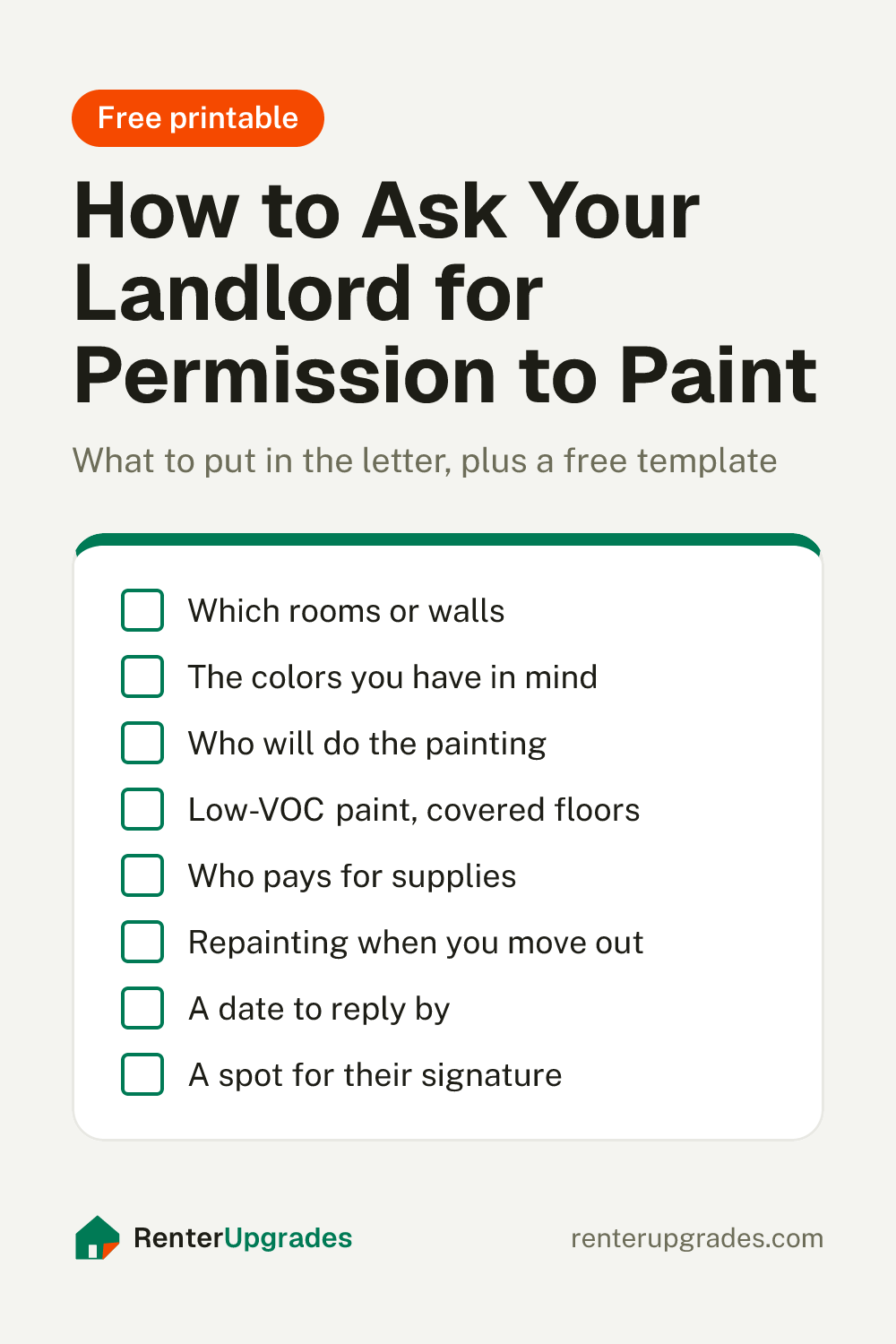
Save it for later
Pin this page so it's handy when you're ready to hang things.
Save to Pinterest (opens in a new tab)