
Paint Calculator
Enter the room's size, its doors and windows and your paint to see how many gallons and quarts to buy, with the ceiling and a coat of primer if you need them.
By Tess Mullins · Updated
Your walls
Paint to buy
1 gallon and 3 quarts
Your walls: 2 × (12 ft + 10 ft) × 8 ft = 352 sq ft, less 35 sq ft for 1 door and 1 window: 317 sq ft. Two coats over 317 sq ft is 634 sq ft of painting. At 400 sq ft a gallon (the top of Behr Premium Plus Interior's range, for smooth walls), that's 1.6 gallons: buy 1 gallon and 3 quarts, or 2 gallons.
| Area to paint | 317 sq ft |
|---|---|
| Coverage | 400 sq ft a gallon |
| Paint needed | 1.6 gallons |
| To buy | 1 gallon and 3 quarts, or 2 gallons |
On textured, new or patched walls, the same paint covers 250 sq ft a gallon, so you'd need 2.5 gallons.
Coverage is the maker's figure for one coat, not counting what spraying loses. Some colors need extra coats to hide the old color. How we calculate
- Deposit Risk: High
- Landlord Permission: Get written permission
- Take It With You: No
The short answer
Add up the wall area, take off the doors and windows, multiply by the coats and divide by the coverage on the can. A 12 × 10 ft bedroom with 8 ft walls, one door and one window has 317 sq ft of wall. Two coats of a paint that covers 400 sq ft a gallon take about 1.6 gallons: 1 gallon and 3 quarts, or 2 gallons.
Coverage is the number that moves the answer most. Makers give a range, such as 250 to 400 sq ft a gallon for Behr Premium Plus Interior, and tie it to the wall: Behr to how porous it is, KILZ to its texture and porosity. The calculator uses the top of the range for smooth walls that were painted before, and the bottom for textured, new or patched walls.
How to measure
- Measure the room’s length and width, and the wall height from the floor to the ceiling. For one wall, measure just its width and height.
- Count the doors and windows, and measure one of each. The calculator starts at 36 × 80 in for a door and 36 × 60 in for a window. Leave a door out if you’ll paint it too.
- Measure the ceiling only if it gets the same paint. Its area is the room’s length times its width.
- Note the coverage on the can, in square feet a gallon, if you’ve already picked a paint.
How to use the calculator
- Pick a room or one wall. For an accent wall, enter just that wall’s width and height.
- Enter the size, then the doors and windows and their sizes. Set a count to zero to skip them.
- Tick the ceiling if it gets the same paint.
- Pick your paint, or choose the last option and type in the coverage from your can.
- Say what your walls are like. Smooth walls that were painted before use the top of the maker’s range; textured, new or patched walls use the bottom.
- Choose the coats, 2 to start, and tick Prime first to add a coat of primer.
The result shows the gallons to buy as whole gallons plus quarts, or all gallons, and what the other end of the coverage range would take. A gallon is 4 quarts. Use Copy link to keep your numbers for the store.
Gallons by room size
Two coats of Behr Premium Plus Interior on 8 ft walls, with one door and one window taken off, rounded up to whole gallons:
| Room, 8 ft walls | Walls to paint | Gallons, smooth walls | Gallons, textured walls |
|---|---|---|---|
| 10 × 10 ft | 285 sq ft | 2 | 3 |
| 10 × 12 ft | 317 sq ft | 2 | 3 |
| 12 × 12 ft | 349 sq ft | 2 | 3 |
| 12 × 14 ft | 381 sq ft | 2 | 4 |
| 14 × 16 ft | 445 sq ft | 3 | 4 |
| 16 × 20 ft | 541 sq ft | 3 | 5 |
A room with more doors, a big window or taller walls changes the total, so check yours in the calculator.
What the makers say about coverage
Each maker gives its coverage a gallon on the product page and the label:
| Product | Sq ft a gallon | Maker's note |
|---|---|---|
| Behr Premium Plus Interior | 250 to 400 | Depends on the application method and how porous the wall is |
| Benjamin Moore Regal Select | 400 to 450 | The maker recommends 1 or 2 coats |
| KILZ 2 All-Purpose primer | 300 to 400 | Depends on the wall's texture, how porous it is and the application method |
- Behr says its figure depends on the application method and how porous the surface is, and doesn’t count paint lost to spraying. It also notes that certain colors may need more coats to hide what’s underneath.
- Benjamin Moore recommends 1 or 2 coats of Regal Select.
- KILZ ties KILZ 2’s coverage to the wall’s texture, how porous it is and the application method, and says to prime the whole surface so the topcoat looks even.
Another brand’s figure will differ. Pick Another paint and enter the coverage printed on your can.
When to use primer
Behr Premium Plus is a paint and primer, and Behr says it can prime properly prepared surfaces itself. For stain-blocking, or over oil-based or glossy surfaces, Behr points to a separate stain-blocking primer, and for deep colors it suggests a tinted primer coat to cut the number of topcoats. KILZ says KILZ 2 blocks light or medium stains and covers 300 to 400 sq ft a gallon. The calculator adds one coat of primer at KILZ 2’s figure for your walls.
How we calculate
- Walls. For a room, the length plus the width, times two, times the wall height; for one wall, its width times its height. In square feet.
- Doors and windows. Each one’s width times its height, times how many, taken off the walls (never below zero).
- Ceiling. The room’s length times its width, added when you tick it.
- Coverage. The top of the maker’s range for smooth, painted walls, the bottom for textured, new or patched walls, or the figure you enter.
- Gallons. The area times the coats, divided by the coverage.
- To buy. The whole gallons, plus quarts for the rest, rounded up to a whole quart; or the gallons rounded up.
- Primer. One coat over the same area at KILZ 2’s coverage, worked out the same way.
Worked examples
Example: A 12 × 10 ft bedroom with 8 ft walls
What we know
- Room: 12 ft by 10 ft, walls 8 ft high
- 1 door (3 ft × 6 ft 8 in), 1 window (3 ft × 5 ft)
- Behr Premium Plus Interior, 2 coats, smooth walls, painted before
How it works out
- Your walls: 2 × (12 ft + 10 ft) × 8 ft = 352 sq ft, less 35 sq ft for 1 door and 1 window: 317 sq ft.
- Two coats over 317 sq ft is 634 sq ft of painting. At 400 sq ft a gallon (the top of Behr Premium Plus Interior's range, for smooth walls), that's 1.6 gallons: buy 1 gallon and 3 quarts, or 2 gallons.
- On textured, new or patched walls, the same paint covers 250 sq ft a gallon, so you'd need 2.5 gallons.
Buy 1 gallon and 3 quarts, or 2 gallons.
Example: A 12 ft accent wall
What we know
- Wall: 12 ft wide, 8 ft high
- No doors or windows
- Benjamin Moore Regal Select, 2 coats, smooth walls, painted before
How it works out
- The wall: 12 ft × 8 ft = 96 sq ft.
- Two coats over 96 sq ft is 192 sq ft of painting. At 450 sq ft a gallon (the top of Benjamin Moore Regal Select's range, for smooth walls), that's 0.4 gallons: buy 2 quarts, or 1 gallon.
- On textured, new or patched walls, the same paint covers 400 sq ft a gallon, so you'd need 0.5 gallons.
Buy 2 quarts, or 1 gallon.
Example: A 16 × 14 ft living room, ceiling and primer included
What we know
- Room: 16 ft by 14 ft, walls 8 ft high
- 2 doors (3 ft × 6 ft 8 in), 2 windows (3 ft × 5 ft)
- Behr Premium Plus Interior, 2 coats, textured, new or patched walls
- Ceiling included
- Primer first
How it works out
- Your walls: 2 × (16 ft + 14 ft) × 8 ft = 480 sq ft, less 70 sq ft for 2 doors and 2 windows: 410 sq ft. Plus the ceiling, 224 sq ft: 634 sq ft in all.
- Two coats over 634 sq ft is 1,268 sq ft of painting. At 250 sq ft a gallon (the bottom of Behr Premium Plus Interior's range, for textured, new or patched walls), that's 5.1 gallons: buy 5 gallons and 1 quart, or 6 gallons.
- One coat of primer over 634 sq ft at 300 sq ft a gallon (KILZ 2 All-Purpose primer's figure for your walls) is 2.1 gallons: buy 2 gallons and 1 quart, or 3 gallons.
- On smooth, painted walls, the same paint covers 400 sq ft a gallon, so you'd need 3.2 gallons.
Paint: 5 gallons and 1 quart, or 6 gallons. Primer: 2 gallons and 1 quart, or 3 gallons.
Before you paint a rental
- Ask first, in writing. Painting is a change to the unit, and many leases need your landlord’s written consent. The permission to paint letter covers the rooms, the colors and what happens at move-out.
- Plan for move-out. If you agree to repaint to the original color, the same walls take the same paint again. The renter upgrade cost calculator shows what the color costs you per month once the repaint is in.
- Prefer no paint? Peel-and-stick wallpaper is the removable option; the peel and stick wallpaper calculator works out the rolls for the same wall.
What leases and the law say about painting:
- HUD model lease: the lease used in many HUD-assisted buildings says no alteration, addition or improvement can be made without the landlord's prior written consent. (Form HUD-90105a, paragraph 12)
- Minnesota: the Attorney General's handbook says a tenant ordinarily isn't allowed to paint or paper walls without the landlord's permission. (Minnesota Attorney General, Landlords and Tenants handbook)
- California: the state's tenant guide lists alterations you didn't undo among the reasons a landlord can deduct from a deposit, and says repainting charges are for damage beyond normal wear and tear. (California Department of Real Estate, California Tenants)
- Changes for a disability: under the Fair Housing Act rules, a landlord can't refuse reasonable modifications you need because of a disability, made at your expense. For changes inside the unit, the landlord may ask you to restore it when you leave, apart from normal wear and tear. (24 CFR 100.203)
These are examples, not a complete list. Your lease and your state’s law decide what you’re allowed to change.
Take dated photos of every wall before you paint and after you finish, and keep a note of the paint’s brand, color name and finish with your lease. If you need to touch up or repaint at move-out, you’ll know exactly what to buy.
Frequently asked questions
How much paint do I need for a room?
Add up the walls (the room's length plus its width, times two, times the wall height), take off the doors and windows, multiply by the coats and divide by the coverage on the can. A 12 × 10 ft bedroom with 8 ft walls, one door and one window has 317 sq ft of wall and takes about 1.6 gallons for two coats of a paint that covers 400 sq ft a gallon: 1 gallon and 3 quarts, or 2 gallons.
How many square feet does a gallon of paint cover?
It depends on the paint and the wall. Behr gives 250 to 400 sq ft a gallon for Behr Premium Plus Interior, depending on the application method and how porous the surface is, and Benjamin Moore gives 400 to 450 sq ft for Regal Select. Use the top of the range for smooth, painted walls and the bottom for textured, new or patched ones.
How many coats of paint do I need?
Plan on two. Benjamin Moore recommends 1 or 2 coats of Regal Select, and Behr notes that certain colors may need more coats to hide what's underneath. For deep colors, Behr suggests a tinted primer coat to cut the number of topcoats.
Do I need primer before painting?
Not always. Behr Premium Plus is a paint and primer, and Behr says it can prime properly prepared surfaces itself. For stains, oil-based paint or glossy surfaces, Behr points to a stain-blocking primer. KILZ says KILZ 2 blocks light or medium stains and covers 300 to 400 sq ft a gallon.
How much paint do I need for an accent wall?
A 12 ft wall, 8 ft high, is 96 sq ft. Two coats of a paint that covers 450 sq ft a gallon take 2 quarts. Enter your wall in the calculator's one-wall mode, with any door or window on it.
Should I subtract doors and windows?
Yes. The calculator takes off each door and window at the size you enter, 36 × 80 in for a door and 36 × 60 in for a window to start. Measure yours: a closet with double doors or a wide window changes the total.
Can I paint my apartment?
Only if your lease and your landlord allow it. Painting is a High deposit risk: ask in writing first, agree on the colors, and settle whether you'll repaint to the original color when you move out.
Next step
Letter to Landlord Asking Permission to PaintFill in the rooms, colors and your plan to write a clear request to paint, with a spot for your landlord to sign their approval. Copy it or download a PDF.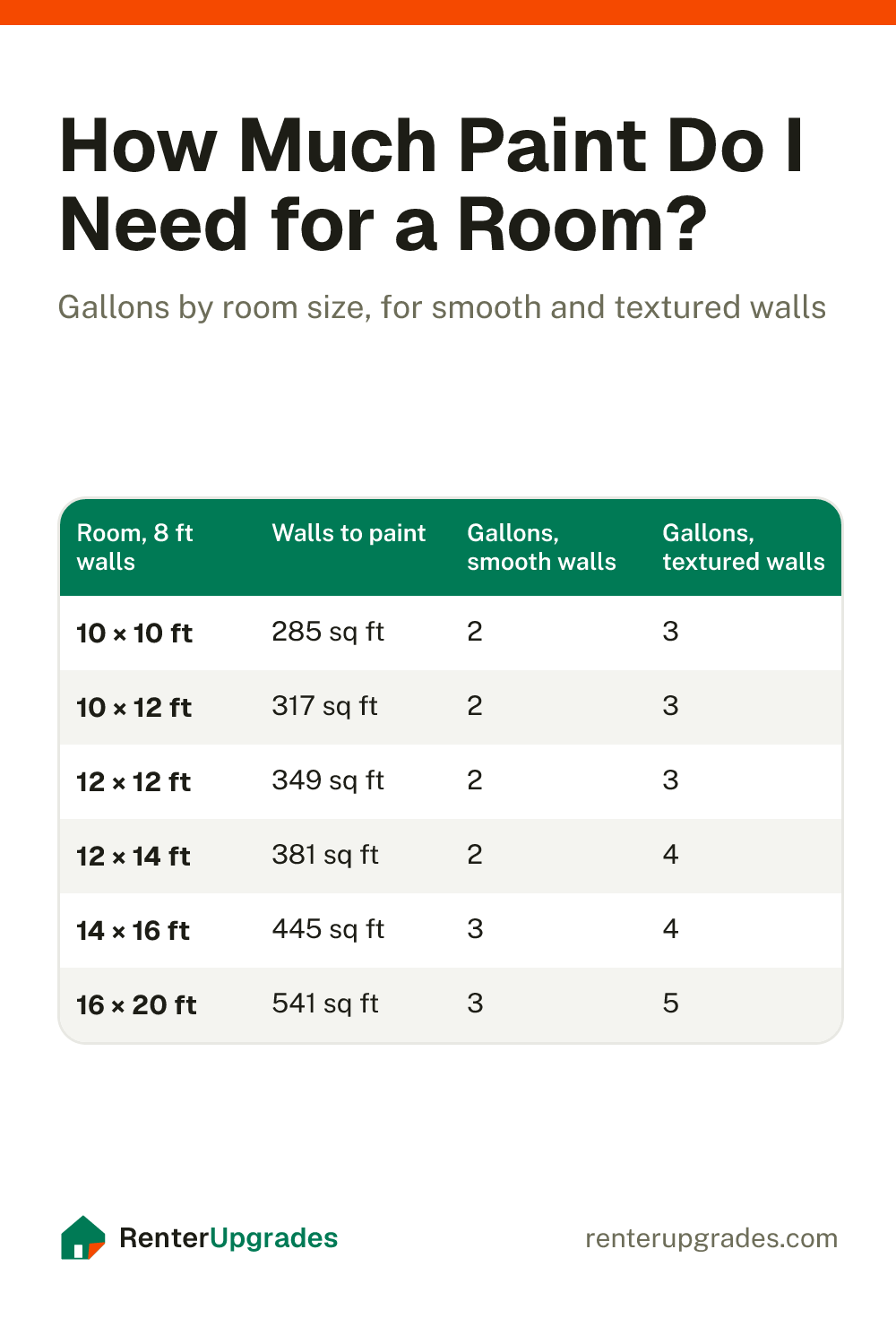
Save it for later
Pin this page so it's handy when you're ready to hang things.
Save to Pinterest (opens in a new tab)