
Moving Checklist
Enter your move date and how you're moving to get a week-by-week checklist, from the first estimates to the first week in your new place. Check off tasks as you go, then print it or download the PDF.
By Tess Mullins · Updated
Checklist preview
Moving checklist
Name: [Your name]Moving from: [Old address]Moving to: [New address]Move date: [Date]
Start each section on its date and check off each task as you finish it. If your move is sooner, start at the top and catch up. Keep this list with your estimates, receipts and photos until the move is settled.
8 weeks before
- Set a moving budget
- Check how much notice your lease asks for
- Get written estimates from at least 3 movers
- Sort what you'll move, sell, donate or toss
6 weeks before
- Give written notice, by the date your lease asks
- Book a mover with a signed, written estimate
- Get boxes, tape, markers and padding
- Measure big furniture and the new place's doorways
4 weeks before
- Set up power, gas and internet at the new place
- Schedule the old place's utilities to stop after you leave
- Get renters insurance for the new place, or move your policy
- Change your address with USPS, online or at a Post Office
- Confirm the move-in date and key pickup
- Ask both buildings about booking an elevator or loading dock
- Start packing what you use least; label each box with its room
- Start your move-out checklist: cleaning, photos, keys
2 weeks before
- Give your new address to your bank, employer, insurers and subscriptions
- Confirm the date, times and both addresses with the mover
- Arrange time off for moving day
- Refill prescriptions you'll need during the move
1 week before
- Pack a first-night box: bedding, towels, chargers, medicine, toilet paper
- Use up frozen food and empty the refrigerator
- Set aside documents, valuables and anything you'll carry
- Give your landlord your forwarding address in writing
- Clean the old place, or book a cleaner
- Check how the mover expects to be paid, in your estimate
The day before
- Pack the last boxes and take apart beds and tables
- Charge your phone and keep the charger with you
- Clear a path from each room to the door
Moving day
- Read the estimate, bill of lading and inventory before you sign
- Never sign a blank or incomplete document
- Go through the inventory with the movers as they load
- Give the driver your new address and phone number
- Check every room, closet and cabinet before you leave
- Photograph the meter readings
- Take dated photos of the empty old place
- Return every key and get a receipt
- Keep the bill of lading until delivery, payment and any claim are done
After the move
- Note damaged or missing items on the inventory before you sign
- Do a move-in inspection with dated photos
- Test the smoke alarms; report any problem in writing
- Update your voter registration
- Update your address with the IRS (Form 8822 or your next return)
- Update the address on your driver's license
- Watch for your security deposit from the old landlord
- Check the old place's final utility bills
- Check that forwarded mail arrives; update each sender
General information, not legal advice. Check your lease and your state's law before you rely on it.
When to use this checklist
Start as soon as you know your move date. Still choosing a place? The apartment hunting checklist covers the tours and the questions to ask. The checklist runs in 8 stages, from 8 weeks before the move to the first weeks in your new place, and each stage shows the date to start it. If your move is sooner, start at the top and catch up: the early tasks, like notice and estimates, are the ones with deadlines.
It covers the move itself: notice, movers or a truck, utilities, your address change and packing. Two other checklists cover the rental on each end: the move-out checklist for cleaning, photos and your deposit, and the move-in checklist for recording the new unit’s condition. Moving into your first place? The first apartment checklist covers what to buy and set up, and the first apartment grocery list the first trip to the store.
How to use the generator
- Add your move date. Each section then shows the date to start it. Your name and the two addresses are optional; they only go on the printout.
- Say how you’re moving: hiring movers or doing it yourself with a truck. The list changes to match.
- Tick what applies: leaving a rental, moving to another state, moving with pets, or with school-age kids.
- Check off tasks as you finish them. Use the notes for dates, names and confirmation numbers.
- Print it or download the PDF if you’d rather keep it on the fridge.
Your answers stay in your browser. A draft is saved on this device so you can come back to it over the weeks of your move. Press Clear to delete it.
Sample moving checklist
Here’s a checklist a few weeks into a move with movers, out of a rental. The name, places and notes are made up.
Moving checklist
Name: Jordan EllisMoving from: 100 Main Street, Apt 2B, Anytown, STMoving to: Riverside, STMove date: May 29, 2027
Start each section on its date and check off each task as you finish it. If your move is sooner, start at the top and catch up. Keep this list with your estimates, receipts and photos until the move is settled.
8 weeks before (Apr 3, 2027)
- Done: Set a moving budget
- Done: Check how much notice your lease asks forNote: 30 days' notice, in writing
- Done: Get written estimates from at least 3 moversNote: Three in-home estimates, Apr 6 to 9
- Done: Sort what you'll move, sell, donate or toss
6 weeks before (Apr 17, 2027)
- Done: Give written notice, by the date your lease asksNote: Emailed and mailed on Apr 20
- Done: Book a mover with a signed, written estimateNote: Signed estimate in the moving folder
- Get boxes, tape, markers and paddingNote: Ask the grocery store for boxes
- Measure big furniture and the new place's doorways
4 weeks before (May 1, 2027)
- Set up power, gas and internet at the new place
- Schedule the old place's utilities to stop after you leave
- Get renters insurance for the new place, or move your policy
- Change your address with USPS, online or at a Post Office
- Confirm the move-in date and key pickup
- Ask both buildings about booking an elevator or loading dock
- Start packing what you use least; label each box with its room
- Start your move-out checklist: cleaning, photos, keys
2 weeks before (May 15, 2027)
- Give your new address to your bank, employer, insurers and subscriptions
- Confirm the date, times and both addresses with the mover
- Arrange time off for moving day
- Refill prescriptions you'll need during the move
1 week before (May 22, 2027)
- Pack a first-night box: bedding, towels, chargers, medicine, toilet paper
- Use up frozen food and empty the refrigerator
- Set aside documents, valuables and anything you'll carry
- Give your landlord your forwarding address in writing
- Clean the old place, or book a cleaner
- Check how the mover expects to be paid, in your estimate
The day before (May 28, 2027)
- Pack the last boxes and take apart beds and tables
- Charge your phone and keep the charger with you
- Clear a path from each room to the door
Moving day (May 29, 2027)
- Read the estimate, bill of lading and inventory before you sign
- Never sign a blank or incomplete document
- Go through the inventory with the movers as they load
- Give the driver your new address and phone number
- Check every room, closet and cabinet before you leave
- Photograph the meter readings
- Take dated photos of the empty old place
- Return every key and get a receipt
- Keep the bill of lading until delivery, payment and any claim are done
After the move (from May 30, 2027)
- Note damaged or missing items on the inventory before you sign
- Do a move-in inspection with dated photos
- Test the smoke alarms; report any problem in writing
- Update your voter registration
- Update your address with the IRS (Form 8822 or your next return)
- Update the address on your driver's license
- Watch for your security deposit from the old landlord
- Check the old place's final utility bills
- Check that forwarded mail arrives; update each sender
Change your address the right way
- Use USPS.com or a Post Office. USPS takes a request up to 90 days before your move and up to 30 days after it. Allow at least 7 to 10 business days for it to take effect. Online, you pay a $1.25 identity check; USA.gov notes you don’t need to pay a separate company to change your address.
- Tell the people who send you mail. A USPS change of address only changes your mailing address with the Post Office. USPS suggests telling everyone who sends you mail at least 2 weeks before you move.
- Contact the senders mail won’t reach. Some senders, such as government agencies and banks, don’t let USPS forward sensitive documents like driver’s licenses, voter registration and bank statements. Standard forwarding lasts 12 months.
- Update your voter registration after the move, as vote.gov asks, whether you stayed in your state or not. Deadlines can be as early as 30 days before Election Day.
- Tell the IRS with your next tax return, or directly with Form 8822 (IRS Topic 157).
If you hire movers
FMCSA, the federal agency that registers interstate movers, gives this advice in its moving checklist and red flags:
- Get written estimates from at least 3 movers, and don’t accept a verbal estimate.
- Be wary of a mover that won’t look at your things before quoting, demands cash or a large deposit before the move, or asks you to sign blank documents.
- For a move to another state, check the mover’s USDOT number in FMCSA’s database (or call 800-832-5660), and expect the booklet Your Rights and Responsibilities When You Move, which movers must give you.
- On moving day, read the estimate, bill of lading and inventory before you sign, and keep the bill of lading until your things are delivered, the charges are paid and any claim is settled.
- At delivery, note anything damaged or missing on the inventory before you sign.
To compare a truck, movers and a moving container on cost, use the moving cost calculator.
If you’re leaving a rental
- Give notice in writing, by the date your lease asks. The 30-day notice letter writes it for you, with a line for your forwarding address.
- Plan the last month’s rent. If you move mid-month, the prorated rent calculator works out a partial month.
- Protect your deposit with the move-out checklist: cleaning, dated photos and keys. The security deposit calculator shows how long your landlord has to return it in your state.
- At the new place, record its condition before you unpack with the move-in checklist, and check that big furniture fits with the will it fit calculator.
Keep one folder, paper or on your phone, for the whole move: the signed estimate or truck booking, your notice, the USPS confirmation code, utility confirmation numbers and your photos. Most of the tasks here end with something worth keeping.
Frequently asked questions
What should be on a moving checklist?
Your notice to the landlord, written estimates or a truck booking, utilities at both places, a change of address with USPS and everyone who sends you mail, packing by room, the paperwork on moving day, and the updates after you move: voter registration, the IRS and your driver's license.
How far ahead should I start planning a move?
The checklist starts 8 weeks before your move date, which leaves time for written estimates, your notice and the utilities. If your lease asks for more notice than that, give it first. If your move is sooner, start at the top and catch up.
When should I change my address with USPS?
USPS takes a change of address request up to 90 days before your move and up to 30 days after it, and asks you to allow at least 7 to 10 business days for it to take effect. Use USPS.com or a Post Office: the online request has a $1.25 identity check, and USA.gov notes you don't need to pay another company to do it.
Will USPS forward all my mail?
Not all of it. Standard forwarding lasts 12 months, and some senders, such as government agencies and banks, don't let USPS forward sensitive documents like driver's licenses, voter registration cards and bank statements. USPS suggests giving your new address to everyone who sends you mail at least 2 weeks before you move.
How do I avoid a moving scam?
FMCSA suggests written estimates from at least 3 movers, and warns against a mover that won't look at your things before giving an estimate, demands cash or a large deposit before the move, or asks you to sign blank documents. For a move to another state, check the mover's USDOT number in FMCSA's database.
Do I need to update my voter registration when I move?
Yes. vote.gov says to update it after a change of address, whether you moved within your state or out of it; after a move to another state, register there. Registration deadlines can be as early as 30 days before Election Day.
How do I tell the IRS I moved?
Put your new address on your next tax return, or tell the IRS directly with Form 8822. The IRS lists both in its Topic 157.
Next step
Moving Cost CalculatorEnter your quotes for a truck, movers or a moving container to see which move costs less, with the truck's gas and the costs every move has. No email or sign-up needed.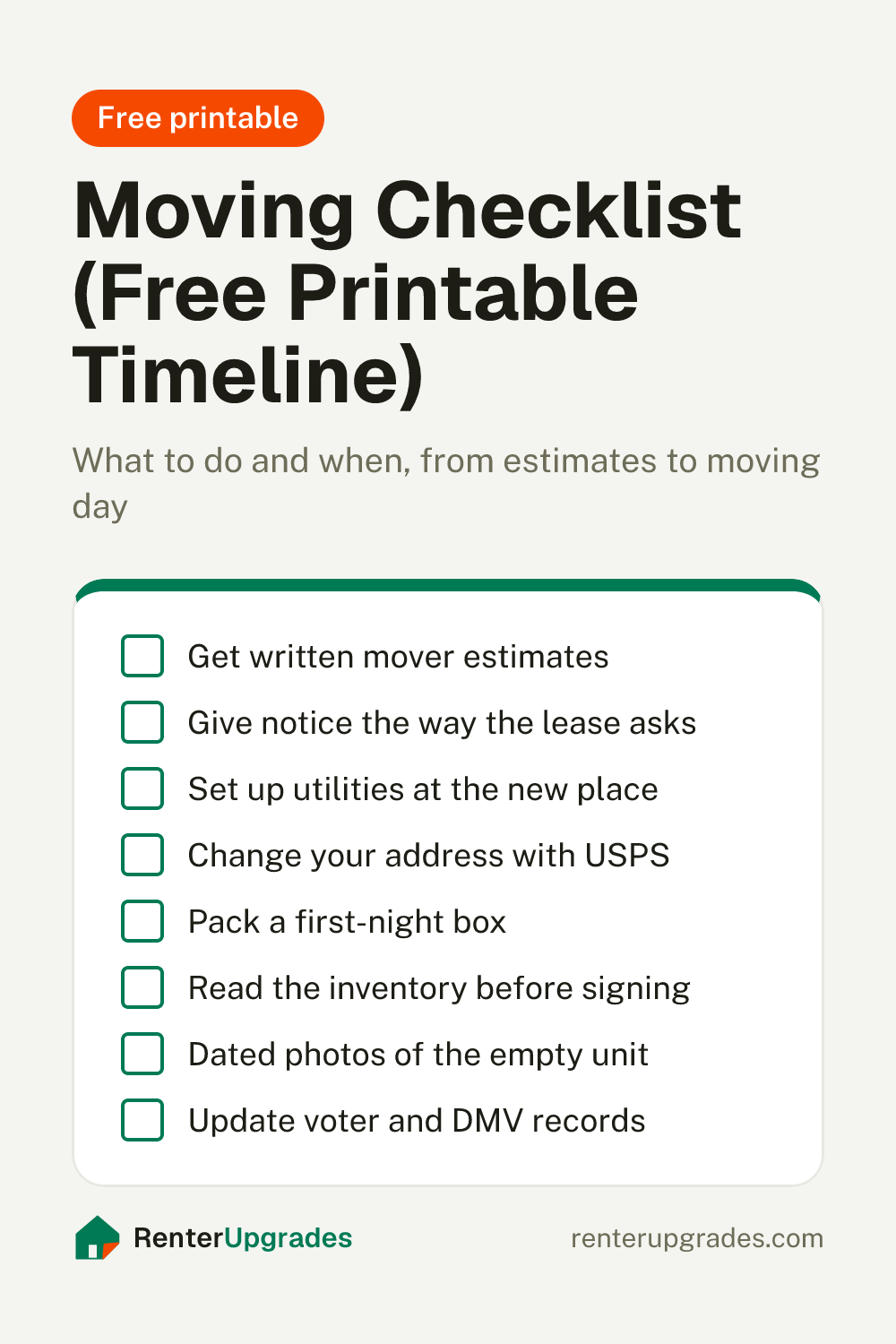
Save it for later
Pin this page so it's handy when you're ready to hang things.
Save to Pinterest (opens in a new tab)