
Cabinet Hardware Size & Placement Calculator
Measure the screw holes already in your cabinets to get the pull size that fits them, check it against the makers' size guides, or find where new knobs and pulls go on each door and drawer.
By Tess Mullins · Updated
Your cabinet
Buy pulls with this hole spacing
3 in (76 mm)
The holes are 3 in (76 mm) apart: that's the most common size. Look for pulls sold as 3 in center to center. The new screws go into the old holes, so nothing new is drilled.
For this drawer, we suggest about 6 in, one-third of it: the usual ideal, and the longest a pull should be. The size guide's range for this size, 9 to 12 in, starts above that. These pulls are shorter. Keeping the old holes means keeping this size: a longer pull needs new holes, so ask your landlord in writing first.
Screws should be 1/4 in longer than the front: 1 in for a 3/4 in front. Most knobs and pulls come with 8-32 screws 1 in long, made for 3/4 in fronts.
Based on hardware and cabinet makers' sizing and placement guides. Keep the original knobs and pulls to put back at move-out. How we calculate
- Deposit Risk: High
- Landlord Permission: Check your lease
- Take It With You: Yes
The short answer
In a rental, start with the holes that are already there. Measure the hole spacing of the pulls you have, center to center, and buy new pulls with the same spacing: the screws go back into the old holes, and nothing new is drilled. Knobs are easier still: the new knob goes on the old screw.
For the size, a drawer pull about one-third as wide as the drawer front is the usual rule. Doors take a pull that suits their height, and knobs 1 to 2 in across suit any door. The calculator above checks your hole spacing against those guides, and if there are no holes yet, it shows where each knob or pull goes.
How to use the calculator
- Pick the front: a drawer or a door, and whether it has a pull or a knob.
- Say whether the holes are already there. For a pull, measure the hole spacing from the center of one screw hole to the center of the other.
- Measure the front: its width and height. For a door, say whether it’s on a base cabinet (below the counter) or a wall cabinet (above it).
- Pick the style. A flat front is a slab. A front with a raised frame around a center panel is a shaker; measure the frame on one side.
- Measure the thickness at the edge, so the screws are long enough.
With the holes already there, the result gives the hole spacing to shop for, in inches and millimeters, and how that size compares with the guides. With no holes yet, it gives where to mark each knob or screw hole. Use Copy link to keep the result while you shop.
Pull sizes by drawer width
What we suggest for one pull on common drawer widths, the range in a hardware maker’s size guide, and how many knobs to use:
| Drawer width (in) | Suggested pull (in) | Size guide (in) | Knobs |
|---|---|---|---|
| 12 | 3 to 4 | 3 to 5 | 1 |
| 15 | 3 to 5 | 3 to 5 | 1 |
| 18 | about 6 | 9 to 12, or 2 at 5 to 7 | 2 |
| 24 | about 8 | 9 to 12, or 2 at 5 to 7 | 2 |
| 30 | 9 to 10 | 9 to 12, or 2 at 5 to 7 | 2 |
| 36 | about 12 | over 12 | 2 |
Sizes are hole spacings, center to center. Where the size guide’s range starts above one-third of the drawer, we suggest about one-third, because the same guide says a pull shouldn’t be longer than that, and one-third is the usual ideal.
For doors, the size guide suggests pulls 3 to 7 in on doors under 24 in tall, 7 to 12 in on doors 24 in to 36 in tall and longer than 12 in on taller doors, again no longer than one-third of the door.
How to measure the hole spacing
Take a pull off, or measure on the cabinet: from the center of one screw hole to the center of the other. That’s the center-to-center size pulls are sold by, not the length of the pull itself. Common hole spacings are 2 1/2 in, 2 3/4 in, 3 in, 3 1/4 in, 3 1/2 in, 96 mm, 4 in and 128 mm, and 3 in is the most common.
Some of those sizes are metric. On a tape measure, 96 mm reads as about 3 3/4 in and 128 mm as about 5 1/16 in, so the calculator matches a measurement to a common size when it’s within 1/16 in. If yours doesn’t match any of them, measure again before you buy, and look for listings in both inches and millimeters.
How we calculate
The calculator follows the published guides of hardware makers Top Knobs and Amerock and cabinet maker KraftMaid. Where they differ, it says whose rule it uses.
- Size. Pulls are sized by their hole spacing. For one pull, we take Top Knobs’ range for the drawer width or door height and cap it at one-third of the front, Top Knobs’ own limit. Where the range starts above one-third, we suggest about one-third, KraftMaid’s ideal for a drawer. For two pulls, we use Top Knobs’ 5 to 7 in range for drawers 16 to 32 in wide. A spacing within 1/16 in of the suggestion counts as a match.
- Count. Top Knobs suggests one knob, centered, on drawers under 16 in wide, and two knobs from there up. The calculator notes when your count differs.
- Existing holes. A new pull needs the same hole spacing to use the old holes. The calculator names the common size it matches, from Amerock’s list of common hole spacings.
- Placement on doors. The hardware goes in the corner opposite the hinges, near the top on base cabinets and near the bottom on wall cabinets. On a slab door, KraftMaid puts the knob or the end of the pull 2 to 3 in from both edges, so we use the middle of that range. On a shaker door, it gives two looks: traditional, at the middle of the frame across and down, and updated, centered on the frame and even with the edge of the panel. A pull’s nearer screw hole goes on that mark, and the pull runs along the frame, away from the corner.
- Placement on drawers. Centered left to right. Top to bottom, KraftMaid gives two options: centered, or 2 to 3 in from the top (we use the middle). On shaker drawers, the middle of the center panel or centered on the top rail. Two knobs go in the centers of the outer thirds (Top Knobs), and two pulls are centered on the lines that divide the drawer into thirds (KraftMaid).
- Knob size. 1 to 2 in across, and on a shaker door no wider than the frame.
- Screws. 1/4 in longer than the front, as Amerock’s installation guide says.
Worked examples
Example: Swapping the pulls on an 18 in drawer
What we know
- Drawer front: 18 × 6 in, flat
- 1 pull, holes 3 in (76 mm) apart, already there
How it works out
- The holes are 3 in (76 mm) apart: that's the most common size. Look for pulls sold as 3 in center to center.
- For this drawer, we suggest about 6 in, one-third of it: the usual ideal, and the longest a pull should be. The size guide's range for this size, 9 to 12 in, starts above that. These pulls are shorter. Keeping the old holes means keeping this size: a longer pull needs new holes, so ask your landlord in writing first.
Buy pulls with 3 in (76 mm) hole spacing: the new screws go into the old holes.
Example: Two pulls on a 30 in drawer, new holes
What we know
- Drawer front: 30 × 8 in, flat
- 2 pulls, holes 3 3/4 in (96 mm) apart, no holes yet
How it works out
- The pulls you picked have holes 3 3/4 in (96 mm) apart.
- For two pulls on a drawer this wide, the size guide suggests 5 to 7 in each. These pulls are shorter than that.
- Drill the holes 8 1/8 in, 11 7/8 in, 18 1/8 in and 21 7/8 in from the left edge, 4 in down from the top.
Drill the holes 8 1/8 in, 11 7/8 in, 18 1/8 in and 21 7/8 in from the left edge, 4 in down from the top.
Example: A knob on a shaker wall cabinet door, new hole
What we know
- Wall cabinet door: 15 × 30 in, shaker
- Frame: 2 1/2 in wide
- 1 knob, no hole yet
How it works out
- Knobs 1 to 2 in across suit any door or drawer, and 1 1/4 in or 1 3/8 in are the most popular.
- Put the knob 1 1/4 in from the edge opposite the hinges and 1 1/4 in up from the bottom.
Put the knob 1 1/4 in from the edge opposite the hinges and 1 1/4 in up from the bottom.
Swapping hardware in a rental
Most rental kitchens already have hardware, which makes the swap simple, as long as the new pieces fit the old holes.
- Check your lease. Some leases count any change to fixtures as an alteration. If yours does, ask first.
- Measure before you shop. Write down the hole spacing for each kind of pull, and count how many of each you need. Drawers and doors often use different sizes.
- Keep the originals. Put the old knobs, pulls and screws in a labeled bag, and store it with your lease.
- Check the screws. Most knobs and pulls come with 8-32 screws 1 in long, made for 3/4 in fronts. A drawer front screwed through a drawer box needs longer ones.
- Put the originals back before your move-out inspection.
- Measure the bathroom vanity’s room first. The small bathroom layout calculator shows whether a wider vanity would still leave the toilet its clearance, before you shop for its hardware.
Adding an island or a rolling cart too? The kitchen island calculator checks that it leaves room to cook and walk past. Swapping a bathroom vanity’s hardware? The towel bar height calculator finds where the towel bar and the toilet paper holder go.
If a pull you love only comes in a different hole spacing, it needs at least one new hole, plus a backplate to cover the old ones. In a rental, look for the same design in your spacing, or keep it for your next place.
Why this gets a High deposit risk
Changing hardware is on our list of upgrades that can cost part of your deposit, because new holes are permanent and many leases need your landlord’s OK for them. Swapping onto the old holes and putting the originals back at move-out keeps it reversible. Ask your landlord in writing before you drill anything, and keep the reply with your lease.
Frequently asked questions
What size cabinet pulls should I use?
On a drawer, a pull about one-third as wide as the drawer front is the usual rule, such as a 4 in pull on a 12 in drawer, and a pull shouldn't be longer than that. Drawers under 16 in wide take 3 to 5 in pulls; doors take 3 to 7 in pulls under 24 in tall and 7 to 12 in pulls up to 36 in. In a rental, the holes already there decide first: same spacing, no new holes.
How do I measure cabinet pulls?
Measure from the center of one screw hole to the center of the other, not the length of the pull itself. That's the size pulls are sold by (center to center). The most common size is 3 in, and listings give some sizes in millimeters, such as 96 mm, which is about 3 3/4 in.
Where do knobs go on upper and lower cabinets?
In the corner opposite the hinges: near the top on base cabinets and near the bottom on wall cabinets, usually about 3 to 4 in from that corner. On a flat door, a knob goes 2 to 3 in from both edges; on a shaker door, at the middle of the frame or even with the edge of the panel.
Where should pulls go on drawers?
Centered left to right. Top to bottom, there are two usual heights: centered, or 2 to 3 in from the top on flat fronts. On shaker drawers, the middle of the center panel or centered on the top rail. Whichever you pick, use it on every drawer.
How many knobs or pulls go on a wide drawer?
One knob, centered, on drawers under 16 in wide, and two knobs above that, each centered in an outer third. For pulls, one 3 to 5 in pull under 16 in, and from 16 to 32 in either one 9 to 12 in pull or two 5 to 7 in pulls, each centered on one of the lines that divide the drawer into thirds.
What size knob should I use?
Knobs 1 to 2 in across suit cabinet doors of any size, and 1 1/4 or 1 3/8 in are the most popular. On a shaker door, keep the knob no wider than the frame, so it doesn't run past the door's edge.
Can I change cabinet hardware in a rental?
Check your lease first: some leases count any change to fixtures as an alteration. If you swap knobs onto the old screws and pulls with the same hole spacing, nothing new is drilled. Keep the originals in a labeled bag and put them back before move-out. New holes need your landlord's OK in writing.
What screws do cabinet knobs and pulls use?
Most come with 8-32 screws 1 in long, made for 3/4 in fronts. Screws should be 1/4 in longer than the front, so a drawer front on a drawer box (1 1/2 in together) needs 1 3/4 in screws.
Next step
Peel and Stick Tile CalculatorEnter your backsplash or floor size and pick a product to see how many sheets, packs or boxes of peel-and-stick tile to buy.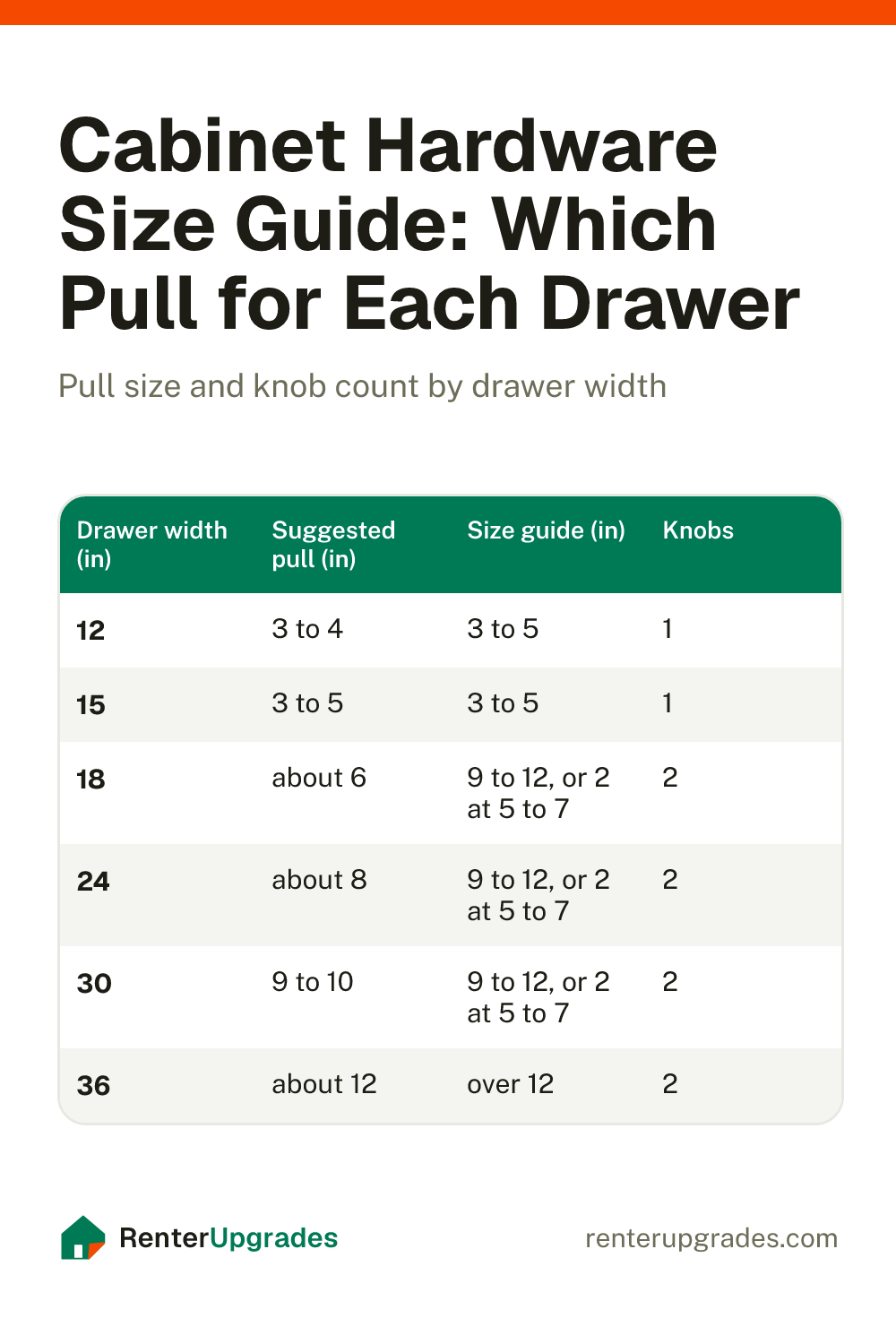
Save it for later
Pin this page so it's handy when you're ready to hang things.
Save to Pinterest (opens in a new tab)