
Curtain Size Calculator
Enter your window and ceiling measurements to get the panel width, number of panels, ready-made length and rod length, plus how high to hang the rod.
By Tess Mullins · Updated
Your window
You need
2 panels, 50 in × 84 in
Buy 84 in panels. Hang the rod so its top is 84.5 in above the floor (4.5 in above the frame).
- Rod: 48 in (36 in window plus 6 in on each side). Brackets and finials can add more, so check the rod's full length.
- Fabric: 96 in of total width (2× the rod), so 2 panels, split evenly between both sides.
- Guidelines, not rules: adjust to taste. How we calculate
- Deposit Risk: High
- Landlord Permission: Check your lease
- Take It With You: Yes
The short answer
Get a rod that’s the window width plus at least 4 in on each side. Buy enough panels that together they’re about 2× the rod’s width. For length, hang the rod at least 4 in above the frame and pick a ready-made length that ends about 0.5 in above the floor, or at the sill for shorter curtains.
The calculator does that math for your window and also tells you exactly where to put the rod so a standard length fits without hemming.
How to measure your window
- Width. For a rod above the window, measure across the outside edges of the trim. For a tension rod, measure between the inside edges of the frame.
- Height to the frame. Measure from the floor to the top of the window frame (the top of the trim).
- Ceiling height, if you’re hanging the rod above the window.
- Window height, only for sill-length curtains: from the top of the frame to the bottom of the sill.
Measure in a couple of places and use the smallest number for inside measurements and the largest for outside ones.
Standard curtain sizes
Ready-made panels usually come in lengths of 63, 84, 95, 96, 108 and 120 in. Common widths include 40, 50 and 54 in. The table shows how many panels common window widths need with the calculator’s default settings.
| Window width | Rod length | Panels (50 in, 2× full) |
|---|---|---|
| 24 in | 36 in | 2 panels |
| 36 in | 48 in | 2 panels |
| 48 in | 60 in | 4 panels |
| 60 in | 72 in | 4 panels |
| 72 in | 84 in | 4 panels |
| 96 in | 108 in | 6 panels |
How we calculate
- Rod length: window width plus your extension on each side (for a tension rod, just the inside width). Most guides suggest at least 4 in per side.
- Panels: rod length × fullness, divided by the width of one panel, rounded up to an even number so each side gets the same. Fullness of 2× is the usual choice, 1.5× looks flatter and 2.5× suits sheers.
- Length: the panel runs from the top of the rod to the floor or sill. A float ends 0.5 in above the floor, a break adds 1 in and a puddle adds 3 in. Clip rings lower the panel by about 2 in. Grommet panels hang from the inside top of the grommet, so the fabric above it (1 in by default, or what you enter) is added to the length. Rod pockets and tab tops hang from the top of the rod.
- Rod height: the rod sits at least 4 in above the frame and at least 2 in below the ceiling. Within that range, we look for a ready-made length that fits exactly, as close as possible to the height you chose (“just above the frame” or “high and wide”, about two-thirds of the way up). If none fits, we keep your height and tell you how much to hem.
Worked examples
Example: A standard window with curtains that float
What we know
- Window: 36 in wide, top of the frame 80 in above the floor
- Ceiling: 8 ft
- Length: float just above the floor
How it works out
- Rod: 36 in + 6 in on each side = 48 in.
- Panels: 48 in × 2 fullness = 96 in of fabric, so 2 panels 50 in wide.
- Buy 84 in panels. Hang the rod so its top is 84.5 in above the floor (4.5 in above the frame).
2 panels, 50 in wide and 84 in long, on a 48 in rod.
Example: A wide window, hung high and wide
What we know
- Window: 72 in wide, top of the frame 84 in above the floor
- Ceiling: 9 ft
- Length: float just above the floor
How it works out
- Rod: 72 in + 8 in on each side = 88 in.
- Panels: 88 in × 2 fullness = 176 in of fabric, so 4 panels 54 in wide.
- Buy 96 in panels. Hang the rod so its top is 96.5 in above the floor (12.5 in above the frame).
4 panels, 54 in wide and 96 in long, on a 88 in rod.
Example: Sill-length curtains
What we know
- Window: 30 in wide, top of the frame 80 in above the floor
- Ceiling: 8 ft
- Length: end at the sill
How it works out
- Rod: 30 in + 6 in on each side = 42 in.
- Panels: 42 in × 2 fullness = 84 in of fabric, so 2 panels 50 in wide.
- Buy 63 in panels. Hang the rod so its top is 85 in above the floor (5 in above the frame).
2 panels, 50 in wide and 63 in long, on a 42 in rod.
Renters: rods, brackets and your deposit
A rod above the window usually means screwing brackets into the wall. That leaves small holes, so check your lease and ask your landlord in writing first if you’re not sure it’s allowed. Keep the brackets’ screws and fill the holes neatly before you move out.
No drilling allowed? Use the tension rod option. A tension rod sits inside the window frame and comes out without leaving holes, and the calculator works out the panels and length for it too.
Want the rod above the window without drilling? The no-drill curtain rod guide compares tension rods, adhesive rods, brackets that clip onto blinds and brackets for heavier curtains, with the deposit risk of each. To put one up step by step, see the guide to hanging curtains without drilling, from clip rings on a rod that’s already there to tap-in brackets.
Buy the panels first and hang the rod second. Once you have the panels in hand, you can set the rod height to the exact length the calculator gives you.
Curtains, rods and even brackets usually come with you to your next place. To weigh them against an upgrade you’d leave behind, use the renter upgrade cost calculator.
Frequently asked questions
How wide should curtains be?
Together, your panels should add up to about 2× the width of the rod. Go down to 1.5× for a flatter, simpler look, or up to 2.5× for sheers and a very full look. Measure against the rod, not just the glass.
How long should curtains be?
For floor-length curtains, most people let them float about 0.5 in above the floor. For a softer look, add about 1 in so they break on the floor, or 3 in or more to puddle. Shorter curtains end at the windowsill.
How high should I hang a curtain rod?
At least 4 in above the top of the window frame. To make a window look taller, go higher, up to about two-thirds of the way to the ceiling, but leave at least 2 in below the ceiling.
How long should a curtain rod be?
The width of the window plus at least 4 in on each side, so the curtains can open past the glass. The calculator uses 6 in per side unless you change it. Finials and brackets add to the total.
What are standard curtain lengths?
Ready-made panels usually come in 63, 84, 95, 96, 108 and 120 in. The calculator picks one of these and tells you where to hang the rod so it works, or how much to hem.
How many curtain panels do I need?
Multiply the rod length by the fullness (usually 2×), divide by the width of one panel and round up. We round to an even number so both sides match.
Can I hang curtains without drilling?
Yes, with a tension rod inside the window frame. Choose the tension rod option in the calculator. The Home Depot notes that most tension rods hold up to 20 lb, so they suit light and medium curtains.
Do clip rings change the curtain length I need?
Yes. Clip rings make the panel hang about 2 in lower than the rod, so you need a shorter panel or a higher rod. Pick clip rings in the calculator and it adjusts.
Do grommet curtains hang differently?
Yes. The rod runs through the grommets, which sit below the panel's top edge, so the fabric above them stands above the rod and the panel hangs that much higher than its stated length. Pick grommets in the calculator and enter the distance from the top edge to the inside top of a grommet (1 in by default; it varies by maker, so check the product page). Rod pockets and tab tops hang from the top of the rod, and ready-made tab-top lengths include the tabs.
Next step
Peel and Stick Wallpaper CalculatorEnter your wall and roll size to see how many rolls of peel-and-stick wallpaper to buy, with pattern matching and trim included.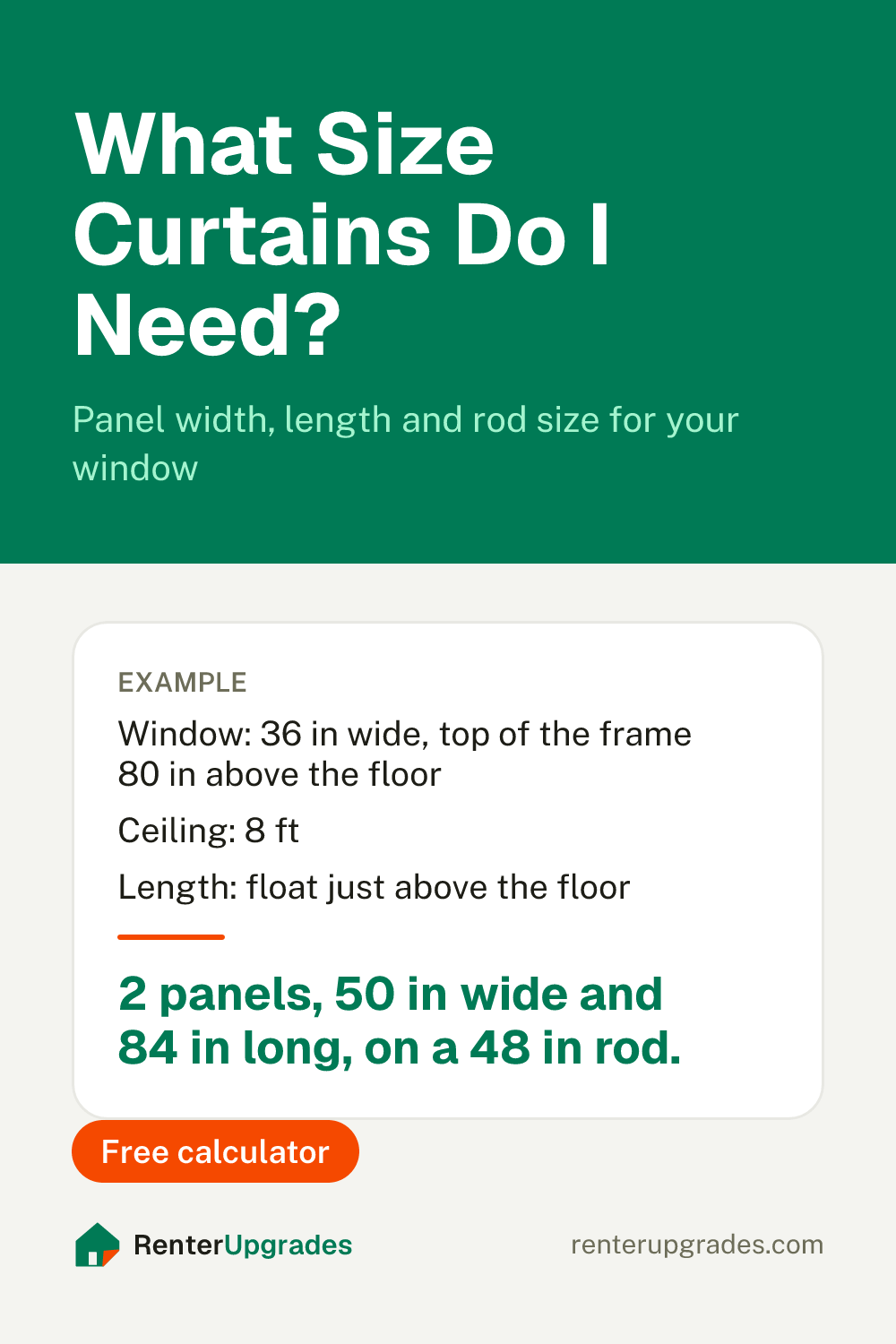
Save it for later
Pin this page so it's handy when you're ready to hang things.
Save to Pinterest (opens in a new tab)